EpisodeTalks with Petri
Ukrainian startup ecosystem
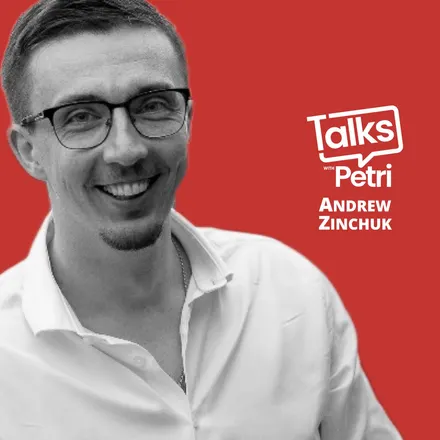
With Andrew Zinchuk
Andrew Zinchuk talks about what’s happening in the Ukrainian startup ecosystem, how things have evolved over the years and what’s expected to happen next.
Andrew Zinchuk - TALKS WITH PETRI
Ukrainian investor and entrepreneur Andrew Zinchuk talks about what’s happening in the Ukrainian startup ecosystem, how things have evolved over the years and what’s expected to happen next. He also shares his insights into living and working in Ukraine during the war and where to find the best cocktails in town.

Ukrainian startup ecosystem
Ukrainian investor and entrepreneur Andrew Zinchuk talks about what’s happening in the Ukrainian startup ecosystem, how things have evolved over the years and what’s expected to happen next. He also shares his insights into living and …
Bio
Andrew Zinchuk is a VC & an entrepreneur with extensive experience in all stages of a startup ecosystem. He's the founder and general partner at ZAS Ventures. Previously, he was the managing director at a pre-team pre-idea startup incubator, and he has advised 100+ startups by acting as an advisor & mentor at Antler, Seedstars & Ukrainian Startup Fund.
 Play video
- 4:20 daily life in Ukraine
- 5:00 new vibrant ecosystem in the making
- 5:20 startups during the war
- 8:20 early-stage funding sources in Ukraine
- 13:20 startup war stories and traction in 2022
- 14:20 startup scene before ‘22
- 16:20 co-working spaces, communities, meetups
- 19:00 angel investors, pre-seed, and seed VCs
- 19:20 private equity and family offices
- new startup funding initiatives
- 24:20 Ukrainian unicorns
- 28:00 crypto and blockchain scene
- 29:20 drone and other startups coming out of the war situation
- 33:20 Starlink
- 33:40 key startup locations
- 35:40 how Ukraine has changed in the last decades
- 38:40 IT employment market
- 41:40 Eastern European tiger
- 43:00 eGov and e-Residency in Ukraine
- 47:40 corruption and the current situation
- 48:40 civil society
- 49:40 judicial and tax reform
- 54:40 Ukrainian startups’ legal structure
- 1:03:00 safety, quality of life, price level, English language
- 1:07:20 Ukraine in five years
Episode links
- https://usf.com.ua/en/
- Mariupol Unlost Hope (more info; use Google Translate for both)
- https://www.1991.vc/en/
- https://www.lift99.co/kyiv-hub (archived)
- https://startupwiseguys.com/
- https://uvca.eu/en
- http://grammarly.com/
- http://people.ai/
- https://gen.tech/en/
- https://firefly.com/
- http://gitlab.com/
- https://eu.delfastbikes.com/ (archived)
- https://www.starlink.com/
- https://diia.gov.ua/
- http://pga.org.ua/en/
- https://glovoapp.com/ua/en/
Transcriptmachine transcription · 1:20:33
Transcribed from the recording by machine (Whisper): it may contain errors.
0:00 This is Talks with Petri show and I'm your host Petri. Today, our guest is Andriy Zinchuk from Ukraine. Welcome. Hey Petri, good to see you. Thanks for inviting. How's it going there? We've been trying to do this interview almost for almost like a week, But there was some trouble for you to get to the office and we needed to reschedule and postpone it. So can you tell me what happened last week? Yeah, just a minor trouble. Well, it's minor trouble for Ukrainians, but probably a big thing for everyone else outside the country. So last week we had our flag day on 23rd and also Independence Day on 24th. And our sick neighbors that was trying to destroy us, they collected a lot of missiles around the country and they were preparing a massive strike on entire country and our interior force and all of the services tell us that, hey, I'm actually based in Kyiv.
1:05 So we got the notice, not get anything close to the city downtown, stay away of like tall buildings. And basically my office also is in the downtown. So we had the building closed for almost an entire week. So I couldn't make it to the office to talk to you. So that's, but fortunately for us, our air defense system was working well. So we didn't have any hit on the city directly. It was something just one hit on the north of the city. So it was pretty okay. No one was injured. Before we went live, you mentioned that there was seven signals coming in the same day. So what does it mean on, you know, in a regular day? Yeah.
1:54 Basically we have this app and then you can hear on the streets, the sirens. And usually we have, you know, like once, twice per night and then maybe once, twice per day. And on 24th, there was seven. So literally, if you follow the rules, you would stay more time in the shelter than outside of the shelter, like a bomb shelter. But typically people get used to them not staying in the shelter and they're playing safe, which is not the best thing to do, not the safest thing to do. But if you just imagine staying up to seven to ten hours in the shelter, you cannot do stuff during the day. right so you have to kind of decide them and make a compromise with yourself like hey if you want to just stay super safe or you want to get also some things done and kind of go on with the life because you cannot live for you know six months in a shelter spending half of your day and half of your night it just ruins the plans the sleep cycle it's kind of mentally hard like initially when the war started and everything was kind of uncertain what's happening.
3:05 And like so on, so forth, I was trying to do like every time I hear every strike alarm go into the basement of the building, to the parking lot, like underneath the ground, like minus third floor. And, you know, trying, you cannot work from there because there is no connection, no Wi-Fi, you just sit basically. The best you can do is like I read the book, right? And then you come out and when it happens during the night, you do it once, twice, then you do a couple times per week, and then your sleep cycle is off. And then during the daytime, you have the same. So it's kind of hard to operate in this mode. So at one point of time, I told myself, hey, like, if it happens, it happens. I'm going to take my chances. Like if I hear it's close explosions next to me, I'm probably going to run for the shelter. I have my kind of alarm backpack with me, with everything packed, you know, like the most necessary things. And then like, that's going to be my solution. But for now, I'm just going to keep living and doing what I do, because otherwise, you just you can go mad.
4:08 So what is it actually? What are you doing nowadays? A couple things. I'm back. Like when the war started, it was kind of preparing for defense. So, you know, digging trenches, preparing cocktails, Molotov, and all of this kind of funky stuff that you cannot tell. But then I was involved in volunteering. We were bringing medical supplies from EU and delivering here to the hospitals on like Chernihiv, on Bucha, different cities that were not on the front lines, but were like a basis for this. Mostly it's like a surgical stuff and for the hospitals anyway and now i'm back to my trying to be back to my professional life so i'm raising a small fund to help ukrainian startups uh scale the attraction and there is like a big story behind of this because like everyone who woke up on the 24th of january of like shocked with the break the word that was broken right breaking so we had like startups lost the attraction uh there was like a lot of crazy stories with the startup founders. Some went fighting and joined Ukrainian military forces, some relocated. And basically now there is a lot of cool stories about resilience, about resistance, about a new Silicon Valley being born in the heart of East Europe. And it's probably going to be third, the most vibrant ecosystem after Silicon Valley and Israeli tech scene.
5:50 Can you tell some stories now from this summer or after the full-scale invasion happened in February? Because I know you've been, and we can go that a bit later in the talk, that you know the ecosystem in Ukrainian ecosystem, you've been basically part of building it. And obviously, everything has changed now and this year is completely different. But the startups are still working. And they are doing stuff, but the circumstances are different. Yeah, sure. I mean, I'm part of the Ukrainian startup ecosystem and the venture ecosystem since 2017 when I joined Ukrainian Venture Capital Association and also we launched Israeli family office investing in startups, fintech, blockchain, martech, all sorts of the things. And we were building the startup ecosystem. And Ukrainian startup ecosystem was kind of growing pretty quickly. So in 2021, we were on the 34th place worldwide. So it was pretty good and we were growing steadily from year to year. For instance, Ukrainian startups last year in 2021, they raised about $800 million, which was 40% growth year over the year. So it's kind of a big jump for the startup ecosystem. And the fundraising that the startups were attracting money were growing from 22% on average and like last year was even was twice of that and what happened this year basically a lot of startups got in trouble because uh their term shifts were revoked uh we have so so-called ukrainian startup fund it's a government fund that is backed by world bank and giving equity free grants to the startups it was launched in 2020 and they kind of boosted the ecosystem drastically they became like number one angel investor in in the country so just to understand
8:02 the scope in uh two years they gave over like 135 i believe uh equity free grants 25k for pre-seed and 50k for seed uh totaling about 6.5 million dollars and it's kind of boosted the ecosystem drastically because ecosystem itself is lacking angel investments is lacking early stage funds out of 800 million 760 to be correct i believe from the last year that was raised only eight percent were the checks for precedence it stages so it's very small but with the beginning of the war what happened like ukrainian startup fund it started operating so they start stopped investing in the startups and even for a certain period of time they hold uh trenches of financing to the startups they already committed because every like the 50k or even 25k check it's not deposited right away it's perk epi is based that it's agreed with the startup right so even if hold it and part of their money was devoted to Ukrainian army. Of course, everything offline stopped working. All incubators, accelerators, like a friend of mine, he's running a chain of incubators called 1991 Open Data Incubator.
9:29 And they had the office in Mariupol. You can imagine what happened in Mariupol, right? I just watched yesterday the documentary movie about Mariupol and about the story, based on the story of one lady that was taking notes. And it's just something unbelievable. It's the movie is called Anna. Sorry. Yeah. So it's anyway, I'll give you the reference for the movie, but it's something to definitely to watch, but not the topic of the time, but just saying that like the whole ecosystem stopped. And a lot of startups start reaching out to me like saying, "Hey, we have this trouble, we lost traction, our customers stopped paying us." And everyone was initially in a big trouble. But slowly, like month after month, startups started, actually some founders went fighting.
10:23 And I'm also a co-founder of equity crowdfunding platform. And my partner, the main partner for this startup, he's actually joined the military of Ukraine. So like, and that's a very close case to me. have the startup founders that were also joining. There's one big startup pretty famous here, and the main CEO and co-founder, he's also went to join the military forces. And it's not a rare thing here, right? But those who haven't joined the military forces, they relocated to Kyiv, they relocated to the west of Ukraine, where it's considerably more safe, if we can call it safe these days, but at least there is no kind of shelling from low distance, multiple rocket systems from Russia, right? It's just airstrikes. And they keep working and progressing. And we can, there's like amazing stories. For instance, one of the founders is a good friend of mine. Nowadays, he joined my, I was running the startup incubator back in the time, It's called, it was European chain of incubators, pre-team, pre-idea stage.
11:34 I helped them to open offices here, was managing director for two years. So the guy, he was working at Henkel at the corporate office. He resigned, joined my first batch. He did like several pivots and he was one of the most stubborn guys you could ever meet. He was like the most resilient and he changed three teams, pivoted three times. And then initially he find like the right, the right problem to solve and the right solution. And when the war started, he moved to Chernihiv where he's originally from. So it's a North East from Kyiv. And it was actually one of the directions the Russians were coming. So there was 30,000 troops going through the city. So they were trying to take the city quite fast and then advance in the Kyiv. And so he spent almost a month sitting in a basement, like just trying to stay safe and avoid all of the shelling from what was going down in the city.
12:33 And then when we defended the Kiev and the region, when the Russians withdraw, so he moved to Lviv and that's where we've met. And long story short, a couple of weeks ago, he managed to raise 250k from Polish VC. And I think it's amazing, like from the VC standpoint of you, what better can be just finding the founders and the teams who manage kind of go through the war, go through the shock, keep the team, keep the product and kind of keep going. Right. And there is a lot of stories like this. There is many startups I'm talking and now I have a good deal flow of startups that actually everyone has a story, right? In terms of the content creation, everyone in the country has a story and everyone in the startup scene also has its own story where the war started, where you've been, what happened and so on. But some stories are amazing. There is a startup that was keep growing their attraction and now they have, in September, they will have about 30,000 MRR, which is amazing, right? Considering that the team was all the time in Ukraine.
13:44 Most of the cases, what happened to the startups is that they lost traction, especially those who had some just Ukrainian market traction. But they start looking to the West, to EU market or to the United States market in North America, and they start getting the traction. There is like B2B health tech startup. We actually, we were investing in them from the incubator, and they also get industry investor, which was using their product. They also lost the traction in Ukraine and the revenue, but they managed to secure a couple LOIs and get the first client, big corporate client in the European Union. It's also like considering that you have to volunteer, you have to do a lot of stuff on the side, and they have all this pressure coming from the situation here. Raising or getting the clients, that's something very admirable.
14:45 So, how was the ecosystem before? I remember you mentioned that you were like 2017 coming to the startup ecosystem and you saw it growing. was a lot of also, maybe not a lot, but you know, there was international companies and interest coming to. And it was, you mentioned that it became almost like a San Francisco, the new great thing to be and you'll be living in New York, Boston and different places already. So you know, you have the comparison there. So is there still a bit of that vibe left? How far are we off? that the situation is different, but, but you know, can you still feel a bit of that same vibe? There's a couple things. The start of the systems from 2017, I moved back from New York to Kyiv in 2014, just after the revolution of dignity. And it was kind of the vibe in the city, in the country, was kind of pessimistic and you know everyone was in a shock but slowly step by step the city started getting this vibe of the vibrant uh very dynamic place and uh you know traveling europe traveling across the world you always come to kiev and like oh i don't want to move anywhere i'm a big fan of the cocktail scene and the the cocktails in kiev one of the best in the world the same for the electronic music they're saying like it's one of the best two cities in the world so it was super kind of uh super vibrant and uh you could see a lot of people coming here and it's also the especially the co-working space in ukraine was amazing uh you could not even imagine like how many very good co-workings we have in the city and they start opening like from 2014-15 the first one what was on the outskirts of kiev and everyone was like hell what is co-working why should we go there And then they start opening the prime like AAA locations and, you know, getting this community
16:54 of everyone, like super progressive youth and like tech people. And now we have like a good chain that is even trying to like go to different markets and open their business model. Right. So, and also to start creating this vibe for and place for gathering like, and also attracting people. We have a known founder from Estonia who opened his co-working in Ukraine and also invested in Ukrainian startups. Like startup wise guys, they started sourcing a lot of the startups from Ukraine. The startup incubator I was a managing director for also was kind of the first move to from west of Europe to east of Europe and opening the location. So a lot of players in the market started joining the startup ecosystem and filling the gaps that was missing because initially there were several attempts like to create the venture builders to create acceleration programs but there was a problem with there is a tech talent but there was missing a lot of education for founders how they should build the startup how like what's the rules in the jungle right with the ecosystem what the animals of the jungle and slowly like step by step, the ecosystem start getting the players that were helping startups and spreading this education and knowledge. And like with every time, even like 2020, when Ukrainian Startup Fund was opened and a member of selection committee, when you see the startups pitching, you see some very good startups with experienced founders and you see like good ideas, good founders, but they don't know how to pitch, they don't know how to produce the deck. And now it was two years of startup, ukrainian startup working the startup fund working you see that the level of the pitches increase so much you can you can you can see that people were actually trying to to prepare as they were reading like why a combinator stuff a lot of material so like the ecosystem is growing and also the capital is also in coming in the only big gap that is still in the market is uh early stage especially
19:06 like angel checks we have very limited amount of people who invest professionally as angel investors and there is also education for angel investors is also missing uh which is a which is a big problem when ukrainian venture capital association we're bringing people from uh different uh angel business networks across the europe and uh even we put some uh educational courses but it's still kind of on early, early days and needs to be growing. And then when we're talking about like pre-seed stage investors, there is actually no funds that invest and even seed. If we talk about more shift our attention to venture capital market, right? So there were early entrants like Aventures that started their fund 10 years ago when it was actually a family office. The founder, Andrey Koloduk, he moved from New York and he did some exit and he started his fund. But it was like a family office structure. And then here and there we started having some family offices being called VCs and they were investing. But according to recent articles in Forbes Ukraine, I believe that 10 out of the 10 top venture funds, 8 did on their entire life cycle from 12 to 14 deals, which is a joke, right? It's nothing. And it's just not because they're bad. They're good. They were trying to invest and taking a lot of risk because the ecosystem was not ready back in the day. But they're also, it's because of their nature. They're not the true venture funds. It's has money, extra money, he invests.
20:58 If not, they don't invest, right? And it's as simple as that. And, but the more you go towards, like later stage, the more capital there is available when we have two super large private equity funds, over 1 billion under the management, and there is more investors who willing to invest kind of in a considerably safer deals, like pre-IPO or series A or post series A. But for the younger guys who just started their startups, it's actually still a hard place to be right now in Ukraine. And that's actually what I'm trying to accomplish here. I'm trying to bring here a classic Silicon Valley style venture fund that will be here not for 10 years and here will be here for 20 years and build the bridge between Ukraine and actually Silicon Valley and North America. that once I'm investing, I'm bringing with me experienced VC's that will invest in the same deals with me and I will be kind of managing the deal flow here and then we can help the startup scale in the States.
22:03 And there's a lot of attempts, there were actually a lot of attempts to start the venture funds, but for like a proper venture fund, but for many reasons as all GPs know how the pain in the butt is raising the fund. and especially for the country with so much turbulence and having such a not lucky neighbor on our side let's put it in the software i'm trying to be nice today so it a lot of attempts failed and now it's actually the time to have a good venture fund for for ukrainian market because uh ecosystem will be if you look forward ecosystem will be super dynamic uh european union announced a month ago i believe that they will invest 20 million euros in ukrainian startup ecosystem and 60 will go towards equity free grants to ukrainian startups so they will give uh 12 million dollars in equity free was 60k so it's 200 startups right it's a lot of i know this this ecosystem super well and that's a lot like there is a lot of startups that will give a a good chance kind of to make it to the next level so that will be and i think after the war hopefully we're gonna uh get rid of russians by the end of this year so from next year the ecosystem will kind of rise again and will be even twice more dynamic than it was previously because it's kind of as a demand that was not satisfied right we kind of sitting at homes working from from home offices or whatever the people working from. But then we used to have a lot of meetups.
23:50 Like even when I moved to west of Ukraine, I opened the coworking space just to kind of gather the people who relocated as myself, IT professionals, startuppers. And we managed to have three meetups in under three months. It was like two and a half months. We had three meetups. And it was a blast. First meetup, we had about 30 people coming. And I was joking that if I lock everyone in, we could build the perfect series A startup because there was everyone from backend developers, frontend, biz dev, sales, you know, everyone who's needed on a startup, like project managers, product managers. And it was like the tiny city in the west of Ukraine. And there's a lot of people who relocated. So the people actually waiting for them to have a more safer conditions that they can go out and actually start building even faster.
24:48 Can you name some famous Ukrainian startups? They are even unicorns so people get a bit of an idea. Yeah, everyone knows Grammarly, right? We have Grammarly, we have PeopleAI, that's also a famous Ukrainian startup. There is actually Ukrainian Elon Musk, the guy who's building Firefly. So it's also the unicorn. What else? I think we have about 10 unicorns with Ukrainian founders. And yeah, so we have a GitLab also. They valued now about 15 billion. There is Genesis, it's also 1 billion.
25:41 Overall, Ukrainian born nationals, they're ranking top 10 founders for US-based unicorns. So I think it's a pretty good number. Can you give us some estimate how many startups there is in the market early states? That's a good question. We, let's say if I can speak from the numbers of Ukrainian startup fund, in two years, there was all like over 1000 applicants, even more. And they invested in, I mean, 13, 15%, something like this. So now there is a program for Google for startups, they also have like over 200, 300 startups applying. So like early stage and from our fund now in the funnel, we have about 100 startups and with the fund that I'm now raising, it's called Brave Ukraine fund.
26:46 I want to invest in the 34 pre-seed stage startups that have actual attraction on the Western market and they need help kind of scaling. So now we have also almost 100 startups that kind of reach out to us. So like the market itself is big and I know a lot of founders now, there is a company that will be big news on the market. I cannot spoil it, but there is a, you're going to hear it. It's one of the famous Ukrainian startups. Uh, that's the exit is coming. Let's put it this way. Um, so there is a team that will be launching a new startup and there's a lot of people who actually are exited or exiting and then we'll be launching new products. they are way more experienced with every time it's not the first time founders are going to be second time founders right and that's what actually where are we getting because as of now everyone was the first time founder and some of them were getting to the unicorn status and some of them were you know getting somewhere closer but what's interesting is that on average if we compare ukrainian startups to let's say their peers in the US, it took Ukrainian startups who became unicorns also seven to eight years as on average it happens in the US market. So which is a pretty good number from the ecosystem there is still emerging.
28:13 Have you seen any trends that the Ukrainian startup scene and the startups are particularly good in something? I mean, is it like a B2C or B2B or can you see that there's something where there's a tendency of having more startups and more successful ones? Back in 2017 and 2018, Ukraine was super strong on blockchain startups and crypto. And we were among probably top three countries that uh raised money uh so that was pretty cool and now the scene is still super vibrant uh even the market changed also uh martex startups uh very there is a lot of them uh we can see now the biggest thing out of ukraine would be a drone drone startups and that's you know why but there is so many there is probably over 100 teams are doing drones and uh with different purpose uh there is a cool startup that uh caliber aviation is it doing the like a drone startup that can patrol the territory with a like a lot of different features uh there is a startup actually in my deal flow they're doing a drone management uh fleet management system and it's one one of the one of the pioneers in the market so like every farmer of a big agriculture company which wants to have their own fleet and manage it by themselves they can just use the uh the service and actually manage the fleet of the drones they don't need to order any other services so that's so now most of the startups are kind of the military shifted but that's going to be super big we have also the electric bikes coming. There's one very Delfast, very promising one. They have among their customers, they have the, I believe it's Mexico police, US police, like border control. They were actually doing some bikes, electric bikes for the military. It's very quiet, so it's very good for the military
30:24 purposes. And in general, we are very good at B2B. And then it's because of the nature. What I mean by this is that Ukraine is number three IT outsource country. And a lot of startup founders actually were working in IT outsource or product companies. And they were seeing the product, like working on the projects for large corporations, right? And they will see the niches which is missing. And then after leaving the IT outsource bench, they would say, "Hey, there is a problem I know that needs to be fixed." And that's how they start the problem and getting the knowledge of this problem in the first place. Have you noticed and seen, I guess, there's some things you cannot talk about or it's not wise to talk about, but you know, during this year, like you say, that the start has been adjusting to the military purposes and supporting the society now. Has there been some innovations or some stuff you know that is going to be like really super great, you know, when the voiceover and they're shifting more maybe to the private sector needs.
31:35 It's completely like unexpected and, you know, just came because of, you know, the situation happening. Any other stories you want to say, you know, besides the drone and the bikes? Okay, we have the startups that helping to identify the enemies and the faces that were committing crimes here. That's face recognition technologies that's working pretty well. There are startups also that helping to calculate the damage to the cities that was done by bombing. And that's all will be in GAG and also to reparations for Russia to pay, hopefully in the nearest future. Well, also, VR startups are helping a lot to train our soldiers using different tools from light to super heavy. And even for those that we don't have yet, but we are preparing to get it just for the political will to be there.
32:33 So a lot of things we will be able to talk afterwards, but I'm pretty excited. It was a very interesting story when actually I was one of the investors, one of the few angel investors in Ukraine asked me to check on a startup, the VR. They are producing actually one of the super famous VR startup here from Ukraine. Just don't want to go into details, not to spoil. But I was checking and talking to the founder and we kind of get a good bond. And then when the war started, a friend of mine was helping the military and he was like, "Hey, I have this task to do." I'm like, "Oh, I know someone." And the guys are in the VR for many, many years. They're kind of one of the pioneers on the market.
33:21 They know everything about the tools, the systems, and all of the software and the hardware. And we helped the military right away, just connecting a couple of dots. I was happy to be in the middle and know the need and demand for this. But that will definitely help Ukraine. And I wish I could talk more about this, but there's a lot of people who help. And also, for instance, the Starlink, it helped a lot our country in terms of IT outsource companies. because a lot when the in initial days of the war a lot of clients for the companies were afraid that the companies will not be able to work right because they have no will be not having any internet connection and when when the company started saying hey we have a star link they kind of the the clientele got uh kind of come down a bit and helping the military to have the connection uh so A lot of things will and are cooking right now and Ukraine is going through counter-offensive on the south of Ukraine. They just started today so we're waiting for a lot of big news and hopefully they will be super positive, not just positive. And the startups are definitely playing a big role in this.
34:47 And you describe a bit of Ukraine because it's a huge country. So the Western part is different from other parts. And how does that look from the startup perspective? If somebody's interested in coming and starting to come involved with the ecosystem, so what are the places to go? What should be done first and where to check? no-brainer is coming to kiev right kiki is number one and it's the the most vibrant uh levi is probably number two and especially now when all of the east and central of ukraine moved to the west and the number one destination was levi so the kind of i feel like city is gonna explode it just overpopulated you cannot even park you cannot even walk not to bump into someone uh so if you come in now you have to come to either key for oliv uh but among other cities it's kharkiv it's dnipro odessa uh there is also the picking up um and from the i would say that uh just to answer your question because it's so deep and we can talk for hours about how to describe ukraine but ukraine is uh what i like about ukraine it changed a lot since you know 2014 and if you look back like with more the new generation of people is here right and they are completely global minded they're so open-minded so they're so brilliant and it's even hard to kind of follow follow them because they start living in the purple like kind of their own universe right and and that's what's russia is trying to take away from us this freedom these people are completely free they had they've never seen soviet unions any they haven't seen the the of the soviet union and all of the hardness of the 90s so they're kind of uh free spirits of the world and they are true rebels and if you see that now who's fighting on the uh against russia i believe
36:57 the the most people who fighting is people who out of like 30 33 years old and younger so it's kind of the most and then the senior positions are of course more senior people and a lot of people have the stories like this at the in 2014 they went to revolution of dignity in kiev and then the war started when the russia attacked ukraine and then they just start uh going and fighting as a volunteers and then like all of the time they were in the uh fighting uh so we we've been preparing and also with this i was there is a lot of stories like this one of my friends he's also joined an army and but prior to that he was uh he just got a position as a cmo in one of the startups the the foreign startups and that startup still keeps him in a position.
37:53 And I really respect this like startup founders and startups who also showing the position as as they do, because it means a lot for the person now that he is OK, he's fighting, right? But he still have a job to come back. And I'm really grateful. There is a lot of stories like this, and I'm grateful for such startups that kind of support in any way as they can our country. When we were prepping for this episode, we were also talking about a bit that now it's easy to do recruitment as well because you see clearly how people are performing and who's who and also forming teams and the unity is in completely different level. Can you describe and tell something about that part of the process and what's happening now and what you have learned?
38:47 Uh, there is the saying that, uh, bright people shine in the dark, right? So now you can easily see, uh, it's more obvious who is who and the market itself changed because if we talk about, we can talk about, uh, the, like IT, uh, part of the, the market. So before the war, it was, uh, employees market and the companies were struggling kind of to hire and it was even unhealthy for both companies and employees because IT specialists were jumping from company to the company and kind of, you know, it was creating this vicious circle of creating the bullshit because you cannot, you know, jump too high right? There is a limit to all of this and as a probably as the valuations of the startup in the US and especially with the new man getting the unicorn status before even launching.
39:43 So sometimes the madness has to stop. And I believe the beginning of work was actually the thing that kind of changed the market and changed the sides of the table. So now there's, there's, it's again becoming the market for employer and people have to kind of deliver because a lot of people are, as everyone who was working remotely kind of working two jobs, three jobs, which is also not the right thing to do. And, but there's a couple things on this. I was recently speaking to one of the investors from the US, but he has his kind of also IT outstaffing business, and he's talking to Ukrainian engineers, and they still want to have even more salary than previously.
40:34 So some people haven't adjusted and kind of live still in this pattern that everything is growing and they can shift jobs. But most of the people come to their senses and kind of that's that's changing. In terms of this startups and the teams, I think it's I wouldn't say that our startups were in the sweet spot before because ecosystem was still kind of young and growing. There was it was not over flooded with the money. So, you know, the start, the start-upers and that's what actually is helping us. And in the same time, because they are hungry. If you, we can talk about, you know, the hungry start-upers, the founders who have their fire in the ice and want to deliver and build, that's where Ukrainians, and that will be more even Ukrainians, because if you look at the job market in Ukraine right now, We have the assumption that about 50% of the economy will be gone.
41:36 So you cannot go and work anywhere. Right. And if you previously were working in big corporation and you had some touch to a startup ecosystem, you know, the problem that you can raise, like fix your only option. And probably if you were laid off, like you're the only solution in the closest term to use your brain, it's to build a startup. And there is nothing behind you. There is just, you know, the falling, uh, falling rounds. So you have to kind of build the startup and that's why we'll see a lot of a kind of startup coming from Ukraine. And which is, which is not bad because it will bring to innovation. And I believe overall it's going to be actually a new Eastern European tiger in terms of the economy.
42:23 But it's still going to take some time. And actually, it's one of the reasons I'm also doing this small fund for Ukrainian pre-seed startups. It's actually to help them to get to the next round. And, of course, the teams are from Ukraine, right? So it will be helping Ukrainian economy, help to employ people, help to employ professionals, and moreover, even to help them stay here. Because even Ukrainians, amazing everyone was, you know, those who relocated to EU and 40% of them got jobs. Right. But we still have someone to work here in the country and create the GDP and create the economy. So what I want to do is actually have people stay here, but build products globally. There is a good saying, think globally, act locally.
43:11 And this, I believe it's one of the good examples for this. Can you tell something about e-services, what the Ukrainian government has been providing? That's quite advanced even, you know, me living in Estonia and there's a lot of e-residency and stuff like that. But what's happening there in Ukraine? And can you give sort of a bit of an idea for those who are listening in maybe New York, in the US, how things are, you know, working at your end? and the level of sophistication. If Starlink is working, what else is working? You know, as the saying goes, it's better one time to see than 10 times to hear. So I invite everyone to come here and we're going to show you around. But what we have here, it's just a huge jump in terms of the digitalization of the country and the country services. So we have an app called dia so in translation it's like action and you can have probably three dozens of services right now you you have your passport you have your driver license you can you have your driver registration you have uh if you get a car speeding ticket you can pay it right there and get a notification you can you have all of your documents on your child you can open an llc company now from idea it takes you know minutes you as a private entrepreneur you can also pay taxes you can get all of the services there is like so much things you can do and uh the country is it's actually one of the driving factors that's changing in ukraine uh because i mean i i'm not carrying my wallet with me i have everything in my cell phone i can pay i can shake my phone to pay the tip or just transfer the money to the body next to me you can split you know the build tens ways and of course i have everything like driver license passport and now ukraine did the first time with the poland to
45:23 exchange the electronic passports so now in ukraine in the poland ukrainian electronic passports are recognized how how amazing is that right so and it helps to create more and more services uh from the government so there's a lot of stuff we can have a pulse on any question from from the government in the phone it's not like uh it's it's not official like a nationwide poll but at least government have a quick feedback uh on a topic that it's arising right and can it can adjust its actions so i'm very very proud of what's going on and especially now ukraine is has its own e-residence And recently we launched the project DSCT. It's a special economic zone for the startups.
46:14 And actually I was part of the team that was developing. It's this early concept, the first presentation that was delivered to the president. Back in the day, it was a year, a little bit over the year ago, I was the head of large NGO called Professional Government Association of Ukraine. It's an umbrella organization that unites all alumni of Western universities, like Harvard, Oxford, all of the kids that came back here and working here on the market. And my board, I was head of the board and I have four members of the board working on this very draft concept, which then became a concept and then it was turned into the bill. And now I believe they have, I don't know, a couple of dozens of companies that joined the special economic zone. So the country is changing and after the war, I believe it's going to be double or triple the speed. So you have to jump on the board and if you want to feel the freedom, the true freedom, you have to come to Ukraine because we are a country of free people. Was the digitalization...
47:31 Well, what I'm getting is that let's talk about also the other part of Ukraine, the corruption and the things which are not working are still, you know, developing as well. So it's not all great. And I guess that was one of the things which was, well, the guys in the EU and the people in the EU, and you know, I know some of my friends even, they were like, okay, but this Ukraine is quite but corrupted and it's a foreign place to go, so to speak. It's not like the rest of the EU where the Eastern part where things got better after the Soviet Union, some more successful than others, but it's like a work in progress. But, so what's your take on that? You know, consider that somebody wants to come and start to build stuff, maybe invest, what's to take into account?
48:24 What's the situation at the moment? Uh, it's a complex question and I believe with years, the situation is getting better. Uh, you have to understand something there is like before the war and all of the revolutions, we, there was one, uh, um, what's the right word for it? A social agreement between the citizens, right? Uh, and the government and now the social agreement is changing. And after the end of the war, no one's going to tolerate the corruption because no one's going to tolerate the injustice. And it's part of the transformation that Ukraine is going through at the moment and paying for this transformation and for their future with blood and tears and sweat. And I believe Ukraine shown that there are civil society is actually working.
49:21 And because ukrainian volunteers were the first ones who gave a hand to ukrainian army to defend and it was in 2014 and it happened now uh was pro providing was uh producing even uh uh bulletproof vessels providing drones providing medical supplies everything that was government slow dealing with because of other probably more urgent things. But anyhow, that was the Ukrainian civil society and the Ukrainian civil society is shown to be strong. And no one's going to tolerate the corruption in the future. And one of the biggest things that is still missing, it's judicial reform and it's on agenda for our EU partners. And one of the biggest mistakes for Potoshenko was he never fulfilled actually the uh judicial reform and it's very personal to me because there is a person in ukraine who was assassinated by uh acid split on the face and she was my class aspen classmate katerina hansuk so she was a deputy mayor of her son which is now uh occupied and hopefully gonna be uh liberated soon uh but she she was trying to oppose to the corruption to all of the that kind of bad were doing, right? And she was the guy, she was assassinated, she had one liter of acid put in her face, and we couldn't save her. And we transferred her from Kherson to Kyiv by airplane, and there was a general prosecutor of Ukraine in her kind of hospital room, promising the justice, and there was connection to the top kind of leaders of the country, and they did nothing. And that's kind of this personality. Do you believe that person like me who had this personal kind of string attached to this that will kind of will tolerate the corruption in this country? And there is like more people who pay with, you know, with their family members because
51:30 of the world. The thing's going to be changing. So there is should be a new, there will be a new uh, social agreement in this country. And that's, uh, and that I believe the corruption will be actually the big part of it. They will not be tolerating. And the government is also working in terms of, there is a new concept for tax system, 10, 10, 10. So they're trying to follow this model that they have in the U S you can avoid, you cannot avoid two things, paying taxes and death. Right. And I believe that's where we, that's what we have to do. And another thing that is changing the Ukraine in terms of the corruption. It's a reform of the regulation. It was a super successful reform. And just before the reform, if you're a city governor or you're a governor of the region or whatever kind of the government official on a senior position, you would go to Kiev and ask for money. You would beg, you would do something, and then you would get a chunk of it, and then you would use it for your favor in the local. Now, like a city mayor or a village mayor, they are motivated to have business and work it officially. So everyone knows each other, right?
52:42 And if there is a, let's say enterprise 200 people and only 10 people were working officially on the minimum wage and everything else was given in cash. So now because of the taxes stay locally this governor this local uh official they will come and say hey john hey you know i know you have 200 people now we're gonna have the plan slowly transforming you to to the white company and because it favors him because he has more money to you know to create infrastructure to do what he wants and stay in power and it's it's all money driven it's not you know because they want but the system is changing from from the inside and if you will travel ukraine before the deregulation and now you just and check some villages you would be super amazing like switzerland probably or like west europe you cannot and they were changed over like five years and and it's all because of the reform so the country is is changing uh i wish it was faster but you cannot like you cannot deliver the baby faster, right? It takes time. And we have to pay the price and we're paying that price. But for us, it's kind of a big reborn and the renewal of our freedom for the long time and putting us in a global context before trying to get away from the bad neighbor and mad neighbor.
54:13 So the government services, the e-services obviously helping with the corruption thing. It's harder to do that because it's all digital and there's no envelopes involved. How about the legal system then in regards to the startups and the companies and private equity and the whole system, what you said that you want to bring the Silicon Valley style here. is that legal system supporting that type of incentive structures for the employees and and all the other bits which are pretty much in place in the EU and obviously in the US. So are there some differences to that may become like a shock if you're coming at all? It doesn't work like that. You assume that it works the same way. The quick question is it's not there yet because all of the startups from Ukraine are incorporated.
55:12 In most cases, if they target the EU market, it's Estonia, or if they target the North American market, it's Delaware or it's the UK, right? Probably, if you take these three, it's going to be 80% of the time, maybe 90% of the time. And it also comes because of the investor preferences, right? If you try to raise money for Ukrainian LLC in the US, everyone is going to tell you you're crazy, right? And there's no reason doing that, especially when your market is somewhere else. And this is part of the big problem for the country. And there is missing judicial reform and the court reform, because we have to adopt more of the English law. And that when this is going to happen, that's going to be a big, and A, it's one thing it's adopted on a paper, B, it gain a trust of investors and show the general public that it's actually delivered and being executed as it promised, right?
56:17 the even for the dsc there was a big battle kind of to make in the special legal zone which is not not now realized but it but it's in progress and we're getting there because anyhow ukraine has only one direction towards uh western countries and civilized world where and we will rejoin the place where we should be right and and that's what this issue is going to be solved but for now just not to talk like a politician it's better to kind of have everything outside until it's fixed. Because there's still, you know, the level of troubles comes with the level of money. If you're talking billions or super multimillion dollar business, it can be some trouble. And it's unavoidable, but there is also ways how to protect it if you structure it right.
57:14 So there is a way how to do it, right? There is no saying, hey, open Ukrainian LLC or other form in USA. No, you have to do it smart. You have to use like very cautious legal structure involving like international company and then some local companies. And also like it also depends on the assets. Right. Well, for instance, why IT business in Ukraine was growing in the first place? Because back in the day, the bad corrupt government officials didn't know anything about IT. There were some weird guys sitting staring at the computer, right? And on the other hand side, the mafia that was kind of protecting and taking the cut from every business, they also didn't get what it was. Some guys sitting there, right? If they understood how to control them that would be the the story was not uh would be quite different so but the situation is changing and for and for good i can witness it for from myself because i i have like some small business here and i never had any troubles i'm doing like small startups also for the local market and you don't get the problem.
58:38 And especially the best thing in the Ukrainian market is to be transparent, because if you're not paying the taxes, if you're not, if you're paying the salaries in cash and not officially, then you can easily get in trouble. You got a call from people who will ask you to share some for them to protect you. But if you do it transparent, that's the best solution. And the market is going this way. How is the physical safety? You know, someone who has never been to Ukraine and thinking that it's safe to other safe areas and, you know, these simple questions, you know, what's your answer? Obviously, voice is different, but you know... i'll tell you that super safe and prior to war i since 2014 i never was in a fight never had any kind of scary situation that was threatening in my life it instead of uh the case that happened to me in new york back in the day when i lived in new york uh i was one of the parties and friend of mine uh she got drunk and i was like a gentleman trying to kind of get her home safely and she lived in uh bronx like the last uh subway train uh on the north and then you also take we took a taxi and i almost died there because it was a kind of afro-american ghetto and i was like 3 a.m in the morning and i was walking and i hear the guys like there was like probably i know five six people calling me hey snowflake hey white ass and like they had guns they had knives and the only thing that saved me it was kind of a bad russian accent that i faked so i was like hey you know what and i was like i was thinking like i was i was like outnumbered and outgunned and i couldn't run that fast as the guys but i had like this short haircut the leather jacket so i was looking kind
1:00:45 of and I'm like white slow face right you cannot get away with this and I was like what should I do because I'm probably done here and I was like oh Russian accent and I started faking it I'm like I'm from Brighton Beach here on a mission you want to have trouble with Bratwa and like they believed it right and now I like I had to fake it you know like literally like my life was depending on it and it was so I was like kind of very aggressive and they decided like okay let's get get a deal this dude and i mean in the even in new york i was like in a couple fights like a bar fight when i was just standing and someone smashed me for no reason so and oh actually it was a funny story happened in the boston it was uh 2013 july 1st of july i stopped in the gas station and there was a guy who trying to steal some stuff from the uh from the gas station and we asked him to then the waiter on the register telling hey i see you trying to get the steel get all everything off your pockets and leave and he started smashing everything on the shelves and so like me and couple uh guys we just threw him out of the of the gas station and once we get on the car he jumped with the bat and started beating the car like and that was that was crazy like and you never have these stories in ukraine like uh so for it it's not even that you are i'm local and you're gonna be a foreigner uh if you know not looking for the troubles directly right so the trouble is not gonna come to you and it's the ukrainians are very friendly people they're very nice and not rude they're gonna try to to help you so it's uh i have my brother who's actually living in denmark so the younger brother so he was coming he started coming here with his friends then his friends and now they like per year they come in four or five times and they love it so much they stay here for like two weeks three weeks there's a lot of people who are working from here remotely one of my best buddies he works for
1:02:57 for oil national company of Saudi Arabia and he works from Ukraine. So most of the time he stays here, then he goes there for a couple of weeks and then comes here. And a lot of people like doing like this, because if we look for the quality of life per dollar that you have, it's uncomparable what you get in the New York or even in the EU comparing to Ukraine. Can you give some idea of the the price level differences. Price level differences. If we talk upscale bar, cocktail bar, actually the one I showed you, right? Uh, from the, what it was last two nights ago. So the cocktail is, it's the best in the city and probably in the country.
1:03:50 Right? So it costs the cocktail $10, uh, 10, there is 12. there's 13. I mean, tell me where in the New York or London, you're gonna get the best cocktail in the city for 13 14 bucks. It's gonna be 20 25 35 for in the upscale places, right? The same was like was everything and like the restaurants the nice check for two person was wine. Of course, if you're not ordering something super fancy, but it's like $100 and you are super full. And you don't, you kind of have the first, the entry, the second, the dessert, the wine, and it's just a couple glasses of wine. So the price is, and also the rent for the apartments is also here is cheaper.
1:04:43 can get something for super nice like two bedroom for in city downtown or like new building for thousand dollars and it would be an amazing place which would cost uh like three times probably more i'm more aware of the new york real estate but for something like that i would back in the day i was paying uh six seven thousand per month and here you can get for a thousand which gives you a lot of saving for fun and travel. And especially if we talk about like restaurants, the service here is amazing, the food is also amazing, and there is a lot of like very conceptual restaurants you can try. And what's changed a lot and was also kind of hard for me back in 2014 when I moved, there was not there many cuisines comparing to New York, right? There is a saying that you don't have to travel the world if you live in New York because you have everything there.
1:05:41 And now it's also coming here. It's not to the same level, but you have, you know, most of the things you can think of, you can have here and then in a super high quality, very conceptual. And, uh, there is a lot of like places where is it trying to play with the recipes, a twist the cocktails and it's super high, high quality. How's the level of English? So if I don't speak the local language, can I survive there? You know, are there, for example, the street signs in English as well? Or, you know, what's the, what's the level in the, in a city is that how easy it is to actually communicate? If you're in a bigger city, if you're on downtown, I think you don't get in trouble there, especially if you're talking to people who look 20, 30, the younger they look, the more chances that they speak English. So you will be fine, especially if you go outside of the city, rural area, of course, you're gonna get in trouble. But a lot of stuff you can deal with just without any people. You have Uber, you have Bolt, you have the local car services that works on the same principle as Bolt. Actually, the Bolt took the model from Ukrainian Oklon and they officially recognize it that they that was the model. So you can have a lot of services without any need to ask anyone. You can get like grocery delivered to your to your apartment or stuff from pharmacy. You can use the courier to deliver everything you want. So you can pretty much easily get away with you know without even speaking to anyone ordering apartments, booking, train or rb&b, everything is working here and it's working super well.
1:07:42 Let's say that the war ends in the end of this year. How does the Ukraine, maybe the startup scene as well, will look like in five years? yeah well i think it's very simple already we have more startup more unicorns than all our neighbors and i think this gap is going to be even bigger i'm not talking about estonia but i'm talking our direct neighbors so i'm i'm thinking ukraine is going to be number one startup ecosystem in eastern europe maybe even in central europe because if you look at the numbers for countries uh like we are still way way ahead so i think it's going to be kind of the focal point for the for the region and the number one place to go i believe we're gonna get more specialized in the vertical terms and especially i do think like the robotics is going to be one thing and drones ai ml it's going to be big and like deep deep tech stuff because a lot of fans are looking in ukraine right now especially deep deep tech and looking for anything they can get from here because there is a global shortage of the talent in this field and i believe ukraine has a good potential to be one of the the best and i also hope that ukrainian uh startup valuations will also kind of match uh at least their western european peers maybe even outmatch them because right now it's also it's good and bad for vcs it's a good thing but for startups is a bad thing right because uh there is a big gap let's say if we're talking about pre-seed stage, pre-money, here the range would be from 600k to 1.5 mil. And if we talk about the United States, it's 4 to 6 million. 6 million, I believe
1:09:50 it was average last year. So, I mean, you can have 5, 6x just right there and that's kind of the arbitrage opportunity. So if you're Ukrainian founder, you're in trouble. And we're talking about comparing apples to apples right the startup with the same traction uh with the product was a was a good team and u.s peers just because they're in us that it's the different but also it's all opportunity in the same side because in the same time uh the cost of doing business here is three four times less for sure and with this four times less money you can do the same stuff and there is actually a very good uh article from mckinsey it's called eastern european wunderkinds so they're saying that uh ukrainian eastern sorry i wish ukrainian but they were talking about eastern europeans b2b startups uh per invested dollar get six times almost 5.6 times more revenue than us peers. So which just explains this opportunity that is here. So I hope that Ukrainian startups will start raising faster and easier. There will be more trust for Ukrainian founders. And it's going to be a big brand for bravery, for agile, for tech savvy. And there will be more unicorns.
1:11:23 And also, Ukrainian GDP will be driven by Ukrainian startup scene. So they will be like number one for Ukrainian GDP. What is your favorite word? Achieve. What is your least favorite word? impossible. What turns you on creatively, spiritually or emotionally? Say it again, please. What turns you on creatively, spiritually or emotionally? I like challenge. Like all my life I must have a sport background. And for me, when someone says it's impossible or if it's easy, like if it's impossible, I'm saying, hey, challenge accepted. And that's why I like the challenges. I like impossible. Like raising the funds sitting in Ukraine during the war. I think it's not impossible, but it's a big challenge.
1:12:36 What turns you off? A couple things. First is dishonesty and second, stupidity. And there is the joke. If you are stupid and that it's the same because everyone suffers and you don't know. What is your favorite curse word? It's simple. It's F-A-U-C-K. What sound or noise do you love? Sound or noise? I like the sound of aha moment, you know, when you're like, you were kind of thinking of something and then you finally figure out and you're like, yes, like the moment of enlightenment.
1:13:32 Duh! You know, that's kind of, it's like super emotional and you cannot fake it because if it's, you know, if it's there, it's there. And if it's big, you kind of get this kind of mental orgasm if we speak so. What sound or noise do you hate? I don't like when someone complaining and everyone like a negative like, oh, you know, that's, that's the, that's the worst sound. I don't like when someone wants to be pity and get, you know, all of this kind of support. So for me, it's kind of, it's turning off for sure. I'm a very kind of direct and straight person. So I like when it says like, hey, this is the problem, but I need the solution, but not when someone is trying to, you know, just all have a trouble. So that for me turns just into like single noise, which is like just goes past by my ears and I don't care.
1:14:32 What profession other than your own would you like to attempt? That's going to be something new because in my experience, my professional experience, I tried different things and different fields. I mean, from being assistant to the member of parliament in Canada and kind of being on the diplomatic track and working in the Consulate General of Ukraine in Toronto in economic trade mission to having my own radio show in Vancouver, you know, trying to get on a break into the Wall Street and, you know, all of the kind of investment banking in the States and having my own boutique investment bank in Ukraine and then turning into kind of the startups. And I think it's hard to say I'm happy where I am.
1:15:25 Maybe I will turn back because I'm operator and startup founder turned to be a VC. And maybe in some point of time, I'm going to switch the table and become entrepreneur again as a startup founder. So that's the field. I always, I'm very passionate about space and conquering this space. So maybe I'll be building a startup in some, something related to the space tech. What profession would you not like to do? Being government official. I was working on reforms in Ukraine. When I moved back from New York in 2014, I was supposed to join the team of Minister of Economy.
1:16:17 And then the guy resigned and we were like a cool team. So we were like, what should we do? So we launched an NGO on deregulation of economy and covering all sectors of economy. And then I started my own NGO with also some people from private equity partners. And there was a kind of cool team of the founders. And we were doing like a SWOT task force for Ministry of Agriculture and doing different sorts of stuff from evaluation of and diligence on the government on companies to drafting the laws and looking for the bottlenecks in the system. it's it's like a jello when you start working you know energized and you're kind of hey you should do this and you start talking to the government officials with are not motivated and don't want to change the system you're just poking it's like a jello it goes like waves but then if you keep on that poking it just comes down and like nothing happened and then there is a big even bigger uncertainty even comparing to startup world in terms of the result to change something you have to kind of lobby prepare the draft bill get it passed and then kind of implement it and it just getting to the point to get it passed through the parliament it's it's super heavy and then it's the second hardest thing is just to make it work not to be and the you're in the factor right so for me it's like it's maybe when I'll be 60, 70 years old, I will say, Hey, this is, I like when things go slow and you know, this kind of pace. Now I'm not into this. I'm trying to, to change things where you can change it quickly and with a bigger impact. You could be a co-founder of any startup in any era. Which one would you choose?
1:18:18 Oh, that's a tough one. If I would be a startup co-founder, I would join PayPal mafia. Any final words to the audience? Final words, please support Ukraine. We need your help. Don't let Russian propaganda to affect your countries to affect your neighbors to even affect you because there is going to be a lot of disinformation uh please keep spreading the word about ukraine and uh because we need your support now and we will need it even more because you're gonna pay extra with your credit card for the gas and and energy this year this winter and we pain with our lives and blood so uh there is a big difference and i think we can we can all accept that uh there is price to pay and we only together we can get rid of the white walkers from the north and ukraine is a shield that is holding europe so please every day ask yourself what you did to help ukraine and if you are related to the startups, look at the Ukrainian startup scene.
1:19:41 Also, I'm raising my fund. We can do a lot of things, great things together at the same time. Slava Ukraini. Heroyam Slava. And Patrick, thanks a lot for inviting us. Pleasure. And I actually appreciate you a lot doing this and helping and introducing me to the people, great people in Estonia that are supporting Ukraine a lot. My pleasure and thank you, Andrew, for sharing. There was so much stuff we spoke about and I know there was so much stuff we did not spoke about, but you know, maybe it's good to have another session later on. But I think the audience got an idea already, what you are capable of and what's happening in Ukraine and what's waiting for Ukraine when we get past the war.
1:20:33 Definitely. I would love to do another one in some point of time. So that's all for today. Thank you everyone. Until next time.
More from Talks with PetriAll episodes →
- Hannu RyopponenIKEA—Ingvar Kamprad’s startup from 194325 Oct 2022
- Micke PaqvalénYou can fight gravity but cannot beat it25 Sept 2022
- Mikko RevonniemiFounder burnout20 Jul 2022
- Per BylundEntrepreneurs and inflation19 Jun 2022