EpisodeTalks with Petri
Keep provoking happy accidents
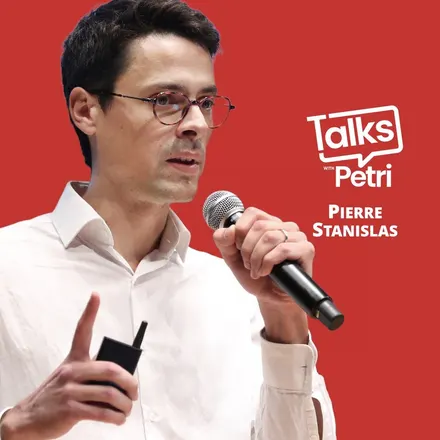
With Pierre Stanislas
Pierre Stanislas talks about finding opportunities in unexpected places, how to become insurtech leader and make waves with side projects.
Pierre Stanislas - TALKS WITH PETRI
Pierre Stanislas talks about finding opportunities in unexpected places, how to become insurtech leader and make waves with side projects. He also shares insights into the future of Clubdeck and web3 audio platforms.

Keep provoking happy accidents
Pierre Stanislas talks about finding opportunities in unexpected places, how to become insurtech leader and make waves with side projects. He also shares insights into the future of Clubdeck and web3 audio platforms. See the episode …
Bio
Pierre Stanislas is the CEO & co-founder of Wilov, and a co-founder of Clubdeck. He has worked in finance for 15 years (London & Paris), advising institutional clients on their strategy. In parallel, and just for fun, Pierre has developed and launched mobile apps in various fields such as gaming, social media, culture or sport, some of which have been downloaded by several thousand users. Passionate about sailing, music and martial arts, he has also written two novels in his spare time. Pierre holds an MSc from Ecole Centrale Paris.
 Play video
- 0:00 happy accidents and serendipitous business life
- 3:40 the math genius trading exotic options
- 4:20 side projects while having a corporate career
- 7:40 trendsetting with Twitter
- 13:00 a side project makes waves and gets an acquisition offer
- 14:20 Clubhouse and its impact
- 19:00 content creation with audio and where it’s heading
- 24:20 low latency live audio on a global scale
- 31:20 building Clubdeck
- traction without marketing
- 45:40 Tech News around the World by Tyler Crowley
- 46:20 new content and knowledge back catalogue in making
- streaming on multiple live platforms
- 1:01:00 an indirect validation and community support for the product
- 1:01:20 Spotify Greenroom and Twitter Spaces
- 1:03:20 Greenroom’s launch failure but solid tech
- 1:07:00 Twitter Spaces’ technological limitations
- 1:14:40 Clubdeck’s future
- 1:16:40 decentralised web3 audio platform
- 1:26:20 insurtech and founding Wilow
- an app-only product has advantages
- design choices shape your business decisions and processes
- 1:29:40 early days bold business decisions
- pay when you drive and ecological implications
- aligning user incentives with your business model
- turning legal requirements into revenue opportunities
- 1:38:40 monetary motivations can drive word of mouth
- 1:41:00 App store featuring as a significant marketing boost
- 1:46:20 corporate VCs as your investors
- 1:51:00 turning a boring business area into something appealing
- choosing which opportunities to pursue when you have plenty
- 1:53:40 big in Japan for 15 minutes
Episode links
https://www.clubdeck.app/
https://www.clubhouse.com/
https://clubhouse.com/club/tech-news
https://en.wikipedia.org/wiki/Spotify_Greenroom
https://media.twitter.com/en/articles/products/2021/twitter-spaces
https://www.agora.io/en/
https://audius.co/
https://odysee.com/
https://ethereum.org/en/
https://solana.com/
https://sia.tech/
https://mirror.xyz/
https://www.amazon.com/Pierre-Stanislas/e/B00AT2ZUEA
Transcriptmachine transcription · 2:04:25
Transcribed from the recording by machine (Whisper): it may contain errors.
0:00 This is Talks with Petrii show, I'm your host Petri. Today, I'm talking with Pierre Stanislav, who's a startup founder from France. Welcome. Hello Petri, thanks for having me. How come all of your career, that's what I heard, has been happening by accident? That's a great question. I like the word serendipity. I like the fact that that's the way of taking your life, making the most of opportunities that present themselves. And I like to go with the flow in general. So, for instance, when I started my career, it was actually before I graduated from university, I had an interview with a bank, not knowing anything about banking, not knowing anything about finance. And, you know, I was just curious about what I could do in that space.
1:00 And also, I like the fact that I had the opportunity to go to live in London, which I didn't know well at the time. So I just went with the flow and went there. And then everything from there was an accident. You know, I had a first interview with people who thought I would be good at trading because I was French and that I was good at nice. I don't see the connection, but maybe they did. The connection for British people, apparently, is that if you're French, you're good at maths. And if you're good at maths, you're good at trading. So I went there. They asked me a few questions. One of the questions. So let me give you an example. They thought I was so good at maths that they said, you know, out of the blue, they said, what is the square root of factorial 8?
1:49 So factorial 8 is, you know, 8 times 7 times 6 times 5 times 4 times 3 times 2 times 1. So it's quite a big, large number. And then taking the square root of that in your mind is quite difficult to do. And I think they didn't expect me to answer anything, you know, to answer with a precise answer, you know, with the actual number. But I was, you know, I thought I had to give an answer. So I started mumbling, you know, rumbling random numbers, you know, trying to come up with a solution. And my rezoning was completely wrong. I know that for a fact because I double checked later on. But I just out loud, you know, did some sort of magic. And I came up with a number which was 200. And the thing is, you know, so they looked at me like that.
2:40 You know, what's happening there? So one of the guys takes off his calculator, does the calculation, and the actual number is something like 200.8. And so they thought I was some kind of Forrest Gump or whatever, you know, like a genius in math. In actual fact, I know that for a fact, my reasoning was completely wrong. But from that day on, they thought I was a genius in math, and they said, okay, you're hired. You're going to be a trader. And that was pure accident. Wow. Well, you were pure lucky as well. Yeah. You could have asked the question, you know, is your career a factor of accidents or luck?
3:26 I think it's a bit of both, but to grasp your luck, you have to, you know, you have to try and do things. There's also the other alternative. You know, they were right. French people are good at math. Yeah, but not me. Well, I am, you know, I've got a background in that, but I'm not good enough to be able to calculate that thing like that. So I was just lucky, but I did it. My you know, I gave it my best and they really thought I was some sort of genius. So I started trading in London for a number of months. And that reputation followed me for a long time. And so whenever there was a complex, I was trading exotic options, which is like, you know, complex options on the trading floor. And whenever there was a complicated situation involving maps, they would come to me and they needed, they required a fast answer. They came to me and asked me, you know, "Hey, Ginos, what's the answer to that? What are your thoughts?" And I was in that imposter syndrome, you know, where I, you know, they all relied on me to provide an answer which I didn't necessarily have and that was really uncomfortable and that's how I ended my career in trading actually. I thought I wasn't suited for that and I went on to do other things but that was really funny. So you spent your first career in tanking but you did also side projects, is that correct? Yeah, I did a bit of trading and then I met who I would consider my mentor in in in finance um a british guy who's who's still a very good friend and who taught me a lot about you know listening to clients and trying to iterate on their uh thoughts you know trying to provide them with the best service possible and things like that um so i i did that with him in london for four years and that was really a great experience um but at some point i was missing
5:32 something you know there's uh i get bored very easily i don't know if it's a common trait with with entrepreneurs but that's actually that's that's my case you know i i can get bored very easily and i need to switch context and think you know i always try to think about other things and other projects and what's happening elsewhere uh and so i started uh programming and looking at what was happening in the B2C, B2B space, web apps, web.o at the time and things like that. And that's how I started site projects with one of the guys who I met in university and who's actually become my co-founder at my current startup. But we did that for almost, I've known him for 20 years and we've done that for 20 years.
6:23 And probably we've done two projects a year so we've done 40 projects together I guess the idea was not necessarily to make money but it was just a survival type of thing I really wanted to keep my mind occupied with something else and try out of curiosity try to understand what was going on in that Web 2.0 space and those new applications social networks and the SaaS world and things so So we did many, many side projects for a number of years. Is there some of those projects still alive? Are they startups? Did you exit? Is there something we could check out on the web now? You could probably dig things in the web, in the history of the web.
7:14 One of those projects, which is not live anymore, actually. And we didn't exit it. We didn't sell it. We got an offer for it, but we didn't take it. It was called Twitscoop. And Twitscoop was... We started that right at the beginning of Twitter. So that's in the late 2000s? Six, five, six, seven. I don't remember. Before the final crisis. Yeah, absolutely. And we thought Twitter was amazing because when it started, people were posting, essentially telling the world what they were doing. Yeah, I'm having lunch and I'm going out now.
8:04 I'm going to sleep. Those were one of the few tweets in the beginning. What's your mood? Yeah, absolutely. But we started to see a trend, which was that people were actually discussing current events or live events or expressing their thoughts about things. You know, the short form, you know, the 140 characters constraint was actually a very good constraint, I think. It can be bad as well. We can discuss that. But it was good because it forced people to express their thoughts and articulate their thoughts very, you know, concisely and clearly. And we saw that, you know, this thing was growing and Twitter wasn't, at the time, wasn't doing very much about it.
8:52 You know, you could only see what your friends were tweeting about and it was very much this thing about retweeting others and following others and having as many followers as you could and things like that. But we thought that underlying that, you could really have your finger on the pulse of the universe in a way, you know, assuming enough people came onto that platform you could really foresee that all live events and current events would be discussed there. And so we thought, why don't we try to have access to that big pipe of Twitter feed, you know, tweets, and try to do something with it. And so we got in touch with Jack, the founder of Twitter, who at that time probably didn't receive a thousand emails per hour.
9:47 So it was much easier to get in touch with him. And we said, you know, hi, we're two French guys based in Paris. We like what you're doing with Twitter. Could we have access? Do you have an API? And at the time, they didn't have one, but they were looking at doing something. And so they gave us an early access to the Twitter feed. And it wasn't, you know, it was for free. You could access it freely. And we created this thing that we called TweetScoop. which essentially was a live tag cloud. So tag clouds, if you remember during the Web 2.0 era, tag clouds were all about tag clouds, taxonomy and things like that, where you were trying to classify things by topics and short words and things like that. And you could display them on a screen, and the size of the tag would depend on the frequency at which it would be mentioned in the corpus that you were analyzing.
10:46 And so that was our idea, which was to get rid of the crap, all the short words and stop words and things like that. Just keep the essence, the interesting words that we could see flowing in the Twitter feed and then display that as a live tag cloud with the tags growing and shrinking in real time, depending on how hot they were, if they were trending up. And that was the ancestor to trending topics, in a way, on Twitter. Yeah, and it was a new thing to have that live. So because there was a lot of static HTML before and updating things live was also a new thing at the time. Absolutely. So it was quite challenging from a technical standpoint. And so we put that out there and it grew like crazy. And a lot of corporates actually started to have an interest in that.
11:39 And we ended up being displayed on big screens in conference, you know, in newsrooms and things like that. The Guardian was using us. Others were using us. Because whenever you had an earthquake, whenever you had some sort of local news that would eventually make it global, you know, be newsworthy enough to become a global thing, it would actually come from the ground. And with Twitscoop, you were able to notice that very quickly. We were, you know, on earthquakes, we were really, really good because people, you know, instead of going, you know, running to safety, people were tweeting, you know, was that an earthquake? So you could see that very quickly on Twitter. We got the news of Michael Jackson's death, actually. We were the first.
12:30 And TMZ, the website, the people website which broke the news, actually used TwizCoop to do that. Because there were fans camping outside of Michael Jackson's ranch night and day, who saw the ambulance and all the things which were going on. And that's how the news surfaced. So TwizCoop was actually a really big thing. We got an offer from a now defund company. so I won't name them. So which made us an offer and we didn't take it very seriously. Why? Did you do the planning to make it big or you just the offer was not good enough or it was an offer you could refuse? It was a combination of everything. The offer was probably not good enough for us to quit our jobs. We had very comfortable jobs. So we didn't want, we weren't ready to go to actually make a business. We were ready to try side projects and be curious about what was going on and try many things in many different sectors. But we weren't confident about our capabilities to turn that into a successful business. So it's more like a timing thing.
13:55 I think we were all of us didn't really think we had what it took to create a business which would eventually make money. And that was the joke between ourselves. The idea was we would make a site project for six months and then stoke it on the shelf somewhere and start with another one. And that was just the way we were doing things at the time. And you keep on doing that. The latest one is, or I assume it's the latest one. If you're having six months rotation, then there should be already something else going on. But the one I'm aware of is Club Deck. Can you explain what is Club Deck? And before you explain what is Club Deck, can you explain what is Club House? Because the other day I learned that not everybody even knows what is a Club House. Yeah, I might need your help explaining what Clubhouse is, because I think everybody's got his own interpretation as to what it is.
14:53 And I think themselves, they're still discovering what they are. And that's very interesting, because it's very similar to what we did with Twitter. Yeah, I already was seeing the parallel, but please go ahead. Yeah, absolutely. So Clubhouse is what they call social audio. So it's basically a social platform where you have friends that you can follow and people can follow you. And the idea is that it's a Nodio-only platform where you can open a room or you can join a room and then people speak freely. You have this concept. It's a bit like a virtual conference to the extent that you have a stage where you have speakers who can speak and talk to each other. And then you've got a Nodians of people who are listening. And you have the ability to either invite people on stage to have them speak, or people can raise their hand if they have something to say, and you can bring them on stage and have that conversation.
15:55 Apart from that, you know, that's what it is. Now, I've just described the tool there, but I haven't really described what it's worth or what you can do with it. And I think people are still exploring what they can really do with that tool. And the founders, Clubhouse's founders as well, are also exploring the various opportunities they are in that space. It's a social network which grew very exponentially. I think it started in 2019. I don't know actually when they started to build it, but it came out when the COVID hit. Was it 2020 April was the launch for the very exclusive limited, basically California, who is who started to get invites and you could find Oprah and you could find celebrities in there. Yeah.
16:55 That's how the bust started. Also the founders, they raised, was it 10 million at 100 million first? Yes. Then within the first year, I don't exactly know, maybe nine months later, they raised more. I don't think it was revealed. I don't know. It was a hundred million. A hundred million. A hundred million at one billion. Yes. And then there was three months later, after that round, they raised at four billion valuation. Yeah. And that's basically that all happened, let's say within 12 months from the initial PDA launch. And it was hard to get into the platform. There was a wait list and everybody was asking for invites, but somehow I assume you got an early invite.
17:50 Not really. We got in just this year, just in February. Oh, I see. All right. I was earlier than you then. Yeah, absolutely. But you're an early adopter. Well, I tend to be in some cases. Yeah, sometimes I'm a late boomer in some of the things like Twitter. I came only 2010. I was aware, but I wasn't somehow. I don't know why. Yeah. So no, we discovered that very late, actually. Well, very late at the same time as everybody else, I would say, when the platform became open, it was iOS only. It was only on Apple devices at the time. And it was very similar to what we experienced with Twitter. I.e., we got on there, there were a lot of not so much interesting conversations, to be honest, with people just experimenting, talking amongst friends.
18:43 You had the usual clique of marketers and people selling stuff that you didn't know you needed. And things like that. teams and everything between. Yeah, and everything between, cryptos and things like that. But there were a few interesting rooms happening and people starting to take it kind of seriously. And that's the whole content creation economy. The thing that you've noticed on YouTube and Instagram and TikTok and things like that. And so a few people started to do it almost professionally with taking things very seriously, preparing their rooms, trying to find relevant topics, relevant people to invite on stage, trying to bring as much production value in terms of the quality of the audio and things to make it more palatable to people.
19:40 And we thought there's definitely, you know, personally, I think social audio is going to remain. You know, it's a big thing. I think Clubhouse is going to win this. I know it's kind of contrarian to some of what many people think because many people think that raised too much money too quickly and the platform has grown exponentially and it went all over the place and stuff like that. But you can very clearly, if you pay attention to what's been happening on that network, you can very much see the various phases it's gone through in terms of the content, the quality of the content which is in there. And there are ups and downs. And the downs usually coincide with a massive influx of new people coming in and just, you know, staying for a few weeks and then going away, people experimenting and stuff like that.
20:37 But I think that the overall trajectory is really upward. And I can see that, you know, I see it in the stats as well. We don't have that many stats, but as a proxy, we know how many users we have and how many rooms are created with our tool and stuff like that. So I think I'm very optimistic about this whole thing. And I don't think it's going to be just a quarantine fad type of thing. Which also helped them a lot because that was basically what everybody was doing. They were locked in their places. They couldn't do much. They wanted to socialize. And this was kind of an easy way to connect with people around the world. You didn't need to put up your makeup or you didn't need to look good. You could just tap into the audio.
21:24 You could listen. If you have something to say, you could just go on stage and start to talk. You could be more or less like anonymous as well, if you like. There was a lot of celebrities, famous actors, even in the 80s, old people sharing their experiences maybe for the first time. So you get a really good, if you were among that period when that happened, like 2020, late 2020, when a lot of people joined and got access there and the early 2021 in the winter months, there was a lot of high quality rooms like that. And that was, if you were the lucky one in those rooms at the time, like there was Mr. Beast sharing tips and his experience of how you make your videos to happen in YouTube and really openly answering questions.
22:22 And that was sort of fantastic time. And if that was your experience of Clubhouse, that was a really good thing. Another comment just about the community side as well. What I experienced from the very beginning was that there were a lot of volunteers who were opening rooms saying that, "Are you new to Clubhouse? This is what you should do. If you ask any questions, please ask the questions." And they kept on doing those almost like a daily basis without any pay. They were just basically wanting to be part of it. Obviously they get gain followers and some of them got carriers out of it. But that was, I think, part of the product of the limited access. Yeah, absolutely. Yeah. But then, you know, what we've seen is that some people have started to think more in terms of shows, in terms of actual content, creating, you know, trying to add value, having some sort of recurring events. You know, it's not just a one-off, not just opening a room because, well, you can.
23:23 You know, people planning in advance, trying to create some sort of alliance with other content creators to try and pass on the baton when, you know, they close a room, somebody else opens a room and stuff like that. And out of the chaos that you had at some point when they opened up the platform to everybody, it slowly started to structure itself a bit more. And what I also just to comment a bit there as well, that I started to see a lot of musicians coming in, really talented musicians around the world. And even high production value things like musicals. That was in the middle of the COVID time. There was actually musicals where there was probably, I don't know, sometimes 10, 20 people performing in that production.
24:21 And those were the fantastic things. I don't see any more there, but the musicians have still... There are some. Yeah, there still are some. If you follow the right people, you will find really high-quality music rooms. And I think it's a great point, which is the reason why I think also it took off is the underlying technology. And because in audio, one of the main factors is latency, is you say something, and then how long it takes to get to the ear of somebody else across the globe. And if you're trying to have a debate, your latency, or even more so if you're trying to have a live music room with people singing from all over the world, you have to have as low a latency as possible. And quite frankly, I know the underlying technology for Clubhouse.
25:14 I know they're relying on the Agorap platform and things like that. But I'm still amazed at how low the latency can be and how musicians can play together live. Improvising as well. Not just playing live, but improvising. So you have to listen what the other person or the other people on the stage are playing, and then you have to respond on that. And then you have the latency. And if you have a, so there's some particular type of music you can do, which is not so bound on the exactly on the rhythm because you cannot, it's really hard to, because you have to project what's going to happen and estimate what's going to happen next because you are not actually in the same place. And there are physical laws which prevent, you know, there's just the limit of the speed of light, which makes it even in our planet that the delay happens.
26:08 Absolutely. And so that's probably a good transition to ClubDeck itself, which is noticing that, witnessing that thing, that magic happening. We thought, if you're a musician or a content creator trying to do that seriously, to produce high-quality rooms, you can't really do that on a smartphone. It was only on iPhone at the time. So it was very limited. So you couldn't basically plug in even stereo stuff easily. It was really hard to make any stereo thing, any external thing, except your phone and your headset to work in that clubhouse. And so we thought, you know, why not leverage the desktop and try to come up with a desktop version of clubhouse that could then open up, you know on the one hand maybe give you as a moderator as a content creator being on stage moderating other speakers bringing other speakers on stage and stuff like that giving you the tools to do that uh properly with a big screen and the ability to you know very quickly check profiles and to you know analyze your audience and stuff like that and on the other hand leverage the all the software the existing software you have on your computer as a professional audio you know in the audio space um and and leverage all that software to plug it directly into clubhouse through club deck which is what we came up with and so it was back in february so so we went we went on the on the platform in february we started you know about two weeks after being on clubhouse we realized we had to do something. There was this urge to do something. And so we started tinkering with the code and trying to understand how Clubhouse was working. And I think we came up with the first version of Clubdeck after about four weeks or something like that. And
28:19 And we put it out there with no marketing, nothing. It was just, you know, we put up a page and a download page. We didn't really explain what it was doing, what it was for. It's actually not, we were still not doing a very good job at that, to be honest, but we don't have the time. We'd rather code than market the thing. And the numbers were exceptional. How did people know that it exists? Because if you didn't do marketing and it's an audio platform and you couldn't at the time show any links or anything, so how did that marketing happen? Did you tweet or go back to the old technology or what happened? I'm trying to... like all these things you never really know the actual... you know there's the the story that you can tell and then there's the reality and i'm i'm trying to remember but i think i i do think that the first person we showed it to and that was through a twitter dm was tyler crowley from all right yeah tech news around the world yeah so tyler just to give a bit of background Tyler Crowley is a guy who runs a show twice a day on Clubhouse, which is called Tech News Around the World.
29:44 And the concept is very simple. You go through the headlines of what's happened in tech in the past 24 hours. Big headlines, but also smaller headlines that you can find through other means, you know, not necessarily mainstream headlines. And then a panel of kind of experts, but also tech, you know, nerds and people, geeks and people like that, discuss that. That's an open discussion on headlines. And that's very interesting. It's like a conversation you'd have at a cafe or whatever, you know, somebody reading, you know, tweets and saying, oh, there's this news about Apple. And then people start talking about that. And then all of a sudden you've got a guy who's worked at Apple, who knows things about, you know, who can bring value to the conversation. So but if somebody else working in a totally different space, but having an insight and and Tyler is very good at making that secret sauce, you know, and making it work. So it's I think it's the biggest show, you know, on a consistent basis, on a daily basis on Clubhouse.
30:48 And so that's, you know, I think I got in touch with him through Twitter. I said, you know, do you want to try that? He downloaded it and he's never stopped using it since then. And it was quite a bold move because the terms and services of Clubhouse was not exactly clear that you could use any external software and you could be kicked out of the platform. Yeah, I think he doesn't care. I think that's something about Tyler. He's an entrepreneur and he's worked with entrepreneurs and he's done many things in his life. And I think he's very curious about things and he's very concrete and straight to the point. If there's something that facilitates his work or what he's doing, he's going to try it. And I'm very grateful for him to have tried ClubDeck, really, because I think that the fact that we have now more than 200,000 users is probably in no small part thanks to him.
31:48 But it was indeed a bold move on his part, and it was kind of a bold move on our part as well because there's no official open API for Clover. And it still is in a way that you've been building it on somebody else's property, if you will. It's like a house on somebody else's property, and you don't exactly have the rights to do it. But later on, maybe we can go to that one. when there was something happening, you needed to knock on the door of the clubhouse and ask a permission to enter at least temporarily so they can wear what you're doing. I think that's the beauty of site projects where you don't really care about the outcome. And that's all those site projects we've done for 20 years with Philippe, my co-founder. I actually have a day job, a startup, which is quite successful in France, which I co-founded with Philip and Anne-Claude, my third co-founder, which runs smoothly and is a very good business.
32:46 So we have the luxury of just dedicating 10% of our time to Club Deck just for the fun of it. And we don't really, it's not a big deal. I mean, and so it's a big deal for a lot of people, actually, and we love what we're doing. And, you know, we love Club Deck and we want to make it succeed and make it grow even bigger and be even more useful. But what I'm saying is that we're not invested in it to the point that if it fails, it will have an impact on our personal lives financially. It's actually costing us nothing, nothing at all. It's just our brain and our fingers on the keyboard. And that's it.
33:35 And so that's the luxury of all those site projects, which is you can take big leaps and essentially, effectively, like you're saying, build something on top of somebody else's property without really caring about what the outcome would be. We just we we have good intentions with with Club Deck. We want to build something which is great. I think we it's one of our most successful site projects so far. And we want to continue doing that. But the fact that it's not a big deal if it fails, makes it even easier for us to be bold and try to build things further and further like we're doing right now. So how do you build it? You obviously implement the new features which Clubhouse is continuously putting out.
34:26 So you have to keep on tap what's happening and then quickly come up with the solutions because the club deck users are quite active and they start to shout the Twitter and become almost like aggressive if there's something which is not happening. You know, that's surprising. I think we've tamed that down a little bit because at the beginning, I think people, and that's again the luxury of running a side project, which has no financial impact on your life. So we're doing things because we want to, not because we're forced to, and that's very important. And our users are just users. They're not customers. They're not paying. It's a free software. So we don't feel the obligation. We have kind of a moral obligation to try and make the best for them, for sure.
35:18 You know, and whenever somebody is requesting something, we take it very seriously. And we usually implement it in a limited amount of time. I have a personal experience on that one. I think I started to contact you. I don't know who it was. I assume it was you because it was the Slabdeck Twitter handle. And I think I reported some bug or something. I think it was a bug. And the feature was implemented within one or two days. It was already in the new version of the software. So that's how fast you responded. Yeah, we hate bugs. And we hate... That's a tendency we have as well. I can't believe knowing that there's something wrong in the software where there's a feature missing or whenever Club Deck releases a new feature, it's very hard for us to say, okay, let's take our time to do it.
36:15 We can't do that. We have to have it as soon as possible. It's just a nudge to do it. It's like a creating thing. But yeah, so some people at the very beginning, there were a few which were a bit aggressive, saying, yeah, how come you didn't implement? I don't know, frankly, if it is because they were confusing us with Clubhouse. Maybe they thought we were part of Clubhouse, but we made that very clear, actually, that it's not an official Clubhouse client. We don't have their blessing to do that. They don't give us any time to implement things or advance warning about... We don't know what they're going to release. Whenever they do a town hall, so basically every week they do a big town hall with all the users who want to listen in and explain what's going on and what's the new features and the new directions of the platform.
37:07 We're just casual listeners like the others, and we have no insight at all. We don't know what's coming up. And so we discover the thing and we say, oh, depending on how complicated it looks like, we know it's going to take us maybe 24 hours, but in some instances, it took us a week or more for some of those features. So what were the hardest months to do? music mode was was a hard thing um music mode so it's basically basically the the stereo mode so the ability to stream in stereo it's yeah they are complicated um you know it's it's it's from a technical standpoint it's not an easy thing to do and it's not an easy thing to do properly without sacrificing the quality of the stream.
38:00 So we had a proof of work, proof of concept very early on, which was actually streaming in stereo, but the quality was bad. And so we had to understand the WebRTC and how those streaming protocols work to really get to a point where the quality was actually good. And I think we're doing, It's funny because the processing we do on the audio for music mode is different from the one you have on the actual native clubhouse apps. A few musicians have noticed that and they actually like ours better. So we because I think clubhouse is still trying to favor voices whenever, including in music mode.
38:50 Oh, really? So they are processing just for the audience as well. They, if you're in a regular, there are different modes when you're in the state. So there's like a low quality. If you have a low bandwidth, then there's the high and then there's music mode at least, which is just when you're playing music. But if you're in those other modes, my understanding is that they're actually doing some echo canceling and they're processing the voice to make it more clear and more understandable for listeners to make it better because people are having different headsets, they are sometimes outside in the traffic and there's a lot of background noises. So the audio quality all together varies. Yeah, absolutely. And for music mode, for instance, you can't do echo consolation for technical reasons. So you have to get rid of that.
39:38 So some people didn't really understand because they were just speaking on stage and they wanted to use music mode, although they weren't playing music. And it started echoing and people were a bit confused about that. So for those who are on Clubhouse, good advice is just to stay on high mode. If you're just speaking on stage, music mode is not useful for that. And also, if you're using Bluetooth headphones, Whenever you get on stage, your headphones get into telephony mode, i.e. the mic gets activated. And on most headphones, you can't have the mic activated and stereo at the same time. So it switches automatically to mono. So even if you're on music mode, for instance, doing something and monitoring with your headphones, if you don't pay attention to the fact that your mic should be not the mic of your headphones, but something else, you know, an external microphone or something like that, you will be switched into mono.
40:39 So there are a lot of technicalities and details there, which we had to go through. So music mode was a difficult one. And lately, what did we release? Yeah, replays. Yeah, that was quite a feature. Yeah. So, and I think that's going to change the game, literally. I think Klaavau's nailed it with that. They took their time. People were complaining you couldn't record a room. And actually, originally, the founders were a bit against recording rooms, saying that it could potentially prevent people from expressing themselves freely. And I can see that. This is something I would tend to agree that it could prevent some people to express themselves freely if they know this is recorded.
41:30 But the issue is even on a smartphone device, you can record the screen. And you could always do the recording. So always when you're in a clubhouse, assume that it's recorded. But there are also these other issues which if you're performing, you need to have the broadcasting license to have some music if you don't own the rights. So there are these issues as well. So sometimes having a spontaneous room without the replay mode on might have advantages as well. Yeah, absolutely. So that's why they gave the possibility to do that. But they took a very interesting approach to replays. And now they are slowly but surely building a huge back catalog of rooms and audio content on multiple topics. They've added transcriptions as well.
42:19 They will be able to apply taxonomy, like the famous tech cloud I was talking about. It's coming back. Yeah, maybe. I don't know. And so it's going to become a search engine like YouTube is a search engine. Nowadays, if people are bored, they go onto YouTube, they search for their favorite topics, and you always find something interesting to watch. And I think Clubhouse is going to be the same for audio. And so that's why I'm very optimistic about its future. as long as content creators stay on the platform and stay invested and do high production value shows. And that's what we're trying to do with Club Deck. You know, help them, provide them with the tools to do that. And just to give an example how great the service is, I would love to get the same in Hopin and those webinars as well.
43:12 You could skip this peak and go to the next one immediately. You could have a double speed. Sometimes they have that feature in other platforms as well. But Clubhouse really needed in a way that you can, if there's, let's say, something, some experts talking about some topics, so you could quickly check, you know, the ones you like and what's the most important or you couldn't go to the live room so you can review it and you don't need to take the whole two hours. You could just do it in 15 minutes. And that's quite amazing service. There are so many good experts still in Clubhouse. If you find the rooms, they're talking about everything from physics to the quantum physics to arts, to anything you can imagine. And this becomes a huge back catalog of knowledge over time. Yeah, absolutely.
44:00 And I think it took us a week to implement replays because of the dynamic feature. It's not just replaying a sound. It's actually replaying the sound alongside having a dynamic stage with the profile pictures of people interacting, muting and muting. It's as if you were live in the room. And also giving that skip feature that you just mentioned, where you can jump from speaker to speaker, and also displaying pin links, which is a feature they added recently, which I love, which provides context to the conversation without distracting everybody. It's just a link which is pinned at the top of the room. And this is part of replays as well. So whenever people pin new links, you see that dynamically appearing on the screen. It took us a bit of time. And the way they implemented it is interesting. I'm not going to comment on that further on that, but I think what we've learned by implementing kind of reverse engineering, what we've been doing, is that it's a very clever, They've got a very clever engineering team. We're quite impressed by how they're driving the engineering projects there. I can see the appeal to you. This is like a game. Somebody else is doing something and then you have to challenge to crack it. Then you can learn a lot, you know, being the cutting edge of the technology and you implement it and you have kind of a framework within the work.
45:31 so you don't need to always jump in different directions. You can keep focused, but it keeps you excited. Yeah, absolutely. And at the same time, we're trying to implement other things that you have the privilege of being able to implement on the desktop because you've got a bit more computing power, you've got a bit more screen real estate. And so there are things which are very unique to Club Deck that you will not be able to find on Clubhouse. And one of these is actually the restreaming feature. So you can record a room and have the file actually on your desktop at the end. But one thing you can do is redistribute your content live on more than 20 social platforms. And Tyler, for instance, we were mentioning him and his room tech news around the world earlier on.
46:21 He's doing that on a daily basis. So whenever he starts a room, he starts restreaming it so that you have the room in Clubhouse. But at the same time, you have the room on Twitter, on Twitter Live. You have the same room on YouTube, YouTube Live, and the same room on LinkedIn. Very recently, we added LinkedIn. And all of a sudden, it kind of solves one of the problems that content creators were facing on Clubhouse, which is that your audience can be limited because it's limited to a point in time where everybody is not necessarily available to attend your room. And this kind of back catalog issue of having all that great content, but you're not doing anything with that. So with just a click of a button with Club Deck, you can do that. And all of a sudden, multiply your audience by several orders of magnitude.
47:14 And so that's one thing that we're very proud of and that you could really only do on a desktop. We've done other things, you know, which enable you to analyze your audience. And that's the famous tech cloud I was referring to earlier on. But what we do is we look at the profiles of all the people in your audience. And as a moderator, you will see a split by gender and also a split by interests. And this is fascinating. If you go to several, you know, a crypto room and then a marketing room and then a music room and then a tech room, you will really see the difference in terms of audiences. and the profiles and the gender split and things like that, which are really, really fascinating just from a, I'd say, an academic point of view or a sociologic point of view.
48:08 I don't know if that's a word in English, but I hope you understand. And also it can be useful for marketers as well, obviously. So, you know, all these people, those content creators at some point want to make a living directly or indirectly from what they're producing on Clubhouse. And I think this helps a lot, you know, understanding your audience, being able to put out to potential advertising companies and stuff like that, or partnership companies, is very interesting. So that's one of the things we've been doing with Clubdeck as well. Can you pick the new crypto earthquakes quickly as well? Be the first one to know what's happening in the world just by observing the rooms popping up and then the topics. Yeah, we actually added a feature. So, you know, on Clubhouse, they also added a search feature, and they added that very recently.
48:57 The product is still very new, and it's still... That's the amazing thing about that platform, is that it's still evolving on a weekly basis. And that's the difference with Twitter. Twitter nowadays, there's one new feature maybe every six months, apart from Spaces, which we can talk about later if you want. the core Twitter product is not the UI is changing for sure, the user experience, but the core product, not so much. People have been asking for the ability to edit tweets for ages, and it hasn't changed for ages. So that's one example. On the other hand, the Clubhouse product is evolving before our eyes, and being able to put our hands in the engine and reverse engineer it and adapt it to the desktop is a very interesting exercise.
49:47 And when they implemented search, which was recent, you could finally have the opportunity to search rooms by keyword, if you want to. And what we've done on Club Deck, which isn't available on Clubhouse, the native app, is the ability to have several hallways. So a hallway is basically where you have all the rooms of the people you follow and the clubs you follow and all you're interested in. And our idea was to supplement that with other columns, which are search columns and live search columns. So if you're interested in marketing, you can type marketing in the search box, pin that as a column, and then you will have that updating live alongside your main hallway. This reminds me of the old Twitter desktop apps as well, when you had those columns. Absolutely, yeah. And we took some inspiration for that.
50:39 The interesting thing is that this old Twitter desktop app was actually using Twitscoop. So our product, as one of their columns, they were showing the TypeCloud, the dynamic TypeCloud. So it's kind of a full circle type of thing. But yeah, for us, it was really obvious that having those search columns with your various interests updating live in front of you and being able to customize your notifications and things like that would be very useful. So that's what we've been doing. And if there is an earthquake and somebody opens a room to talk about it, you'll be the first to know about it if you're on Club Deck and you've searched for earthquake. You had a bit of earthquake, the Club Deck earthquake, when Twitter changed something and people couldn't log in.
51:28 Yeah, that's a very good one. Yeah, so we started, so I don't remember the chronology exactly, but so we launched, I think we launched Club Deck in April, late March, late March of this year. It grew very quickly. And, you know, Tyler started to use Club Deck. He started to talk about it in his rooms and then other content creators jumped on it. some of the famous Clubhouse icons, the musicians that are famous on the Clubhouse, started using Clubdeck as well. And at some stage, I think Clubhouse had this issue where other people had started to reverse engineering their internal APIs, and they wanted to crack down on that, and that's fair.
52:22 I mean, they didn't want the personal user information to leak outside. They didn't want to have to deal with multiple actors doing things they weren't necessarily very well aware of and not aware of their intentions either. So they changed something. I can't be very specific there, but which essentially cut us off. So it wasn't possible to load on to. All of a sudden, I think it was on a Friday, as it always is the case when something goes wrong, You know, when you're programming something, it's never in the middle or at the beginning of the week. It's just before the weekend. Yeah, it's five o'clock Friday. Just to make sure that your weekend is going to be as crap as possible. And so I actually think they did it on the Friday. And so they cut us, they cut everybody off.
53:13 And we noticed it very quickly because we got an influx of Twitter DMs and public messages and emails and stuff. like thousands of messages. Wow, that's even a weekend job to respond to those. Yeah, so we looked at it and we realized we very quickly understood that they wanted to get everybody off the platform so we we thought about it um which we we sent messages to to some of the members of the the clubhouse team at the time you know saying hey can we have a conversation um i think nothing happened over the weekend and it was really you know us sending messages out of the blue and i i assume that at that time they were already being literally snowed with messages all the time, being very public figures on the platform and stuff.
54:16 So we didn't get an answer. But what we learned later on is that our users actually started sending messages to Clubhouse as well, to the Clubhouse. I remember the tweet as well. Please, Clubhouse, enable us to put out our rooms. I've not been able to do my room for five days. I'm waiting for Club Deck to work. Please. Yeah, there were people tweeting out. Yeah, that was actually really motivating for us. We had exchanged to a few users and iterated on their feedback, but we didn't realize that there was actually a big mass of people using ClubDeck. And very, I wouldn't say not necessarily influencers, but big content creators.
55:11 So, you know, major content creators, let's say major content creators came out of the woods and sent us a DM saying, what's up, you know, what's happening, can I help, etc. And we realized, for instance, you know, at that time, I think Clubhouse had launched the creator first program. So that was basically a paid program for top content creators or content creators they had selected and that they wanted to promote and help and that they were running recurrent shows on Clubhouse. And so we realized that probably 90% of these were using Club Deck because they got in touch with us. But we didn't know that before. We didn't have that information. And so we don't know what happened behind the scenes, whether Clubhouse took notice of that or simply they took notice of our email. That can be a possibility.
56:02 And then we had a quick chat with Rohan, the CTO. I think that their concern was to make sure they didn't know about us. Honestly, before? No, they knew about Club Deck. Okay. But they didn't know about us personally, as the individual developers behind Club Deck, which is a concern. They clearly weren't ready to endorse us. They weren't ready. They're still a relatively small team to some extent. So they didn't want to make anything official or saying, you know, Club Deck is fine, you can use Club Deck.
56:49 They just wanted to have some degree, I think, of reassurance as to the fact that we weren't bad actors doing things with your private information. We actually, everything goes from Club Deck directly to Clubhouse, to the Clubhouse server. There's no in-between. There's no nothing. So we don't know who's using us. We don't know the phone numbers. We don't know the user data. We don't know anything at all. It's just exactly as it is on your iOS or Android device. It goes directly from Club Deck to Clubhouse. So we gave them reassurance about that. And so they decided that for now, fingers crossed, it was fine. And they're never going to ban somebody for using Club Deck, for instance, which could be a concern in the early days.
57:41 I can safely say this is not going to be the case. I mean, this is going to be the case if you do anything against their terms of service on the platform. But that's whether you're using Club Deck or the native app itself. It's no difference. But so we got the reassurance that we could keep doing what we were doing. And that's it. And so it took us a bit of a technical back and forth to get things working. And now it's been happily working for more than six months now. I think there's a few lessons here. One of them is that when you have enough users, you cannot be ignored anymore. So I think it became an issue for Clubhouse as well. that if if club tech is not working you know it was disturbing a lot of people and upsetting them and there was already spotify green room and twitter spaces so there was becoming competition so it was not evident that people would actually just keep on doing things if they already love to do something in another way yeah i think i don't know i really don't know what happened in the background and I can't you know I don't know if it's really our users pushing them to do you know to to let us do what we're doing uh at that time we still had a very limited user base I think we had I don't know 10 000 users or something like that um only the creators maybe but still I mean they They could have, you know, really, I don't, we were just a small rock in their shoe.
59:17 You know, it wasn't really, and it's really not the tone of the conversation we had with Rohan. There were more, you know, they are, this is what I like about the Clubhouse team is that I think they are genuinely, they are genuine people. They really care about what the product they're manufacturing, they're creating, the environment they are creating for their users uh they are not afraid to try things to try many things um but they care about their users and this particular incident or situation occurred because they cared about their users and didn't want anything bad to happen it was just a courtesy call in a way just to get to know each other and understand you know that um we weren't bad actors So I'm not sure they acted under pressure.
1:00:12 There was no pressure, really, compared to the size of our user base. But you're right. At some point, the more and more users you get, the more influential or creative they are on the platform, the more it's in their interests not to harm us, in a way. But I don't view it in that particular light. It's more, we're trying to make our best, to do our best, to mirror their features and to add value to the overall ecosystem. And because this is your side project, like you said, you didn't really care what happens in the extent that this would be your main job. So you didn't ask in the beginning permission to do things, because if you ask permission and then you get no, it's really hard to, you know, then you basically have to reject the project and stop doing it if you're not getting that. But you didn't do it.
1:01:08 Now you kind of got the validation to keep on doing after you get the critical mass in place. Yeah. And you mentioned, you know, you mentioned Twitter Spaces and Spotify Greenroom. I think it's something that will come into play in Clubhouse's strategy. I think they've ignored, they've done a good job at kind of ignoring all that noise and trying to focus on their product, their communities, their users, and creating their own thing. Not necessarily trying to do, you know, for a start, all the others have been cloning them. So they have kind of an advantage to the extent that they are a bit in front of them in terms of product.
1:01:58 But at the same time, you know, they, you know, for instance, on Twitter, A lot of people on Twitter Spaces, which is the equivalent of Clubhouse, but for Twitter, users have been saying, yeah, on Twitter Spaces, there is a desktop version, a web version, actually, which is listen only. You can't actually participate in conversations. Why don't you do that on Clubhouse, etc.? And I think Clubdeck is a good substitute to that in a way. I don't know. I frankly don't know if Clubhouse are going to build their own version of that at some point. Maybe they will. Maybe they will do a web version. Although we could do a web version to the extent that the technology we're using for Club Deck is actually web-based. It's in the desktop. It's using web APIs in a way with a bit of low-level native C++ stuff for the audio.
1:02:56 But they might do something on their own at some stage. In the meantime, Club Deck is a good substitute, I think. So that's also maybe why they let us keep going. Or maybe they are buying you out and making an offer you this time cannot refuse. I don't know. I don't think they are even thinking about it, to be honest. No. They are churning so much features and there's so much left to do on the product that I think it's not in their mind at all. Just a bit of a side to when Greenroom started, I already forgot when it started, but it was obviously a platform that was working before. It was a startup which Spotify acquired and it was more sports related at the time. And probably because of the pressure of the clubhouse and things moving on in this space, they launched it and there was a buzz.
1:03:55 You could even see when you went to clubhouse that day that there's a Greenroom. What is green room? You see in the town hall, a lot of rooms with the green room and you don't know what is green room. And then you went to the room and you were like, okay, this is Spotify snooting. And everybody was rushing into the Spotify platform. And then they were like, what are these diamonds? What do you do with the diamonds? I'm going to get diamonds. And everybody was getting diamonds. And I haven't been to green room for many months. I haven't logged in, but I think it kind of failed because the community didn't. I think that they had a perfect opportunity because you have the music in Spotify. So it's a natural place for musicians, artists to perform for DJs, to have excellent music rooms and focus on the music and that genre.
1:04:47 But somehow it became to get grits and get diamonds and what not type of people took it over and it's drew away the regular people. That's my take on it, but I haven't really locked in. Yeah, I fully agree with you. I think they rushed the thing because they wanted to, you know, at that time, Clubhouse had just announced the new funding round at 4 billion valuation. So they were taking all the spotlight and stuff. And so my understanding, my view also is that they rushed the thing out to normal people like you and me, the average Joe, without having a strategy for the music content, which is a shame. They should have done that before. They should have done a launch with a big concert, a live concert or something like that, and it would completely have changed the dynamics instead of having people trying to collect diamonds and whatever stuff that I think Spotify wasn't really aware of.
1:05:49 even you know they took that from the old product the startup they acquired didn't pay attention and didn't realize that it would become the new thing that people would want like those diamonds or whatever which is the equivalent of followers or likes you know it's more the equivalent of likes likes in the social audio space for spotify and so that's that's a shame it's all the more a shame I think because I have a feeling that the underlying technology they're using is kind of similar to the one that Clubhouse is using. So IE is very, very music friendly. There's a very low latency. There's no latency when people jump on stage. And so it's like Clubhouse. It would have been a perfect place to organize music events. Are they using Agora as well?
1:06:39 Yeah, I think so. I think so. I'm not 100% sure now because I haven't taken a look for quite some time either. To me, it's essentially kind of dead. But at the time it launched, I think it was using Agora. Which is what brings that low latency to the picture. Which is not the technology that Twitter spacing is using. Right. So they completely build it in-house or using something else? We haven't had the time to reverse engineer the thing entirely, but I wouldn't be surprised if Twitter had the resources to make it their own, have their own technology. And you can see by the behavior, whenever the stage is limited to seven or eight people on Twitter spaces, this is funny because design choices, product choices, and technological choices can be a big, big disadvantage, even if you have the critical mass in terms of users.
1:07:45 Arguably, Twitter, they have the best users out there. All the celebrities are out there. Many people are on Twitter. So you would assume that if they launched a social audio project, it would be a success. It has to be a success. But the technological choices they made might not make it a success because there are two things, I think, which don't quite work yet on Twitter spaces. And I don't know why they haven't solved that yet. And that's why I'm thinking that it's an in-house problem. They've developed it in-house. The first thing is the limitation of people on stage. And if you look at the most successful rooms on Clubhouse, for instance, those are the ones where you have many people on stage. If you look at Tyler's stage, for instance, the tech news around the world stage where people discuss tech headlines, there are many people on stage.
1:08:40 Not everybody is speaking. Not everybody is speaking at the same time. But those are the most successful rooms because you've got the most diverse, you know, you've got the most diversity, many point of views. And if you have a very strong and good moderator, it's where actually the magic happens. So on spaces, it's limited to six or seven. It doesn't make a lot of sense. Yeah, in Clubhouse you can have in some rooms 50 or even 100 people on stage. So, not everybody's talking, but the idea that you have a completely different amount of people on stage. Yeah, and so that's a complete different design decision. And the other thing is that on Twitter, whenever you invite somebody on stage, you have to wait for 30 seconds for them to be able to speak. And it's supposed to be live audio. So it's not working.
1:09:32 I mean, yeah, in the TikTok time, your attention span is five seconds. If you're not responding to me immediately, I take the next call in. Okay, everybody is in 30, maybe 30 seconds, quarantine time now. So, you know, it doesn't really work. Yeah. So what's happening next with Klubdeck? Can you reveal something you've been thinking outside of Klubhouse or like a proactive approach? So there's one thing we're thinking about is the statistics. So right now we're using ClubHub, which is a third party. We're just displaying the statistics from ClubHub for those users who have an account with them. But we, in principle, we have everything to do analytics in a good way.
1:10:24 The only question, you know, the only thing that makes us hesitant to actually build something right now is that we understand from the clubhouse town halls. So that's not inside information. We have no inside information. But we understand from the official, you know, the town halls that they are thinking about it as well. And so it wouldn't make sense for us to build, you know, something from scratch if clubhouse do a good job at it. And they've been doing a fairly good job at all the various features they've implemented. So I think we'll be a bit cautious about that and wait. But analytics is definitely something that content creators are asking us every single day. And it makes sense because how do you monetize your content if you don't have analytics?
1:11:19 We do have what we call audience insights, so the ability to know who's in your audience, know what they are interested in but the missing part is really the fine grain and detailed analytics of what's happening in your room and we have the technical uh know-how um in order to do something that would be smart about it i think in terms of ai and there are things we could we could definitely do to make it click and make it work but at the same time we know that clubhouse have got some really good people and have I think they have a vision about that so we'd like to to wait and not step on their toes and see what they're going to to produce actually the other thing we are currently working on live and that's my co-founder philip who's tackling that project is actually improving the quality the audio quality of recordings and I'm thinking about live performances live music performances. So that's something which is very low-level code. It's C++, so it's really low-level code. There's some free and post-processing on the audio. But I think we've tried it. We have a proof of concept working, and the difference in audio quality is awesome.
1:12:43 So you will be able to record a live performance with more or less the same quality as you would with Cubase or whatever DAW you're using on your computer as a professional musician when you're recording. So then obviously it will depend on your setup, your microphone, your room. But the actual quality of the audio we'll be able to save to disk will be really good. And we actually hope that some of the content creators, the musicians on Clubhouse, will produce an actual live track that they will then distribute on Spotify or wherever. But for that to happen, you really need to be able to record high-quality audio.
1:13:40 This is not the case with the current smartphone apps. You know, the quality of the audio is not good enough. We don't think it's good enough. And so we're working hard to do something about that. Awesome. I would actually be thrilled to have like Audius, the Web3, completely decentralized Spotify, if you will. So it would be actually amazing for people to produce it live and then have it as they own tracks. Talking about Web3, the decentralized web. It's a concept which I still find it difficult to grasp from a practical standpoint, not from a theoretical standpoint. The idea that you are the platform, your content is yours, it's written in a blockchain somewhere so that you can freely move it around.
1:14:39 The idea that as a user, this new category, previously you had users, customers, but now you will have users but with a power on the future of the tool they're using through Web3, that kind of voting rights and stuff like that by owning a part of the platform you're using. This is something which we actually like than we're actually thinking about, which is, should we make ClubDeck? Should our users own ClubDeck? But in a Web3 type of concept, so having tokens in the tool itself, it would make sense that this is the tool that content creators are using to make a living.
1:15:35 it's a free tool at the same time they are requesting features all the time we have to also follow what Clubhouse is doing there's this whole thing about content creation and the content creator economy and all these creators know more or less what Web3 is they like the idea and so we kind of at a stage where we're thinking should we open up ClubDeck and say a part of our users will have the ability to own in the way of Web3, but to have a stake in terms of voting rights and stuff like that, and maybe advanced features or early previews. So this is more like a structural thing for ClubDeck, but it would be very interesting, I think.
1:16:31 It would be a good experiment, Yeah, I'm quite excited about it because then it basically would be like a new DAW, digital audio interface in this new era. And then the Clubhouse would be one interface. Absolutely. It would be some input and then you could do different things. And if everybody basically can see the code and they can add things, you could quickly get a lot of interfaces to different things and do various of things you cannot even imagine. And it becomes like the live platform to do and monetize and create and replay. And because the whole web3 is basically about the legal blocks, you can just pick and choose. And if you don't find anything, you build your own. So that's the amazing thing about it, but it's so difficult to describe. It's way better to start going in there and dive in and maybe you skip the Ethereum and go directly to Solana or see some other piece which are more cheaper and affordable and also more fun to play with.
1:17:35 Yeah. So that's really... and you made, I think you named the term there which is "ClubDeck, we want to be the DAO of live audio". And there's nothing for that. There's no there's no tool for that and that's what we're trying to be. And there's already some of the the pieces in place like the audios, which is a natural place to put in. And then you have audio, see if you have video. So they are already these, are they like distribution platforms, if you will. Yeah. In that sense that they are like YouTube and Spotify in the old world. So you could nicely fit into that one. Yes. Yes, absolutely. But it takes, you know, ClubDeck is still a side project. It's still only 10% of our time.
1:18:25 for our audience noticed a still word in there. Yeah. I'm just joking and teasing. What I'm implying is that if we wanted to go further than that, it actually would mean hiring people and hiring people takes money. Well, Fortune Detail is this thing called Miro, where you can do crowdfunding and you know, throw in a few NFTs and then you probably can have millions in fiat currency to spend for the project. Yeah, but it takes time to organize all that. But it's something we could contemplate. The thing is, Clubhouse is churning so many features every week that we don't have time. We don't have the time to think about the future and to think about the direction we're going to take and things like that. We just have to work. Sounds like your main job is distracting your site.
1:19:30 Hustle. Yeah, my main job is distracting my site also a lot. And funnily enough, since you have already a platform and I'm in all the possible possible because you have those creators, you could most likely raise the funds as well for this project. Yeah, we could. We've been We've been approached by investors, you know, so we know we can, but we can't. We can't. We physically can't. We need to get organized and to have the time. We just don't have the time to think about it properly is the issue. Our main business takes us a lot of time, including on the weekends and stuff.
1:20:21 Club Deck is just a recreation, you know, it's just for us to think about something else. And, you know, it's just a, I don't know how I would call it, mental hygiene or something like that. You know, like it's good for the brain and it lights up a few creative bulbs in our brains that we wouldn't light up otherwise in our current jobs. So that's the benefit we get from it. but we don't have the time to sit down and think about a strategy and things like that. But like I said at the beginning, most of what I've been doing have been by accident. And we like to go with the flow. And we've had numerous questions from investors. You could raise 10 million.
1:21:13 And they want to know about our business plan and our strategy. And our strategy is just to go with the flow, which might not be a strategy. At the same time, we have the luxury of being able to do that. And being free is something to be cherished, I think. I think it's now time to talk about also what's your main job. And how did you by accident get that started? Yeah, so it was actually a consequence of all the side projects I did with Philippe, one of my co-founders. So at the time, I was based in Paris. I was still working in banking. So you moved from London to Paris in some time. Yeah, I moved from London to Paris to get married. And that's not the reason why, but I got married at the same time, you know, a year later on.
1:22:10 And when I was at some point during my banking career, I got bored, even though I had side projects. So I knew that at some point side projects would have to become, you know, one of them would have to become my main product for me to be invested. You know, to give you an example as to how bored I was, I had the time, you know, so I was working in banking. So banking, usually it's long hours, right? You're busy most of the time. I don't know if it's busy. And so I had the time to write two books, actually, during that time, because I wanted to try something else.
1:22:58 I had done a bit of music when I was at university, and I wrote some music, and then I love reading. Actually, when I have some spare time, I do a lot of reading and I wanted to write as well. You know, that was one of my dreams. So I wrote two books and then once that was done. Can we actually find those books in Amazon or are they published? Yeah, if you look for my name. So what are they about? Just the titles or people curious enough? It's in French, you know. So they're about, one is a kind of, they're not good books. They're not very good books, but it's not business books or anything. It's like actual stories, right? It's just imagination. And so I was, you know, even after writing those books, I thought, you know, I'm not going to write a third one and the fourth one.
1:23:53 And so I need to find something else. And at that time, when I was in banking in Paris, I met with my third co-founder, Anne-Claude, for my current company. And she was actually my boss there. And she left the bank before me. I think she got bored as well. So she left. She actually decided to leave and go back to school in a way and to learn new things. In the meantime, I was still doing side projects with Philip. And at one point, I had this idea about, you know, I saw that there was something happening in the fintech space, you know, all the startups in finance, most of them, you know, targeting payments and cards and things like that and banking accounts, you know, like the Revoluts and the things of that. So we're now in somewhere in 2015, 16 neighborhood.
1:24:48 16, yeah. 2016, yeah. And I thought, you know, isn't there something similar that could be done in the insurance space? Because the insurance space is even more dusty and old and not customer friendly than banking. And so I looked at that. And at the same time, there was this, and it was very much, you know, it was happening in France very much. So I don't know what happened in other countries, but we could see a shift in the way people were traveling, were moving themselves around. Especially in Paris, all of a sudden we had electric scooters everywhere, like in a free-floating version, bikes, things, you know, public transport was being developed even more outside of Paris and in other cities in France and stuff. And so the way people were using their car was changing and the way their mobility was changing, was evolving.
1:25:58 We thought that there was something there. And the interesting thing about your car is that in France and in many other countries, there's a legal obligation for you to be insured at all times, whether you use your car or you don't use your car. That's the same. You have to be insured. And we thought that it was a bit unfair because, you know, Today in France, more than 50% of cars are actually parked. Every single day, you have half the amount of cars you have in France who are not moving. And all these people are paying for the full price for their insurance. So we thought, isn't there something to reinvent about that, you know, to find a product? And so we combined technology and trying to simplify the insurance space with that idea for a product. And that gave birth to my current startup, which is called We Love, and which I co-founded with Philippe and Claude in 2016.
1:27:01 And the idea behind it is fairly simple. First, if you want to subscribe, it's an app. It's on your smartphone. You have to subscribe on your smartphone. And the reason for that is nowadays people don't think in terms of the Internet or the web. They think in terms of apps. There's an app for that. Apple was very good at putting that into people's heads. But it's really the case. People think in terms of TikTok and Snapchat and Facebook to a lesser extent and Clubhouse. And we talk about things which are actually applications, not websites. There is a supporting website, of course. and the interesting thing is that in continental europe more than 50 percent of online of purchases whether it's e-commerce or services are being done through apps on your mobile now and so we thought if you're an insurance company you have to be an app you have to be an app before you're an insurance product and so we decided that willow would be an app and that it would be the best insurance app on the app store because once you're in somebody's smartphone, it's very hard to displace you.
1:28:13 Being an app means that you have to simplify the product like crazy because you're not going to be able to have 20, you know, 50 pages of things written in small letters and technicalities and complex questions to get to a price and things like that. You can't do that. You know, you have so little real estate on your smartphone that you can't do that. And so that was a very good constraint for us. And so we simplified the process where you can get a quote in six questions instead of 40 to 80. In France, it's between 40 and 80 questions to get an entrance quote for your car. So with us, it's six questions. And it's not just a UX or UI thing. It's really we had to think in terms of math, in terms of risk, in terms of how you calculate the risk. We thought at the time also that it would be good because it's an insurance product and because you have to reassure the person in front of you, no pun intended, but it would be good to have the onboarding process take place as a live video conversation like the one we're having now.
1:29:20 At the time, it felt a bit like crazy in 2016. People were saying, are you sure people are going to be okay that an agent, somebody, a customer support people is going to come in the smartphone screen of somebody at their job place or at home or something like that. But we thought actually it would be great for people to see us, to see that we are real people, to put a face on us, and vice versa. it's very important. Do you remember what version of the iPhone came out at the time? Because just to give a bit of timestamp for people, because it's so easy to forget that, you know, iPhone 6, iPhone 6, I think. That's a long time ago. Yeah, I think it was the iPhone 6 or 6s, maybe. Yeah, so it was not evident that people actually have the bandwidth and not using and having those. A lot of people probably have still the iPhone 4, which was the auto iPhone 4s, which was the first really good iphone and so it was early days yeah it was really early days and it was early days even for our our own people our own customer support agents who had you know some of them had already worked in that field but they had done that behind us behind a keyboard or on the phone but never face to face and actually having a conversation with somebody and at the same time in putting things on your keyboard is not easy at all.
1:30:50 It's a skill. And you need a lot of underlying technology to be able to free their mind so that they have a real genuine conversation with our customers. And that's what we've done. So there's a lot of tech, you know, the CRM, the software that our customer people use to speak to customers is actually done in-house. We've done it ourselves so that it's as simple and as free flowing as possible so that it's really an interactive conversation. It's more conversation than anything else, really. And so that's what we did. And then you can sign your contract directly on your phone and you pay from your phone and that's it. And the other aspect is adapting the insurance product to the actual usage of your car. And so we came up with something that we call pay when you drive, where the idea is that the price you pay depends on the number of days you've been driving.
1:31:48 So there's no notion of miles or kilometers, nothing about that. It's more like the frequency at which you use your car. So the price you pay is you've got a monthly subscription fee, which is a fixed fee that will ensure your car when it's not moving, when it's parked. And on top of that, you pay what we call daily usage fee, which are just valid for 24 hours. Inside a day, you can drive as much as you can. And at the end of the month, you pay your monthly subscription plus the number of daily fees that you've been using. And Willow is essentially the combination of the two. That's actually interesting because you are de-incentifying to using your car because you now consciously are thinking that I actually have to pay every time I drive. And that's exactly our goal.
1:32:35 Our goal is to make sure that you use your car responsibly. I mean, that's the interesting thing. And that's something that people didn't realize before the quarantines, before the COVID situation, which is that insurance companies, they just made you pay for something you didn't really need or wanted. And then during the quarantine, they didn't move and they still had to pay. And in France, there was actually a public outcry about that. And some insurance companies have been forced to give back some of the money. But with us, you pay for the risk you represent. so we have no our interest is aligned with the interest of the client and it's also aligned with the interest of the planet itself we don't make we make more money if you drive more but the amount of money we make on the more money that we make you know that money is supposed to cover the additional risk of you actually using your car so it's not profit for us. It's just an extra buffer for the risk you represent because when you're driving, it's obviously more risky than when you're not driving.
1:33:45 And so we're very proud of that because whatever your usage of the car, we're going to actually make the same amount of money. It doesn't matter. What matters is that your risk is covered. But you will probably exercise a little bit more or change your habits. And we've actually seen that. you know, we think that more than 50% of our customers changed their driving habits six months after becoming a client of ours. And on average, they reduced their car usage by two days per month. So that's almost a month per year, 20, 24 days a year. How much they are saving in euros? On average, if you drive less than 15 days per month, so one day out of two on average, you will save 30 to 50% on your car insurance. How much does it usually cost in France?
1:34:44 Around 400, 500 euros. It really depends on your car. It can range from 300 to more than 1,000 euros per annum. Per month, sorry. And it's also aligned with the interests of the planet. People are not going to take their car to buy their French baguette because we still like our baguettes in France. That's not a cliche. They're not going to take their car to drive to the boulangerie 200 meters away. They know it's going to double the price of their baguette because the average daily fee is probably around one euro for our clients if they actually drive the car. And a French baguette is probably one euro as well.
1:35:33 So if you use your car to go buy your baguette, you're going to double the price of it. So that's very anecdotal. But like you said, it makes you realize, do I really need to use my car? Can I do it differently? And that's what we like. And then you know, if you could flip it in a way that can I earn the euro or more by not using the car and let some other people use it while I'm not using it. So it's also the capital costs I could actually get rid of or start to realize them more. That's a great point. And actually, some of our clients are already doing it. They are renting out their cars to platforms like Getaround and others, which enable you to do exactly that.
1:36:20 And so they're financing the cost of owning your car and not doing anything about it by going through those platforms. And they're only paying for the insurance when they need it through us. Have you noticed that people who actually start to use your service, they realize the cost of the ownership of the car and then they sell the car and obviously stop using you as well. And they just become carless. Yeah, this is not really happening. And this is where it can happen in a very specific situation, depending on where you live. If you live in a big city, depending on your traveling habits, depending on your family status, do you have kids, do you have kids and lots of luggage and stuff like that?
1:37:14 You have to know that on average, I think, every, you know, households in France, they own more than a car on average. So, you know, it's very present in France still. And I think the reason for that is because there are instances where your car is just the cheapest transport, you know, alternative for transport. If you have a family with kids and luggage and you need to go as a group, It's the cheapest way to move around. And it's also the, there's a sense of liberty there. You are free to go whenever you want. You want to go, you have your car, you go. We're not at a stage yet where you can really do that with a free floating provider, like renting out a car. Because you have to go from point A to point B, but then you have to return the car at the same point.
1:38:11 There are still a lot of limitations in that space. And so we haven't really noticed that. We have noticed people who essentially subscribe to our product because they know they are going to eventually sell their car because they're not using it. Yes, for sure. But have people changed their mind about their car by becoming a client of ours and realizing the cost of it? I'm not so sure because in actual fact they're saving money. And so it makes the car affordable to them once again. So it's more in that way that it's changed their view. Did COVID do anything to your business? It actually made it thrive. Like Clubhouse, that's a similarity, as we can mention with Clubhouse. But in all seriousness, yes, because the people realized word of mouth grew like crazy for us.
1:39:05 You could save money now. You need to save money properly in COVID times. So this is one good way. So it was a really good motivator, I would imagine. Absolutely. So people have been talking about us. And, you know, right now, I think that more than 50% of our clients come from word of mouth. So there's no marketing involved. It's just an existing client talking about us to somebody else. And in part, the acceleration of that came from the COVID period and the quarantine period. the fact that, you know, I don't know how, you know, if it happens in other countries, but in France, certainly there was a lot of debate about those bad, bad insurance companies making a lot of money during COVID and not giving it back and stuff like that. And we could simply say, well, we haven't made money.
1:39:53 We have, well, we have made less, you know, the money we've made represents the risk you represent, but we haven't made extra money out of the COVID situation. So it's been actually fairly good for us. How about in the marketing terms as well? You were in Apple's App of the Day and Editor's Choice, and I think you were the first one in the insurance category. Has that made any difference? Is it worthwhile to get those titles? Yeah, definitely. That's a strategy I would recommend to any business. When we raised funds initially, that was probably one of the first slides of our presentation pack. So that was the friends and family round? Yeah, absolutely.
1:40:40 And we said from day one, we said we want to be the best insurance app in the store. And we want to have those distinctions from Apple. So you actually got the award quite or the recognition quite early on. Was it because of the design and approach you took? Or was it hard to get or you were the only one or all of the above? I think it was, we had, we wanted it. So everything we did, that was a conscious choice for us to try and have the best, you know, the best app in Apple standards to be cautious about privacy, about user experience, how we were displaying things on the screen, make things as simple as possible, not to have a thousand features that nobody would understand, but make it really simple, clear, understandable, make it look good, make the App Store page palatable as well.
1:41:41 So, you know, we spend a lot of time on the marketing copy of the App Store page, you know, putting out a video, the screenshots, thinking about the screenshots, the copy of the description and things like that. Yeah, it was really, it was a lot of work, but it came fairly quickly. I think we got that in 2018 or late 18, 2018, I think. It was a surprise because I think, you know, app of the day, well, you have apps of the day every day so that's that's that's good and I mean there are millions literally millions of apps on the on the app store so that's already a good achievement but being editors choice is completely different because it's it's completely different levels at Apple in terms of who decides and how and I don't really know how it works I just know that it goes fairly higher the chain and I I know that there is some sort of restriction as to how many apps in a defined geography can get it.
1:42:49 Yeah, I think there were two apps that got it on our year in France. And so that was a great achievement. And the other thing that they probably looked at was customer feedback. And we are the best rated app, insurance app on the App Store globally. I mean, we've asked them and they've confirmed that. We've got a rating of 4.8 on the App Store and even better on the Android Store. Interestingly enough, we're at 4.9. And that was also part of their decision. And in terms of, to answer the second part of your question, in terms of the impact, for us it's been massive because the App Store is a huge platform. And when Apple endorses you, especially as an insurance company, as an insurance product, it brings down the major barrier that anybody would have in buying a contract of a startup for insuring his car. You know, there's this issue about, you know, who are they?
1:43:52 It's a new company. I don't know them. Is it going to work? Blah, blah, blah. But if Apple is endorsing you in a way, it changes the dynamic completely. And we're very grateful to have had that. And it's made a tremendous impact on our trajectory, I think. And I would absolutely recommend to anybody starting a new business where there's an app involved. And I would hope there's an app involved in most of them to aim for that, to try and be the best app in their space and to get that recognition from Apple. And I think Google do it as well. They've started editorializing things a little bit more in the Play Store. We haven't really looked at that, but yeah, I would definitely recommend it. Can you remember what kind of impact you can expect in numbers of downloads and signups?
1:44:45 So is it like, does it last long, you know, when you get... I'm not allowed to share that. Yeah, no worries. but it's significant it's like several orders of magnitude of what you would have on a normal day I would say and it lasts for a while and I think like with everything we've seen that with Club Deck as well it works by the progression it's not smooth there are some steps involved and once you go through one step you usually don't go down unless you do something wrong and then you can build up from there. So each time we've been featured has been an interesting step for us. You did an institutional round. Can you elaborate a bit? Was there something different if you take money from angel investors or VCs and working with institutions? Is there any difference? If somebody is thinking of that, any advice? Well, there is to the extent that to get to that point, well, you need to have some sort of traction and so you need to work hard to make your company presentable to a VC.
1:46:05 And then you have to work hard to get the funding. We didn't do that many investor presentations. I know of startups who've done like 80, 100, more than 100 investor presentations. We haven't done that. But it's as tiring, if not more, than buying a house for the first time. That would be the equivalent in the standard life, I would say, which is you don't really know what to expect. It's a huge life-changing thing. a lot of money involved and there can be a lot of legal stuff involved as well. This is coming from a corporate banker who's been selling financial products before. Absolutely. I can imagine that for somebody who hasn't been used to going through very long contracts and negotiating and having lawyers involved on the side and stuff, it could be... and for young people, you know like 20 something their startup in their young age, that can be, you need to find a good mentor, somebody to coach you there because it can be a bit impressive.
1:47:27 But on our side, things went pretty smoothly, but it probably took, I don't know, three to six months to finalize things. I mean, we had interest. The frustrating things with those processes is that it always takes a lot of time and there's some back and forth with lawyers. And you have to open up a, how do you call that, a data room where you can put all your documents and stuff and people look at these and then they come back with 500 questions that you have to answer in 24 hours and things like that. So it wasn't particularly stressful to the extent that we knew that we would be raising money, that it would work, and that there was some interest. But it was tiring.
1:48:16 It was really tiring. And at the same time, you need to keep going and keep growing and have your business running and keep the show and the lights on. So that's the most tiring things about things. In terms of the relationship, we have a very good relationship with our investors. but these are corporate investors and it's corporate VC funds so we have two investors, one is Arkea Credit Mitchell which is a French bank, it's a regional bank a large regional bank and the other is Allianz, the German insurance company that is pretty much everywhere around the world and they don't have the same I don't think they have the same expectations and the same behavior as a traditional pure VC would have.
1:49:11 And I don't have much experience with traditional VCs, so I'm not going to be able to compare. What I know is that corporate VC, if they are aligned, if they understand your business, if they are aligned with your strategy and what you're trying to do, can be a very good thing. And you can actually leverage the relationship you have with them as an investor to try and do things in terms of partnerships and stuff, and they can give you access to a large network of potentially other investors or other potential partners or new markets or new geographies. So if we had to do it again, I would most probably do it again. But I wouldn't, one word of caution with corporate VC is that I wouldn't take just one corporate busy. It's always good to have to give a bit, to have a bit of balance in your boards and to make sure that the discussion is sensible and it's not going just in one direction. So what's happening next? Are you starting your international abroad? I would assume that you're getting bored, so probably you need to do something, wrap up the company 10 times, 100 fold or start new side projects.
1:50:24 So what's happening next? We keep growing the team and the product. We've recently launched a new offer for ancient cars, for collection cars, would you say? Antic cars as well. Antic cars, which is a fairly small market in terms of number of actual cars, but which is an interesting one with an interesting dynamic and completely different profile in terms of who are the clients and how they go about their car and stuff like that. But our product is very much suited for that. We are approached by tons of people who want to partner with us. And the interesting thing about car insurance is that it's not a sexy product at all.
1:51:16 And that's why we went into that. We tried to make sexy something which was completely unsexy. sexy and boring. That being said, even if it's not sexy, most people have one. And it's kind of the first tap into the insurance world for a client, like the current account would be in the banking area. And so many people, many businesses, be it on the banking side or the insurance side, but also completely different sectors who want to expand their reach in terms of services they provide to their clients are very interesting into what we're doing. And also, especially in light of the mobility aspect, in light of our vision around, we want to be the insurance that you will have in your pocket at all times, because we are your insurance app and we will ensure your mobility, whatever form it takes, at all times, at a fair cost.
1:52:18 It will be usage-based. It will be transparent. You won't have to do anything or click a button or whatever. It will follow you everywhere and ensure you properly for your mobility needs. And you can imagine that there are actors in the insurance space who are interested in that banking space as well, but also actors in the mobility space, big car manufacturers, but also many, many other players in that field. And so we're working on stealth projects now, which are very exciting for the future. So these are the next steps for Willow. I can imagine that we are approaching winter and Christmas time soon. But summer is coming as well, so yachts could be also something really nice. It's part of the year.
1:53:05 Yeah, absolutely. That's an interesting market as well. Yeah, absolutely, because you're not using them all the time. So there's for sure there are many things. And the other thing which is a bit complicated for us is that our clients want us to do everything. They say, OK, but mobility, OK, can you ensure my bag? Can you ensure my whatever? And then can you ensure my house? Can you ensure my pet, my dog or my cat? Can you ensure? And so I would like to have a credit card with your name on it because they like our branding. I like the way we do things with them, our customer support and things like that. So we have many, many possibilities and we're still discovering what we can do in a sensible way. And you mentioned other markets and other geographies.
1:53:54 And obviously, we are still the only ones, I think, in the world with that specific model, pricing model of pay when you drive, where the number you pay depending on the number of days you've been actually using your car. So, yeah, we could go to Asia even or wherever, but there are a number of markets interested in what we are doing. Just before we wrap up, you also won a startup award in Japan. Can you tell what happened? Yeah, that was an accident again. That was really peculiar because we had launched maybe for six months. We had quite a bit of press in France. It's just our home market. The insure tech space, the startup space in the insurance sector, was not very developed in France at the time.
1:54:48 We were probably the second startup in the space when we launched. So there was a lot of interest from the press. And for some reason, it came to the ears of somebody in Tokyo, in Japan, who was at the time organizing a fintech conference sponsored by Nikkei, the Tokyo Stock Exchange. And it was called the FinTech Week. And it still exists to this day. It happens every year. And they were running their very first event. And they wanted to bring foreign startups, which was very important for them to make it an international event. So I think a guy contacted us and said, would you like to come and do that?
1:55:39 And we thought, why? It's been six months we've been running. We love, we're not going to launch next week in Japan. Are we going to do that? And the guy kept insisting. So we had a call and he said, yeah, and we'll pay for everything. We'll pay for the plane, the hotel. going to you know it's been it's going to be a week long and and so i started to think you know i had never been to tokyo japan i i i liked i loved japan um so you know i discussed with my co-founders and it was decided that two of us would would go to japan and uh and uncle would stay in france and hold the ship um at the worst time possible because we launched a campaign in the a display campaign in the metro like big you know uh four by three posters in the metro so we had a lot of inbound queries exactly at that time so that was crazy but anyway so we decided to go to japan and we arrived there we go to the conference center and they asked us to prepare a presentation because there was a pitch contest.
1:56:57 And the venue was gigantic. I mean, I was expecting to be, you know, to be presented, to be presenting, sorry, in front of an audience of, I don't know, 200 people. There was actually room for 2,000. So all of a sudden, you know, the vibes kind of changed there. I started to look back at my pitch, try to, you know, I wasn't doing this. you know it wasn't very serious in our part it was just some sort of well-deserved holiday for a week in Tokyo so went there did the pitch in front of Japanese there were in the audience you had only Japanese people so there was a translator in place there was a translator in place there was that was really odd you know because the back and forth the conversations, the questions from a jury at the end. It was really impressive. And the cultural shock for me was huge. I mean, I don't know if you've been to Tokyo or to Japan.
1:58:00 Yeah, I've been quite a bit. I don't know if you remember the first time you went there, but for me at least, it was probably the only or one of the only countries where i really felt you know like it was a different dimension it was a different culture completely different world i think it was my first time was 1993 and that was so way back and they already have those bullet trains in place and yeah absolutely and so it's like you know the film the movie lost in translation i was really experiencing that and And so I did my presentation. It was surreal, really surreal. I still have memories from it where I had all these Japanese people and then the questions in Japanese and not really understanding what was happening because the speaker was only speaking in Japanese.
1:58:53 I didn't know, you know. And all of a sudden, you know, they asked us to come. So it took a few days. You had different rounds, you know, pitch rounds. And so we went to the final. And at the end of the presentation, they asked us to all go on stage. And they had prepared, I don't know what was the budget of this thing, but they had prepared a big light show and music. And we were in the middle of all that. And they were announcing winners. And like that, all of a sudden they said, and the winner is Willow. And I looked at my co-founder because he was not so far in the audience. And he was like that completely baffled, you know, and a bit tired because we had late nights when we were there. And so that was a crazy experience.
1:59:44 Really, really interesting. And the people were really kind and we really enjoyed it. I enjoyed the fact that I was not in my comfort zone at all. And I liked that. It was not uncomfortable from a bad way, but it was more like I felt out of place. It was an out-of-body experience, which was really interesting. And winning an award there was really interesting as well. And so we exchanged cards with all the people and started doing the Boeing thing in the proper way. went back to the hotel, had a party or two and then went back to France and that's it. And we never launched in Japan or anything, but who knows, one day maybe.
2:00:40 What is your favorite word? My favorite love. Do you want me to explain or is that something? No, I guess that's... Yeah, I think that's enough. It's up to you what you want to... But I think that's a perfect word. What is your least favorite word? That would be sadness. What turns you on creatively, spiritually or emotionally? Music, for sure. What turns you off? Routeness, rude people. What is your favorite curse word? I'm French, so don't need a translation. Yeah, you just spoke some French here and that's okay.
2:01:29 Sometimes in some of the episodes we've been speaking French. What sound or noise do you love? Generally, yeah, waves crashing on the beach, for instance. What sound or noise do you hate? I hate noise. I hate, you know, noise with no purpose. I like silence, generally speaking. What profession, other than your own, would you like to attempt? I'd like to be a pilot. A plane pilot. What profession would you not like to do? surgeon, I would be very bad at it. It's not that I dislike the profession, it's that I would be not suitable for it. If you could be a co-founder of any startup in any era, which one would you choose? There are a few that come to mind, but if there was one, that would be SpaceX.
2:02:43 And that's not because I would get to work with Elon Musk. Although, I mean, yes and no, for obvious reasons, I guess, because I don't necessarily share the same work ethics and stuff like that, but he's a brilliant guy. But the SpaceX project is just this idea that one day you wake up and you say, I'm going to build a rocket that will lend back like it happens in Tintin, which you know the comics. I mean, is there anything crazier than that? SpaceX would be the one. Any final words to the audience? No, I mean, keep exploring, keep provoking as many accidents as you can.
2:03:37 I think is, well, in a safe way. As an intro, I shouldn't be saying that. I mean that in a positive way. There's no harm in acknowledging that sometimes things happen by luck or by accident. Serendipity is a good thing, but you have to provoke it. You have to be open for it. That's actually how we came to meet each other, Petri, and it was a good accident. So thanks for inviting me on this podcast. Thank you for doing the side project which led us together. And thank you for this conversation. It's been so inspiring. And thank you everyone who's been joining us today. I guess that's all for today.
2:04:25 Until next time.