EpisodeTalks with Petri
Speed and resilience in market downturns
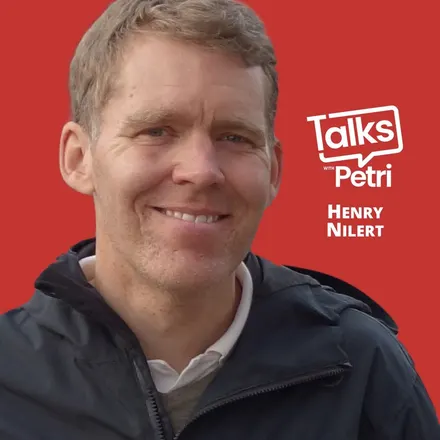
With Henry Nilert
Henry Nilert talks about building startups during market crises and how you survive the volatile times. He also shares his founder stories of building and exiting to large corporates as well as his take on the venture studio business model.
Henry Nilert - TALKS WITH PETRI
Henry Nilert talks about building startups during market crises and how you survive the volatile times. He also shares his founder stories of building and exiting to large corporates as well as his take on the venture studio business model.

Speed and resilience in market downturns
Henry Nilert talks about building startups during market crises and how you survive the volatile times. He also shares his founder stories of building and exiting to large corporates as well as his take on the venture studio business …
Bio
Henry Nilert is a Swedish entrepreneur with a background living and working in France, the US, the United Kingdom and Finland. He has extensive experience building successful startups, as co-founder of iobox, one of the largest early mobile entertainment portals in Europe, and co-founder of Credit24, a leading online lending platform in Finland, the Baltics, and beyond. As advisor and angel investor he has supported a large number of startups, with a focus on B2B SaaS and Fintech.
 Play video
- 2:20 the story of iobox: €230m exit after 18 months from the first round of funding
- high clock speed execution and compressed implementation timeline
- 15:20 technological infrastructure limits your capabilities
- rapid geographical expansion and PR success
- 18:40 three rounds of funding within a year
- 19:40 what to do when the market starts to weaken down
- 22:40 IPO track disappears
- options when selling your company
- 27:00 hiring an investment bank
- 27:20 getting the company ready for the trade sale and the due diligence (DD)
- 28:20 the deal details: different shareholders (options, employees, share classes etc), lock-ups, warranties
- how to keep the deal momentum going
- 30:40 startups are fragile
- 31:20 how to keep the transaction costs under control and close the deal in a few weeks
- 32:20 leverage on negotiations: know what you want
- what happened to Iobox after the acquisition
- timing and technology as a part of the success
- 40:40 the story of Credit24
- a regulatory change allowing new business opportunities
- 43:00 when the founders have no experience in their line of business
- 43:20 online lending business
- rapid market expansion
- listing the company and raising funds
- 48:00 small cap pubic company disadvantages in fundraising
- 48:40 when your share price does not reflect your real value
- when out of industry players have advantages over incumbents
- 52:20 building a company during the credit crisis
- 52:40 switching to a crisis mode with your startup
- when even your shareholders expect your company to fold
- the thin line of having enough business to have a chance to survive
- 58:00 learning the business and becoming resilient via crisis
- 59:00 speed vs. resilience
- 1:00:20 challenges in an unregulated business environment
- 1:00:40 regulatory uncertainty
- 1:02:40 team confidence
- 1:03:20 clock speed as your de-risking method
- 1:09:00 acquisition by a traditional business
- synergies for both parties
- closing the sales with a hard deadline
- 1:13:40 Credit24 lending business after the acquisition
- 1:21:00 selling your company as a listed entity
- coming up with the sales price
- 1:25:40 pros and cons of a venture studio business model
- 1:28:00 an angel perspective on deal flow
- 1:28:20 how to approach an angel investor
- 1:30:40 why your angel investor is not investing in your next round of funding
- 1:38:20 disciplined angel investing
Episode links
Transcriptmachine transcription · 1:48:02
Transcribed from the recording by machine (Whisper): it may contain errors.
0:00 Welcome, everyone. This is Talks with Petri show, and I'm your host, Petri. We have a serial entrepreneur, venture builder, and angel investor, Henry Nilert, with us today. Welcome, Henry. Thank you. Great to be on board. Markets are down. Startup funding is getting harder. Cryptos are in free fall. Russia is still in Ukraine. Finland just announced joining NATO. how do you sleep at night? Interesting question, yeah. I try to keep it in perspective. I've been around for a while. I've been working since 93, 94. And somehow things always sort themselves in the end. Things are good, things are bad. Things are a bit more difficult, things are a bit less difficult.
0:51 It usually works out. Sun comes up in the morning. Yeah, usually. So far, so good. Yeah. Well, let's go a bit back because I think, like I explained, there's a lot of turmoil in the market. But history tends to repeat itself. If it's not directly repeating, it's rhyming, like the saying goes. 2000, you made, you were co-founder of a company which made a 230 million euros exit, but in 18 months. So before we go there, can you explain, you know, the story behind it, what happened, how did you get involved? And then we can go to the details. How can you do that when the stock market is crashing and everybody is like running around and trying to save their startups and firing people and whatnot is happening. So, I/O Box. What is I/O Box? What did it do?
1:50 I/O Box, interesting times. I/O Box was one of the first mobile messaging/content/entertainment platforms. Obviously, the technology wasn't there yet. We didn't have iPhones or Androids or whatever was text message and WAP, which was this very clunky technology at the time. What is WAP for the people who are a bit too young for the WAP? WAP was a way to build very, very, very simple, almost text-based web pages on mobile phones. It was a lighter form before mobile phones could do anything, really. And Eierbox started, I mean, it was started actually by Jari Ovaskeinen.
2:43 And it was a very quick story, at least in the press. But it wasn't that quick after all. I mean, it's 18 months from funding to, or from our first funding to exit. But we had spent at least over two years on the case before that. the business started was Yari who had this was back in 96, 97 when the internet was very new. You had Amazon who had started you had Yahoo that had started. Nokia was growing a lot with the old normal mobile phones that you had at the time. And Yari had the idea of combining that to initially do a website with email.
3:41 iobox was initially the first web-based email. There was no Gmail. There was Yahoo Mail at the time. There was Yahoo Mail, and iobox was one of the very first in Europe to do a similar web-based email, free type of email, and so on. So you didn't actually know that you have an email if you didn't get a text message? Well, you had to go to your computer and check it out. and probably before you had to spend a few minutes dialing up to your internet provider. Anyway, that's... Yeah, these were the brutal times. And it was very slow. But then by chance, we happened upon a piece of software, I can't remember the name of the company, that allowed us, it was initially built for operators, but that allowed us to connect that email to text messaging.
4:33 And that became the foundation for iobox. That suddenly we thought, okay, the internet is happening, the mobile is happening, how can we put these things together? And over time we changed the slogan of iobox to internet on your mobile. Even though the internet back then, and the capacity of the mobile was nothing compared to what you could do today. But that kind of chance occurrence really shifted the company. And then from then on, we built everything around iBox was around the mobile. So it was internet to the mobile. You could get your email to your mobile. It was very rudimentary. You could read the first 160 characters of your email as a text message. You could get, back then, downloadable ringtones and icons.
5:25 It's a big thing. You could download news. You could download weather. You can download stock quotes. We even did agreements where you could start buying things eventually with your mobile. You could buy CDs, again, back when CDs were a thing. So we had a few e-commerce integrations as well and so on. And this was at a time when, you remember, a lot of your listeners won't remember, when the internet was absolutely booming. It came from nothing back in 1994 with the launch of companies like Amazon, Yahoo, The Globe, which was a European startup last minute. All these names that, well, some of them still exist, obviously.
6:23 And it was incredibly fast. And what we were doing here, we were looking, we were sitting in Finland, which at the time was the backwaters. Most of this stuff was happening in the U.S. Some of it was happening in London. Finland was a bit behind at the time. But we thought, you know, why not? And the kind of advantage from a technical recruiting point of view that we had was that Nokia was here and there was already the whole infrastructure around Nokia and the suppliers and so on. So we had access to really good engineers who we could hire and who understood this stuff better than anyone else in the world. So we built this company.
7:15 Yari had started it back in early 2006. I got involved in 2007. Sorry, 96. I'm a decade off here. I got involved in 1997. And then we did our very first fundraising in January 99 with a handful of Finnish and UK-based venture capital funds. we raised 3 million euros for a company that had three people at the time, which was at that time, now it's not such a big deal, at that time was a very big deal for, you know, Finnish venture investing. There was venture investing and so on, but it happened at a much larger scale for companies that were much more mature than, certainly, than we were.
8:08 So this was one of the first in the region where, you know, such an early idea got proper funding. And that was also almost peak of the market. 99, I think, is almost. It's maybe the end of 99, if you look the stock market at the time. That was really like, you know, when they were going still up. Well, yes, it was a peak of the market, but by that time, the market had been going on for quite some time in the U.S. But it was actually the beginning of the market in Finland. It had been going up and so on. But the year before, I think, if I remember right, Sonara and there had been TJ Group and a bunch of other kind of tech and mobile-oriented companies had gone public. And yes, the market had grown and so on.
9:01 But when it comes to, you know, startups, that was close to the peak, but it was also very close to the beginning. the window was very very narrow it was also sorry to interrupt it was also the beginning of the VC industry because there were some VCs before but they started to make some serious investments there's new funds coming in so obviously they have money now so they want to spend it and there was a lot of investment at the time but it was we had SFK which was one VC fund with Equitech which still is around and then we had a UK based fund called Alta Barclay and it was very difficult to find traction because we were way too early for any normal type of investment compared to what they were doing at the time and then we had Miku Yusisuanalati at SFK who was the first guy to say, listen guys, I like what you're doing, I'm in, if you find the other two thirds to run this round. And then we went out and found the other two-thirds and closed the round.
10:17 And that allowed us to move. And at the time, that was a lot of money. And we executed like hell. Yare and I worked really well together. He was CEO of COO, making sure things happened, we managed to find really competent technical team. And most of our hires were very hardcore technology, which in the end was our insurance policy. When it came to selling the company, the strength of the technology that we built, that was really the key. Because that allowed us to sell to the type of company that we sold eventually to Telefonica, an operator, and they needed something that was robust, that was solid, that they could integrate, if they wanted to, into their business.
11:15 But it was a furious pace. The window in Finland was literally from that early 99, we probably couldn't have done it before because the funding would not have been available before because mentally people were not ready for this type of thing in the Nordics. And just to give a bit of context as well, what was happening, this was also when the Nokia was at peak, at least publicity-wise, it was the biggest thing ever, at least coming from Finland. And it was like the moment in everything, internet boom was happening, startups were happening. Peter Vestapakka was having HP Bazaar starting so there was a lot of also international focus on Finland so all it was building up and the excitement in the air that you can build a lot of stuff maybe actually I pulled now just to give you a bit of a sense while I was doing research I was digging out an article and I found Henry was talking and this a direct quote from Cardian article. I can put it in the show episode notes, but just to give an idea that how you can compare yourself, how right he was. This is 20 years back. There was no Gmail, there was no YouTube, there was no Uber, there was basically everything iPhone. There was, well, the music player, I guess, was Apple from Apple coming already at the time, but you know, nothing else was in place. So bear with me, I give directly what Henry was talking 22 years back.
12:56 Looking to the future, you will have a device that is on all the time with unlimited bandwidth with better information and graphics. Further on, it would be nice to have voice recognition as I browse through sites. There will be a little video camera there too. There will be seamless integration between the internet device you have in your home, whether it's a screen or your fridge or your desk, and the thing you have in your pocket and the device you have in your car. It's going to be all the same service receipt in different ways. I may be typing an email to a friend of mine from home, reply when I'm sitting in the car, I may listen to it in the car on the the phone and then reply talking into the phone. So 22 years back, you know, it's hard to, it's obvious now, but nothing is obvious when, when basically, you know, even text messages are like a wonder and, and, you know, the webpage is called, you know, text message, you know, you can scroll in, in WAP.
13:55 So that was a pretty good prediction. And, and, uh, but it, and it's, but it's funny because you, when, when I guess, I don't know what we were thinking back then, but things have come so fast. But when you're doing it, they just seem so slow. So one of the things we were struggling with at iBox was that there was no infrastructure. There was basically text message. There was WAP, but nobody really was using WAP. So we were forced to focus on text message services and so on. And all of these other things that we wanted to happen, they happened fast and were there today. But when you are running a business and you're trying to get things done, they're not happening fast enough for you.
14:48 One of the examples, for example, is payments. There was no way for us to get paid. premium numbers, premium text message numbers and so on, didn't exist at the time. The operators were kind of thinking about it and it was kind of, perhaps we're going to look into it, but it was nowhere close. Yet in Finland, you could buy a can of Coke or have your car washed while paying by mobile. That was sort of the experiments going on, but it was not like that you could use Apple Pay or anything. Exactly. And there was also, when building the company and why you needed quite a lot of money as well, servers, you know, the cloud, you know, AWS didn't exist. So you actually needed to buy these physical boxes and they are in your office and then you need to, you know, wire them to the internet and all this is like, most of the money was spent on employees. We grew from three people to 85, I think when, by the time we sold and then we grew a bit after that. But you know, you had these Sun servers, right? They cost hundreds of thousands of euros and there was no alternative. You had to buy them and finally hosted them with a hosting provider. But still, the cost of technical infrastructure was something completely different. And of course, all the code you had to write by yourself from scratch, you can just kind of plug and play like you can today.
16:12 So what happened at the Red Herring? Red Herring has a financial meaning, but it was actually startup magazine had a lot of, you know, it was the thing to be, and they had a conference as well. Yeah, no, Red Herring was one of the magazines at the time, you know, following everything that's happening in the internet and so on. And they had these conferences all over the world. And I remember us going, I think it must have been early 2000 to the Red Herring conference in London, which was huge. And a lot of hype had been made about the iobox. We were by then already, obviously in Finland, we had expanded to Sweden, Germany, UK. We were looking at other markets as well.
17:00 We had, in terms of users, quite a lot of users using the different services and so on. So there was a lot of hype around. And we were by then looked at as one of those companies that was going to continue to grow and then do an IPO. the whole story that a lot of other startups were pursuing at the time. But it was funny. I was a young guy. I was 28 years old. And it was the first time and probably the last time I felt like a rock star. Because you're there, you're the center of attention. I was doing the main pitch and Q&A and so on. and yeah it was weird to be in that position to have so much attention to have so much excitement around what we had been building for the last few years it was pretty cool it doesn't last and that doesn't build a business it helps with our fundraising but it was a really interesting experience How much money did you raise all together and was it difficult to get the next round We raised 3 million that early 99.
18:23 We did a follow-on round of about 10 or 12 million in late 99. So I think in October. And then we did more like a bridge round, another 10 million just before we sold in the spring of 2000. This reminds me of actually a club. All about 23, 25 million euros. This actually reminds me of Clubhouse, which did two years back. They did like three rounds within a year or so. Okay, yeah. So this is actually explaining quite nicely the compressed timeline as well. Yeah. But it's not so usual to have three rounds of funding within a year or so. No, and you see that more and more. Companies who are going and keep raising within almost a few months of each other, they see the opportunity, which looking now at what's happening in the markets probably has been very smart for those who have been doing it for last, you know, who completed their runs last year.
19:25 There are several companies who kind of made sure that they had enough cash in the bank because it's going to become more difficult. How did you actually get traction? You needed users in order to raise the funds and get to the exit as well. did it happen at the time? Back then we had a lot of interest, kind of innate interest, just because it was such a new space. So you always have the early adopters who came and so on. We had a lot of good PR. We were very well known in Finland and we went to Sweden and Germany. There was a lot of, you know, written about us in the press and so on. But it came down to very traditional marketing. you didn't have all the online marketing possibilities that you have today. So we did outdoor advertising, bus stops and train stations. And I think we did, yes, we did TV, magazine, newspaper advertising, also online. But that market was at its infancy. Google didn't exist.
20:39 Facebook obviously didn't exist, and so on. It's quite traditional and quite expensive. So if you look at, I don't know what our CAC was, I certainly know that our LTV was low, but we were in a different market. Other businesses I've built, we've built proper businesses with revenues and profits. Back then, startups were measured wrongly, probably, on a different metric. What mattered was users. It didn't so much matter how much revenue we had. And we didn't have much revenue because we were basically asking young guys to pay with credit cards because there was no real alternative to getting paid.
21:35 So we focused on users. We gave a lot of service for free. The whole philosophy was that once the payment systems do come in place, we can just plug it in and do that. And several companies who later, for example, focused on ringtones and icons and stuff like that, did that very successfully. But that was a couple of years down the road when payment systems had come, or at least premium SMS and these type of payment systems became available. So now you have three rounds of funding, 2000 starts and in the first quarter, things are starting to blink a bit like yellow light or going to red already. So can you describe what happened? What was your thinking in the company and what did you discuss with the founders and your investors? This was a very interesting time. I mean, we were going gangbusters and we felt the urgency. We had a very motivated team. We were working like dogs to build this company and to build the technology and to get everything done as fast as possible. And I think that was, in the end, our strength, that we managed to get a lot done within this short window that was available to us in hindsight in that market.
22:56 We moved our headquarters from Helsinki to London. That was considered a better place. We were looking at Europe as our main market initially. And we had built a management team there and so on. But then what happened-- and we were full track. We had hired an investment bank. we were preparing for IPO, all this kind of stuff. And then it was March 2000, and in my view, the top of the market was the IPO of lastminute.com, which was, I think, mid-March, something like that. And that was the first of these IPOs, of.com IPOs, which didn't go so well. They traded down, and at that point, I think, everyone in the market set up and went like, aha, there's a shift in the mood.
23:52 And I remember quite soon after that, we sat down with Yari, the founder, and myself. And Yari is a guy who has incredible intuition, really, really good kind of sense for what's happening around and so on. And I remember him saying that and us discussing that, Let's, things have changed. Let's park this thing. Let's change our, let's de-risk it, I think is the thought that we had. And by then we'd already been approached early in the year by several potential buyers, mainly mobile operators who were looking at this. Remember, the mobile operators were bidding for 3G licenses, spending billions and billions of dollars for 3G bandwidth.
24:46 and they were very interested in what we're doing. We had really good technology. We had a lot of users, good services and so on. We decided at that point to shift our investment banks, it was Morgan Stanley's brief from IPO to let's try to sell the company. At which point they started this process of approaching potential buyers, getting bids and so on. And the one we ended up with, the one that was most interested, the one we felt most comfortable with, was Telefonica, which was at the time the state-owned Spanish telco. They had very good operations in Spain. They were very strong in Latin America. And they had spent an enormous amount of money, together with Sonera, actually, on the 3J license in Germany.
25:40 And they were preparing for their IPO. And a big part of their story for their IPO was not only the fast growth in Latin America, but also the mobile internet effort that they were doing. And that's why we were so interesting to them. Because with one acquisition, they had a whole service platform that they could talk about. They had a million of users, more, that we had across several different markets, and that was attractive to them. And compared to the money they were spending on 3G licenses, an acquisition like ours was, you know, reasonable. Yeah, they were spending billions, at least in Finland it was called, like, they were buying hot air.
26:32 It was literally air, which they eventually lost, as I understand, because they were not building out, they didn't build out the network eventually, as they should have according to the license agreement. So they actually lost that spectrum. There was a big lawsuit a decade later and so on. So how do you, when you realize, okay, I need to now do something about the business, sell it, how do you do that? Can you walk us through, and if somebody now is listening and say, okay, I need to actually sell as well, I need to find a buyer, maybe I have already some offers, what do you do? We started a process. I mean, it's internal, external. We had our business and we were continuing to build that. That's the best thing you can do. Because if you take your eye off that ball, then you don't have anything to sell. So that was what we were doing.
27:24 We were continuing to build, building out our services, our technology, expanding the user base and so on. But we started with, and we were large enough, or the deal was large enough that we decided to work with an investment bank. And we started a process with them, both in terms of getting the company ready, all the due diligence, and making sure that we were clean, which I think we were. We had run things quite well. But also soliciting offers, and getting to a point where we had something that we could decide, that it's not like, oh, we'd like to sell, we'd talk to this guy. No, we have, okay, now we have three offers on the table, and they help coordinate that so that we can look at that at the same time, which is a better alternative for us.
28:18 And then we settled on one, which was Telefonica, and then started a very interesting negotiation process because the bankers, they're really good at agreeing in principle deal. They say, okay, here's the price. Great. Everyone's shaked hands. Great. And they pat us on the back and they probably pat themselves a bit on the back and say, deal's done. And we were like, hang on. There's a few details we need to work out. We had different classes of shareholders. We had investors. We had founders, we had employees, we had people with shares, we had people with options. We had all sorts of, you know, these type of detail, which need to be sorted. You cannot kind of shortcut that. So we started, and that, at the end of the day, came down to us to negotiate face-to-face with Telefone. And I was, again, I was young at the time. I had worked in investment banking before, so I had been part of it, but never at the senior level. I've been kind of in the room, but not in charge of it. And suddenly I was there with real money at stake, real money for lots of people at stake, not only ourselves and our investors, but our employees.
29:44 We had been quite generous with options and so on. And we needed to get this deal done. And any deal, especially in the market, the market was collapsing around us. So we knew or we felt that there was an enormous urgency to do something. Because whenever the market is weakening, the risk, of course, is that the buyer either walks away or that the buyer comes back and says, actually, things have changed. We need to change the terms. and they could have probably done that quite significantly. So it was a bit like trench warfare to kind of work through each of these different issues in terms of who would get what. There was things around lockups for founders and key employees, warranties, and who was going to stand behind warranties that we were giving.
30:41 Some money was going to go to investors immediately. Some money was going to come to us and employees immediately. But a bigger chunk was going to be held in escrow with vesting and all these type of details that you need to work out in any acquisition. So it was really interesting, always. All these things are fascinating to me. But it was really stressful as well because there was a lot of stake. and you know how... I've always had a sense when working with my own startups and the startups I work with, it's incredibly fragile. Startups are incredibly fragile organizations until they reach a point where they have a proper business and they're making profits and they can kind of take care of themselves.
31:32 I was always enormously paranoid that what could go wrong? How can we prepare to make sure that we're not blindsided? Are there any issues we haven't thought about? And so on. Do you have any tips how to do the deal fast and maybe make it so that it's also a bit cheaper from the expensive side? Because you have lawyers, you have also investment bankers, and they may have a bit different incentives. Yeah, I think at least our approach or my approach was to keep things close. Let's us stay on top of the details. Let's not hope that some advisor is thinking about it because the clock speed can become much slower and then things can lag, right?
32:20 You can decide something this week or the guy was in a meeting and he didn't get the email and then we're three, four, five next week until we decide and get back to telephoning with this particular question or whatever. I think so speed was really key. And to do that, because we happened to know all the issues and so on, we kept very tight reins over all the different things that needed to happen. The other thing we did, we had a big law firm in the UK who was helping us with the documents and some of the negotiation, but we told that guy two things. Number one, we want you doing the partner working on this. not his associate. And we agreed a fixed price deal. We didn't want him have any incentive to waste time in order to bill ours. We wanted him to be completely aligned with us. We wanted to get this deal done. And we told him that don't mess around with finer technical points or legal points.
33:29 You'll get paid. Don't worry about it. And that is a small thing. I don't think that made all the But these are the small things that help to make sure that things go quickly and that everyone is 100% aligned in getting something done. And we also made it very clear because you have situations where, and it depends on negotiation and the power relationship in the negotiation. At that point, I don't know what Telefonica thought. They knew we, and we certainly let them know that we had other bidders for the company. but those bids in some cases actually had higher headline numbers but had more of a share component as opposed to cash so we were clearly more interested in the Telefonica deal but of course we didn't let them know so we kind of tried to keep them on their toes as well that they knew that they needed to move fast because we had well we had alternatives although they weren't our preferred alternative.
34:36 So I think it's key to keep that tension, I think, to make sure everyone's moving as fast as possible. Did you actually negotiate with other parties at the same time or what was the setup? How do you have a credible threat in the sense that you have to move fast? I think you knew also that Telefonica was heading for the IPO or maybe they already published the date. they had a clear they had a clear deadline we had an internal deadline which was partly our funding running out of money in other ways yes always as well that's every startup at some point but Telefonica knew that as well but they were not using that I'm not sure how much they were focused on that I'm not sure how much they were familiar with that feeling because they were a state-owned traditional business and the guys we were negotiating with had never been through what we had been through. So I don't think they were focused on that.
35:45 But yeah, it was about and we couldn't of course negotiate with the others because once you sign a letter of intent it's exclusive and you can't go and but they knew that we had alternatives. But we kept a very very tight process strict control over everything that went back and forth to make sure that there were no fuck-up. Did you have an appointed person in Telefonica you directly speak? How do you keep it? Yeah, it was basically a group. It was Eliseo, who was the CEO of their unit that were buying us. It was their number two and their lawyer. And so it was a fairly small group that we knew. There was very open lines of communication. That was never a problem.
36:33 The negotiations were hard, but it was always done in a very open way and in a friendly way. So no issues there. Are there any tips? How do you do the negotiations? Is there any takes on this particular case? What do you have learned later on that? Because these are the high stakes. Yeah, I think you need to know what you want. and I think you need to be aware of your issues, what you need to work through. You need to be able to explain those clearly to the opposite side. It's not rocket science, really. And you have to be willing to... It depends on the negotiation, but you have to be willing to take the discomfort. You have to take some risk.
37:23 If there's really something you want, which perhaps under normal circumstances you couldn't get, you have to be willing to bluff a little bit in order to get that through. And I think, in this case, I think that both sides were very much aligned. We wanted to get this deal done. They had their pressures. We had our pressures. And so on. So it wasn't an issue. I had several negotiations later with other startups with Credit 24 when we really had, you know, nothing on our side except effectively a bluff that we had alternatives when we didn't have alternatives.
38:11 So you have to kind of be willing to take the risks. But the best way, obviously, is to have an open discussion, have an open trusting, you know, Anytime we had an issue wasn't because we wanted to be difficult. It was no, because there's this particular person with this particular contract, and we need to find, please, a solution that works for everyone. And in that way, we managed to solve all these things. And it was very intensive. So we did the main negotiations for a period of, it was literally a couple of weeks. So it works, but it requires everyone to be kind of mentally there, focused and willing to communicate. After the deal was done, you stayed a few years in Telefonica, didn't you?
39:00 One year. They were great to work for and so on. The challenge was that the market changed and their strategy changed. So, you know, almost the second they bought their 3G license, the second they've done their IPO, the market changed completely. The sentiment changed completely. and their strategy around mobile internet changed completely as well. So it took them about nine months to realize that we have this asset that they thought they wanted and now they didn't really know what to do with it. So unfortunately, they eventually ended up closing it down I think about a year and a half later, something like that, which happened.
39:50 That was their decision to make. They owned it. By then, we had gotten paid, and our employees had gotten paid. So it was no skin off our nose financially, but of course, it felt difficult because this was a business we had fought to build. This is a business we believed in. We think they could have done a lot with it. But being a big corporate, I think they didn't have ownership of that asset and eventually they just kind of closed it. I think they could have started really good as several other businesses. You had here in Finland, for example, Yipi, Mobile Entertainment, which had a really successful business.
40:40 And in this kind of stuff that we had, you know, mobile text message space, tones, icons, services, news, et cetera, et cetera, they did a great business across Europe with that. If one had gone the same, it probably got even bigger across Latin America. But they didn't. So they closed it down. I left. I looked at a couple of other businesses and then eventually, you know, got involved in another startup, Credit 24. and you move on. But it was a really nice, really interesting story, very intense. And in hindsight, I think we were quite good.
41:29 We were really fast. Of course, we had quite a lot of luck with our timing. But I think we made the most out of that timing. We really executed like Mad Men during that short window that we had. And that allowed us, and we focused on technology. I think most of the team that we built was hardcore, heavy-duty, really great tech guys. And they built a platform that really stood up. At the end of the day, they stood up to do diligence from Telefonica. And that's what allowed us to sell the company. Have you followed the people who were EObox at the time? What have they done before? Is there like there's a PayPal mafia? Is there like EObox mafia?
42:20 It's not as strong perhaps as a PayPal mafia but most of those people have ended up doing great but some of them have started their own companies, some of them have moved to bigger companies yeah there's a connection I'm still in touch with a few of them but yeah it's always like that you work intensely with people and we hired really good quality people and you know they after this story which I think they would most people thought it was a great experience as well after that they've moved on to do other great things as well. So this was in the early 2000s.
43:10 Ancient history by now. Yeah, it is ancient history, but you know, like we started history probably somehow rhymes. Yeah. From crisis to crisis hopping, you know, this really shows how old we are. But then you jumped to a completely different business and you became a founder again. You became really involved in the business again. But this time it was nothing to do with the mobile per se, but it was something which was tough, which was different. And can you explain what Credit24 is and how it started and why it started and what was it all about? Yeah, lending, one of the oldest businesses of the world. I was in London at the time. We moved there with Iobox and then I stayed there.
44:00 And this was during 2006. And one thing had happened which kind of shifted the market. There was a regulatory change in most of the Nordics where before lending could not be done unless you were a bank effectively. And the regulation change, I think it was early 2006, where lending was opened up to non-bank lenders. So shadow banking was now okay? Yeah, well, shadow banking can mean other things as well. But basically lending by normal companies was okay. You didn't have to have a bank license, which obviously before had been a huge barrier to entry.
44:51 And I got involved with some people who were based here, Rami Ryhonen and Rheinsepp in Finland and Estonia. And they had been looking at this for a while. And interestingly enough, none of us had any lending or credit experience. Rhein and Rami were very good at consumer marketing. That was their background. Super good consumer marketeers. So that's one thing we had. But we looked at the lending market and we saw that, you know, if you look at the US or the UK, you know, you have lending for kind of prime people, people with jobs and houses and good salaries and so on. But as you go down the risk level, if you look at the US and UK, there are lenders at every level of risk.
45:46 So even if you're a so-called subprime borrower, you have alternatives to lending at different interest rates and so on. And when we looked at the Nordic market and the Nordic and Baltic market, there was a different structure. There was lending at the prime level, but then it just stopped. There was no supply below prime, effectively, or what's considered prime. So that was a really interesting opportunity. And as the legislation changed, it opened things up, and it led to a huge number of new companies entering the market. They were all the text message, the VP, the text message lenders. We never felt comfortable with that approach.
46:38 we felt that was too loose to lend based on an ID number only. So we never entered that market. We went into online lending. And to do it online allowed us to gather more information and to have a process which was a bit more rigorous. And it also allowed us to gather better information, but also allowed us to have a product offering in terms of loans, which was wider than, you know, 100 euros for a month. So we, from the start, had, you know, a bit larger loans, much more reasonable repayment periods up to two years, and so on. But we entered the market, we entered, we started in Estonia, and after the summer of 2006, we opened up then Finland, in late 2006, and then we went into Latvia and Lithuania early 2007.
47:46 And at the same time, we did an IPO with a company. So that is, you know, we're keeping a bit busy the conference timeline again. And the reason we did that was that the London AIM market was very hot at the time. It was a very good place to raise money, even for very, very early stage companies. So there was an opportunity that was open to us. So we went for it. And we raised a decent amount of money that way at a good valuation and so on. It caused us a bit of hassle later because being public is difficult. When you're a small cap public company, it's difficult when the markets are weak. And as I think a lot of companies that are in public here will realize as their share price comes down.
48:41 And the problem is that it anchors your valuation. Even though you have no float in your stock price, no one's trading it. Some guy in his home office is buying 100 shares for 500 pounds. it still marks a price, even though it has nothing to do with your value. And it makes funding discussions very difficult. If you want to then raise money from a VC or someone privately, they will look at your price, even though that price is not real. It's not the result of a liquid market. So it causes some hassle in funding later on. But at the time, it was very interesting.
49:29 But that was also a business where we moved incredibly fast. We launched four markets in the space of literally six, eight months. So Estonia, Finland, Latvia, Lithuania did an IPO. Again, recruited a great team in technology, in customer care, very heavy focus on marketing. And this is, as you've seen, living in Estonia, it was an industry which became incredibly competitive with a lot of different participants doing very heavy advertising in all the markets where we were present. But it was super interesting.
50:16 And what was interesting was normally now when I'm, as an angel investor, I look at startup founders and so on. I always want them to have a particular edge, a domain expertise. Usually the successful founders are familiar with their faith. In this case, we weren't. We had never done lending. I remember a very early meeting we had and we were playing around with a financial model could look and stuff. And, you know, it took us a while to figure out basic, basic things like, oh, you had to, ah, interest, you had to accrue it over time. You couldn't book it all. You couldn't book it all as a profit on day one. Ah, okay, that's interesting. There are fundamental things like that, which we had to learn. But on the other hand, I think, so perhaps this was an exception that in this case, the type of lending we did was so fundamentally different from the traditional lending that the banks were doing through mortgages, loans, credit cards, and so on, that had we had too much traditional credit experience, I don't think we would have been able to put our mind around the type of lending we were doing.
51:37 This very quick scorecard base lending that was really kind of statistically driven as opposed to based on an interview and sitting down and getting to know the customer and so on. I think it would have been very difficult to get our heads around that. So in this case, and I think it's quite rare, we benefited from not having domain experience. What we did had It was a really great marketing experience, and that helped us a lot. Because fundamentally, it's a consumer business, you need to get people through the door. But then you need to be able to manage the process in a very efficient way, and know that you are making good lending decisions, and also that you have a profitable business.
52:29 And we managed to do that to some extent. At least, we managed to do that to some extent initially. And if I continue the story that we built this, so we're talking 2006, 2007, we were growing a lot during 2008. And as you remember, 2008 is when things started to get very shaky in the US. Credit crisis. And the credit crisis and so on. And of course, we were following this story like Hawks. It started in the US and it slowly kind of, you know, made its way across to Europe. Here again, US leaving and then Europe coming a bit later. It seems to be a trend. And we're seeing the same thing today. But we were looking at this.
53:18 And we were growing fast in our four markets. We hadn't launched Australia yet then. We hadn't launched some of the other markets. But things, and we were looking very carefully at the credit performance. And we had built a system where we could really early see, early warning, within a month, we could see if there was a deterioration in the loan book. So we could adjust our lending policies quite quickly if we were starting to see that things were going south. And we're, of course, following the economic news and unemployment rates and so on. And still, through 2008, the big crisis was in September 2008 when Lehman went bust and all hell went loose. but still our markets felt quite solid.
54:07 There was full unemployment. I mean, I think unemployment rate in the Baltics was 3% and Finland was a bit higher, but still very, very strong levels of unemployment. Into late 2008, it felt fine. Early 2009, it still felt fine here. But then, literally the floor fell out of the market. And it happened very suddenly. and we were of course very involved with this because we were lending we were dealing with lots of consumers across these different markets tens of thousands of people taking loans every month and many more who had loans outstanding and so on and I believe it was March 2009 where it really felt almost like a physical wow, something now has changed It was like someone took the water tap and just put it shut overnight.
55:10 And as you remember, unemployment went from effectively full employment in the Baltics to 20-25%. It was dramatic over a period of six months. It was very hard. And we could see, of course, being in the lending business, the impact that had on people's ability to pay and on cash flow. The hardest was in Latvia. and we could see that and I think if you look at the economic situation, economic statistics, it shows the same. Finland was the least hit or the most mildly hit. Estonia and Lithuania were somewhere there. And then we had a very interesting situation. We had, at that time, we had, I can't remember, but we had 60, 70 employees. We had lots of customers, a big loan book, outstanding, large outstanding bank loan with one of the regional banks, and a severely deteriorating loan book. And we had already kind of started to tighten, even before we saw the difference of poor performance but then we really had to slam on the brakes and we had and for some time it looked and the whole story of Credit 24, the 10 years we were working that, we should have died four, five, six times we've had a lot of different stories but this was probably the most critical and we had a lot of pressure also the picture had a lot of pressure from our shareholders who felt that let's just collect the book and close shop and go home basically. But we looked at this. We sat down with Ramein Rein and we looked at our models and we felt that there was a tiny window we could navigate. Because the problem is if you cut too much, you never recover. You don't have the volume of business or the people to come back out the other side.
57:18 If you don't cut enough, we run out of cash. But we played with the Excels daily, literally, and we felt that, okay, there's just one quite narrow passage that we perhaps could sail through and take this business out the other side. And it took a few months. We never needed to raise additional funding. We never broke our bank covenants. But we went from being an okay lender in a good market, which obviously wasn't good enough in a bad market, but we completely changed our approach. We completely changed our scorecards. We learned a lot.
58:06 And over time, I would say a period of six months, we became a really good lender also in a bad market. So first you thought that you were a good lender in a good market, but then you actually realized that you were not in a bad market. So it was just basically a market floating. And I think this happens to a lot of businesses, right? That things are going great, sun is shining, yeah, it's easy. When you realize if you're good enough or not is when things get hard. And that actually, incidentally, I think the credit crisis saved our business. We actually became at that point competent at what we were doing. We weren't really before. And that was cool. I mean, that was really good experience. We could see it in the numbers. The team could see it in the numbers. We were really excited by this. And it gave us a lot of resilience to kind of keep fighting.
58:59 We had lots of ups and downs after that as well. And I think we always kind of, as a business, look back and say, well, if we can survive that, what are we crying about now? so we kind of rebuilt the business up rebuilt the volumes I mean if you look at the charts the volumes were high they went almost super low and then we gradually kind of built back up during late 2008, 2009 and several years ahead so it was a super interesting business in that sense but it's one again I think where ibox was built on pure speed. I think Credit 24 was built more on resilience. We never, and luckily we had a team and we could support each other when one of us was feeling down that the other one could give some encouragement and vice versa.
1:00:02 But we really became resilient. And it served us a few times later because it was a very competitive business which had a lot of pressure, both from competition and so on, purely operational and technical challenges, but also regulation became a very meaningful and interesting part of the equation as we continued to build the business because when we started, it was effectively a not-regulated business, which was bad. Any business like that should be regulated. But it was completely Wild West at the beginning, which we didn't like because the challenge you have in an unregulated market is that almost if you want to have a business, you have to go down to the lowest common denominator.
1:00:59 If my competitor has a form with three questions, but I would like to ask 30 questions, I can't because customers will not spend the time. If there's a minimum regulation which forces everyone to do a certain amount of checks, then we're all more on an even playing field. And that became an interesting dynamic as regulation came in in all the Baltic states. Sometimes it made it harder to do business. But most of the times for us, because we were large enough and we could kind of handle the requirements and we were willing to handle the requirements, it actually became easier because it cleared out some of the competition which was more ruthless in their lack of best practice when it comes to lending.
1:02:04 But we had situations where regulation changed so much overnight that I remember, for example, Lithuania was, during most of, actually most of the time that we had Credit 24, Lithuania was our largest market. But we had at least two occasions when because, well, first of the credit crisis and then because of regulation, our volumes went from something to almost nothing. And we had to rebuild the business from scratch. Things changed so much. I can't remember what it was, but it was one regulatory change where things changed so much it just messed up all of our models that we basically had to build up the business from scratch again. But we managed to do it.
1:02:54 And we did that in different markets several times. And after a while as a company we started to realize, okay, we've done this. Now, this market, that market, you know, things go to hell, fine. Okay, let's get our head down. Let's continue. And we rebuild. So you're basically had like a playbook, you know, how to build a market and you already have the risk models and, you know, sort of, you know, the ins and outs how to operate. Kind of a playbook, but also the team confidence that we could do this because we've done it before. And the process, we literally sat down and particularly Rami, the CEO, with the market team, they literally sat down every day and went through the previous day's numbers in terms of what's happened, where were we marketing, where are the volumes coming in, what was working, what wasn't working, how do we adjust, how do we adjust, how do we adjust.
1:03:57 And I think it's that clock speed that I look a lot at when I look today at angel investing and at companies. How do they move? do you have the right clock speed internally to get things done, right? Or are we sitting there saying, oh, we should look at this. Okay, let me look at the calendar. Let's meet Friday next week. And it's like, no, let's talk this afternoon and solve it then, implement it tomorrow. So I think that's the speed at which you can get things done in a startup. The runway is always so short. The money is always insufficient. What you can do to compensate is speed. And I think that's incredibly important. It's an incredibly important tool to de-risk your business. Because the more you can get done, obviously, in a shorter period of time using less money, the less risk you're going to have.
1:04:54 And also, the less the market is going to have a chance to change next to you, whether it's going to collapse or whether competitors are coming in or whatever it is. speed is absolutely critical. And then you're actually adjusting daily and not like weekly or monthly because you're iterating all the time and you're not just doing it in the bad market, bad situation, you're doing it every time, every day. Yeah, yeah, I think it has to be. And yeah, I think that that concept of clock speed is super important for people to remember. And if you look at the big successful, you know, startups around, whether they're here or internationally, they all have the same. They don't sit around. They go for it 100%, 200% every day. There's no choice if you want to be successful in a competitive and changing market.
1:05:50 I think that there's no way around it. And I see some startups that don't quite understand that. And it's an important lesson to remember. And yes, definitely also in good times. I see it was very interesting, for example, during COVID. I think COVID was a wake-up call for a lot of people because it was so dramatic. And I suddenly saw a lot of startups making decisions very quickly, very fast, which they wouldn't have done before. but which they probably should have done all the time. Really brutal.
1:06:37 Things that have been lingering. Like, do we really need these people? Do we really have the right people? Should we really be doing this activity or that activity? In this very crisis moment of COVID, all those concerns go away because you're focused on the essential, which is surviving a very, very deep crisis. And I think that helped a lot of startups in COVID, but the problem is that that mentality, that thinking should be there all the time because there is no wiggle room. The resources are so ridiculously small for most startups, I would say for all startups, even if you've done a 50 million euro run.
1:07:28 It's so ridiculously small that you don't have room for much fat. Can you teach that to the founders who don't have that inherently there, or is it just better as an Asian university to choose some other companies? You can teach it to some extent, but of course people need to be open to listening. and this is just life, right? Unless it's happened to you yourself before. It's very tough. Of course, I've had people tell me, tough, you know, until they turn blue probably before and, you know, I don't yeah, yeah, whatever, fine, I get it. But you don't really get it.
1:08:17 Until the COVID hits or something else happens, it's like, hey, what did you say about this thing? Exactly, right. Unfortunately, many times you just have to yourself. But of course, it helps to listen and it helps to look at the experience of others. Yeah. There's a lot of stuff that has happened before. Yeah. He said many years back that only the paranoid survive. So I think that sort of mentality is still there, what you need. Closing the Credit 24 story, not credit, a credit line. What's still going on? Yeah, absolutely. So Credit24 was doing great. We had by then five countries. We'd open Australia as well. It's a different story. But it was a very attractive market for this type of lending, and we had some connections there.
1:09:10 We were then approached by several companies, but one in particular called International Personal Finance. And this is a very interesting typical story that you see with the traditional media companies in the region and globally where they had a very traditional business. They were doing doorstep lending. So they had 30,000 agents across Eastern Europe and Mexico making cash loans and doing weekly cash collection. So you mean that they're like a vacuum cleaner salesman, like salesperson knocking on their doors? And would you like to have a credit? But for loans, and this is a very traditional way to do it. International Persuade did it very well in a very ethical way. Almost all of their agents were women who were lending money to people who otherwise couldn't get access to credit in those markets.
1:10:06 Huge business. But they were feeling the squeeze from online suddenly. Their biggest business was in Poland. They were in Hungary and Czech and Slovakia and Romania, Mexico. And they were starting to feel the squeeze from the online business. They did not know online. They were still a very much paper-based, massively hierarchical business. They had really good cash flow. They had really good lines of credit. This is like amidst the 2010s. This we're talking now 2014 when they initially approached us. We at the other side were very good at lending, but we didn't have the best access to credit.
1:10:53 We had good access to credit. We had issued bonds on the stock on stock exchange and were raising money for the loan book that way, but it was too expensive really to be very competitive long-term, and we felt this. And they approached us and we agreed a sale. Again, that's a sale that was because of the particularities of the stock market that had to happen really quickly. They literally, given by the regulator, the UK regulator, gave them a month to kind of do a deal or, you know, go away. So again, furiously executing that one, but it worked really well. They were prepared, we were prepared, you know, with online data rooms and all this kind of stuff. But it was interesting, you know, they were such a traditional business.
1:11:48 We had to, for example, when we went through tech due diligence, we had to convince them that it was okay to host things in the cloud. For that, them and how it worked with data privacy and all this kind of stuff, it's something they had to get their heads around because they'd never, you know, done that. but eventually we closed the deal and they were very good acquired, they had definitely read the book on how to acquire a business and the reason they acquired a business was just this, they had their traditional business gradually under pressure and they wanted to move to digital in the same way that you know, Fanon, Bonnier and all these other guys in the region have moved from traditional newspapers to digital services.
1:12:39 And they were trying to do the same in lending. And they had definitely read the book that they gave us a lot of autonomy. They gave us a lot of resources, but at the same time a lot of autonomy to execute. So with their support, we managed to grow significantly the business and the core business in the Baltics and Finland. We opened Poland, and by then I had shifted to new markets. I opened Spain. I opened Mexico for them. and they're doing great today. They really continued to work. I'm still in touch with some of my ex-colleagues there. So that has been a really, really good, it was a decent exit for us. I think if we had waited a bit, it would have been even better, but at the time it was an okay decision. A very good acquisition for them and the business has thrived.
1:13:29 It's now called IPF Digital and it has thrived. and still going quite strong today. So that was a good ending. And in this case, unlike the Telefonica story, they've definitely used and continued to build on the business that we had built, which is the way it should work. You hinted earlier on that there was this regulatory deadline that they needed to close the deal. But then you said that you didn't actually have anyone else, you know, any other acquirer at that point. So you needed to sort of fake it. How did you manage to negotiate and keep it sort of the leverage on your side and make it a good deal? No, that actually was not, in that situation, we had another bidder earlier who had backed away.
1:14:28 And but in that situation, no, I think it was kind of, it was an agreed, we quite quickly came to an agreed price. And because the regulator, there had been companies sniffing around us for a while. And the pressure you get in being an elicit company, according to the rules, is that at some point, this becomes material information that you should disclose. And we were, of course, very in close contact with the UK regulator, stock exchange regulator, to make sure that we were following the rules and so on. But when finally these guys came with an offer, they decided that, you know, fine, you can keep it. You don't need to disclose it, but we give you a very tight deadline to get it done.
1:15:19 So by that time, actually, in this situation, we were quite aligned, actually. They wanted to do the deal. The price had been agreed, had been communicated to the regulator as well. So there was very little wiggle room for anyone to play games. And it was a situation where the regulator had told them you either do a deal now or you have to walk away for at least a year plus. And so on. I've had other negotiations, For example, with our banks at the time where it was very difficult for us to find funding for the loan book with Credit 24. And until we started tapping the bond markets, we had a relationship with a local bank. I'm not going to mention who, but a really good, solid bank in the region.
1:16:13 But the challenge we had was that was a credit line secured against our book, our loan book. But it renewed every year. every year we had to rewrite the agreements and it so happened it was in January every year. So, you know, Christmas was always a nightmare. Yeah, happy holidays. Exactly. And every time, and we went through several cycles of this while that relationship lasted and we never really had good alternatives. And every year they tried to squeeze us a little bit more on the terms and so on. and it became quite challenging because we really didn't, you know, it's one of these things, you know, if you have a big credit line and if you can't renew it, you have to pay it back.
1:17:02 It's a bullet loan, isn't it? It's a bullet loan. It becomes a bullet loan. So it's, you know, you have to renew it. So there are enormous leverage on this side and, you know, the timing is not the best. The challenge for us was how do you negotiate with nothing in your bag, literally nothing in your bag. And clearly, we were a very good customer to them. We never broke any covenants. We paid good interest. We always, I made sure I was CFO and COO at Credit 24. So I was in charge of these things and I made sure that we treated them like gold-plated platinum customer. Anything they wanted, we were always there responding to them and so on. And they appreciated that. We were a good business for them. So I think we had that going for us.
1:17:51 They didn't want to break the relationship, but at the same time, we had no alternative. So every time we came to this yearly credit renewal, it became very interesting. How do you negotiate and pretend that you're playing tough when actually you don't feel so tough at that moment? So you can still feel the moments, thinking back to go to those meetings? Oh, I still have PTSD from that. And that was actually interesting when we sold the company to IPF. I actually remember we had done the deal. It was signed. There was nothing, even World War couldn't have kind of broken that deal at that point.
1:18:40 And it was just before Christmas. And I remember it wasn't a very good Christmas. I was sick. The whole family was sick. We all came down with the flu. But I was so happy. It was the first Christmas in I don't know how many years where I knew I didn't have a funding crisis waiting for me right after the holidays. So in that sense, it was really great. It was really a pleasure to work for the buyer for a time because finally we could do everything we wanted to do without any funding limitations, we actually could just execute the business. And working for them, expanding the business we had, opening Poland, Spain, Mexico, that was really fun.
1:19:28 But after a year, I figured I'm not a corporate guy anymore. So I decided to leave and move on to what I'm doing now, which is angel investing. Before going into the angel investing and venture building, just the final question. How did you come up with the prices when it was IObox in this case? How do you pull a number? And then in this other case, like you mentioned that because you publicly listed, there's always somebody from the basement trading a few stocks and maybe if it's not even liquid, then you have already a number. And these are completely different. You always have a number in one case and the other case, it's like, okay, what's the proper valuation? You have a number. At the end of the day, life is life and you deal with the numbers that you have. So there's not much wiggle room. The offers that came in for iBox were all within the ballpark of where, I think, I can't remember exactly, but perhaps Telefonica came in with a little bit lower and we increased it a little bit.
1:20:43 We could see that it was a good number. So you already get them basically from the offers, you didn't sort of need to do it yourself. Obviously, you have some kind of idea from yourself, but it was more like it was given to you. I'm sure, and I wasn't part of those negotiations, but I'm sure there was discussion between our bankers, August Stanley and Tidif Wuniga about, you know, and I'm sure, yes, we probably indicated, oh, you need to be at least that, you know, 200 or whatever, some number that, you know, in order to set the base. So there's some negotiation there. In Credit 24's case, we had a listed stock price, so it was very difficult to get away from that. So I think that's something that all these companies that have recently listed on North these regional markets should keep in mind that that has a risk of becoming a drag on their valuations because you have a public record and it's very difficult for an acquirer or funding to go to their board and say, hey, we have this great deal but we're going to pay 100% more than what it says on the stock price.
1:21:51 It's mentally challenging. So I think in Credit 24's price It was a premium to that number, but that became the anchor. Eventually, it was okay, but clearly, you would always want more, but I'm not complaining. So, after the exit, you started to do serious angel investing. You've been doing at least plus 30 deals in less than 10 years now. some seven, eight years going strong. You also build, you call it venture studio. You were building your own startups at the time. You were also having a team in Ukraine. Can you tell what you, before going to the angel investing, and I think there's a nice angle we can talk about, you know, how does it look from the angel's perspective when you're selecting and, you know, looking for different companies so that the entrepreneurs can, you know, learn from that side.
1:22:52 but what is venture building and what did you learn from that experience? We had, so right after I left Credit 24, wanted to do something different. I got to know two guys, Nico and Juho, Nico Porca and Juho, who had this idea of... And we had a bunch of different businesses we thought could be interesting to do. And we're thinking, okay, how can we get that done and so on. And they had some connections in Ukraine, in VEV, in Western Ukraine. And we kind of started to look at how can we ourselves fund and grow some of these business. So we launched a few.
1:23:45 There was a company called Meshly. It was a company called Shoot, which is a video app. It was a company called Future Dialogue that we kind of built using resources that we hired in this office in Ukraine. Great guys, fantastic talent over there. And I've always enjoyed, very easy to work with and straightforward. And we built them. And it's the case with these type of startups that they're easy to launch. they're usually quite easy to fund initially. But, you know, as they say, the rubber hits the road a bit further in when things get tough and so on. And that's where, you know, having the right team becomes super important. And what you realize is, at least we found, and other people have perhaps managed to do this better than us, but a venture studio, when you're kind of building your own concepts, You can't run all of them, so you have to hire people or find people who come in as co-founders.
1:24:52 But it's always different when it's not their idea. They come in, they get excited, of course, they do a lot of work, very competent and so on. But things inevitably get tough. You run out of money, the initial product doesn't work, you have to pivot, etc., etc. And at that point, the difference between a founder who is fully invested, has lived with their idea, versus someone who's come in is very, very different. And we found it to be difficult not only to have the right commitment from people, but also to get those companies funded. because since the Venture Studio started the business, they usually have most of the ownership, and that doesn't work with VC or later stage investors.
1:25:48 They want to see naturally, and I'm very much more this now as an angel investor, they want to see that the founders and the core team own most of the company. And that's very difficult to do in a Venture Studio environment. So at least in our case, you have a few exceptions like Rocket Internet in Germany and so on, where they've taken massive resources to duplicate businesses that existed in the U.S. and done so very successfully. But I found that the Venture Studio model, at least for us, was very difficult to sustain. Interesting way to kind of test different ideas and so on, but difficult to, you get the wrong structure from the start, both in terms of team and cat table, and that ends up biting you when you get, you know, when the business moves on.
1:26:48 So I decided that got converted, so that Venture Studio, same work and same people, Nikun Yuhor and Nadia, our manager in Ukraine, are still involved. It's more of a talent acquisition group now called Talent Byte. They help companies recruit, both recruit remote workers in Ukraine and also relocate workers to Europe. more difficult now because people, at least men of a certain age, can't move out of Ukraine at the moment. But TalentBite is definitely still alive and kicking, and people need resources. They're great resources for really high-quality developers. But personally, I moved on to angel investing, which I find fascinating because you meet up with so many great founders, there's so many good ideas out there and I think I've been able to get involved with a lot of business, as you said, a bit over 30 so far so I'm quite active in that.
1:28:09 How do you find the good deals? Is it like they are ding-donging in your inbox all the time and it's like, wow this morning, this could be a good opportunity or where do they come and And what is the best way to find them? This is now the angel investor's perspective, which is completely different from the entrepreneur's perspective, because obviously, if you understand how the angels are picking the good deals and finding them, that probably helps you if you have a really good deal, but you don't know too many people because you just are from different places or you're just young and you don't just have the network yet, but you know that this is a perfect deal for Henry, for example. What's the best way to get to you? Different ways. I mean, when I started, I was completely new. I've been so focused on Credit 24 for 10 years that I didn't know anything else.
1:29:01 I could tell you everything about lending and how to manage, market, make, and collect a consumer loan, but I didn't know much else. So I started kind of by expanding my network. I joined the local Fiban, which is a great angel network here in Finland. I got to know angels in Estonia and Norway as well, where I've done several deals. So it's kind of networking initially and so on. And a lot of the deal flow comes from that. You get to know people, they hear, they understand what you are interested in and so on. Obviously, the different conferences, Shark Week 15, Latitude.
1:29:52 These I've always found very useful as well because they might not lead to deals, but they lead to connections that lead to deals at some point. So it's really just become known in the market. Of course, LinkedIn and this type of profile helps. But most of my investments, I think, have come. one way or another through people I know. I work very closely with other angel investors. Over the last few years, I've worked particularly closely with two angel investors, Ali Omar and Pekka Ulitalo. We work quite closely and look at deals together and so on. And that's a very interesting dynamic because we're quite different as people.
1:30:40 We have different insights and that allows us to analyze deals quicker and kind of get good feedback. And it also allows us to work together and to do a bit larger angel investments together. So from a founder point of view, we can come with, instead of coming with tiny tickets, we can come with a proper funding round and help also organize the rest of the funding round if needed. So that dynamic I find very interesting to work with, and we work with other angel investors as well. So really I think it's network, right? You have a lot more chance me getting interested in a deal if it comes through someone.
1:31:34 You have a lot more chance me getting interested if we happen to met personally. The value of that is so big compared to a cold email coming in. I don't know you from Adam. It might be the best idea in the world, and it's my loss if I miss it, but it's tough to focus on it. You see a lot of deal flow, and as an investor, you have to quite quickly try to make a determination. okay, is this something that should be on the top of my list? And the time you have to make that is very limited, and it really comes down to probably too much. It should be probably more objective, but it comes down to feeling, is this something that makes sense to me?
1:32:31 Are these founders, do they seem professional, solid, do they have domain expertise, which I didn't have when I did my previous startups, but I definitely look for today because I see the difference it makes. Have they managed to get something done? There might be startups I frankly don't understand, but they have traction. Someone thinks this is important. and that might warrant more investment on my side to get my head around it and very importantly have they been able to move things forward I think that's critical it's back to what we were talking about before about speed is this team able to move things forward or are they pretty much where they were six months ago and not showing an ability to move the ball.
1:33:33 I think that some of these things come in in terms of trying to decide which cases to focus on or not. It's the same logic going also for the next rounds. You're already in and you like the startup and obviously you believe on them because you invested, but now they need a next round of funding. Maybe they're going for VCs, getting a bigger one, and they obviously knock it on your door first and asking that, you know, are you pitching in? Are you doing a pro rata? Can you help us? What happens there? You know, oftentimes it may come a surprise that you say, no, no, I'm not actually, you know, supporting anymore. I'm not putting more money in. Why is that? And can you elaborate a bit of that? It's very difficult. And you want to, and we spend a lot of time on this, right?
1:34:23 With the startups that I work with that, you know, what's the plan? What do we think we need to achieve? So when we get in, first investment, right? What's the plan? With this money that we're now raising, it gives us a runway of 12 months, 18 months, whatever. Everyone wishes it was longer. It's usually, it's always too short. But that's life. But what do we need to achieve in order to prove? Because startups, it's two things, right? It's a learning organization, right? The job of a startup is to learn how to do your business. And secondly, to get enough data that you can prove to others that you can do your business. And we spend a lot of time on this when we first get involved in terms of planning. So in an ideal scenario, or worst case scenario, better case scenario, whatever, what do we try to achieve by the next round, if that's what we're talking about, right?
1:35:24 Ideally, you would not have to do the next round and become profitable and so on. Unfortunately, at least in the type of case I look at and the stage they're at, they usually need more time before it's reasonable to start thinking about running profitably. So that's usually what it is. And is it that the product needs to be built, that there needs to be proof of concept with at least a certain number of clients, it could be at that kind of early stage, right? You need to prove that you, from our discussion we're having now, where we are today, you need to go from this great idea to being able to prove that you can go in the market and get some customers. There needs to be many, some customers.
1:36:11 Others might be a bit more advanced. And they're already in the market, they already have lots of customers, but you need to be able to prove that you can go beyond your current niche. If you finish startup, unfortunately, often they start in Finland. Okay, you have a good traction in Finland. You need to prove in order to have any chance of really scaling your business meaningfully that you can do another market. That becomes the goal, right? So how do we do that? What changes do we need to do to your product? How do we need to adapt it to that market? How do we approach that market? How do we market? We need to prove that we have something that's replicable. In the same way we had to do it for Credit 24, that every market, we eventually developed a playbook that we could quite predictably, actually, say that, okay, here's a market.
1:37:05 It has these characteristics. Therefore, we need to operate in this certain way. And then we could, over time, show that there was a J-curve for each market, that, yes, when we open shop here, we take losses this way, And usually within X months, we break a profit and it goes from there. And that became quite predictable in Credit 24. And that's helped, of course, our discussions with investors and eventually when we solve them and so on. And I think startups need to do the same way. So I think that's the key to understand what you need to deliver and to have a very focused plan. Because I always say, like, running a startup is like drinking one of these McDonald's milkshakes through a straw. There's a lot to do, but only very little comes through.
1:38:00 So you have to be very careful about those sips that you take. You don't have many moves to make. And you have to be very careful about those moves. So that's the bottom line. And then to your question about, you know, when do I participate? And you have two main different scenarios, right? Things go well, things don't go well. When things don't go well, there's enormous pressure from the existing shareholders to put more money, to buy more time, because they're only invested, they have money to lose, and so on. And it's obviously more difficult to get in new shareholders, And those new shareholders or new investors look even more at, okay, what are the current guys doing? And it becomes an interesting discussion.
1:38:53 But as an angel investor, you have to be quite disciplined. This angel investing, I do it because I'm interested in the startups and the founders. And that's why I do it. But it's also a financial game. And it is an investment of money. and that investment needs to have a certain return. And there's quite wide literature behind this in terms of you have to be very disciplined. You have to have diversification. You can't put all your eggs in a few baskets because companies do fail. And it's inevitable. And you do rely on those handful of companies that actually do make it for the most part of your investment returns.
1:39:50 So you have to be diversified, which means you can't keep writing checks to a company that's not performing. It just doesn't work. However much you like the guys and so on, you have to keep that discipline. And it's also an objective thing for me that if I had one company where I was so invested that I couldn't sleep at night or I was too worried, then I can't objectively advise the founder. There might be things that I tell them to do that, frankly, it's not really in my interest. But it's best for the company, best for the founder. In one case, I even told, move on. It's not going to work. And fine, take a hit, but that was the right decision for that founder.
1:40:40 So you have to kind of, it's the balance between this passion and wanting to support and the discipline of running an investment portfolio, which, you know, my book at least, needs to perform, needs to have a certain return. That return needs to be better than other less risky investments on the aggregate. And in order to do that, you have to, of course, try to find good companies with good founders that have a high chance of success. You have to be disciplined in terms of how you invest in them. You have to be diversified. You have to be disciplined in how you follow. And you also have to be disciplined in terms of, for example, the valuations. I see too many, unfortunately, great businesses.
1:41:32 I'd love to invest, but I just feel the valuation is too high. And therefore, the potential return is not there. And therefore, it doesn't make sense for me to participate. Then you have the other cases, the good cases. And there, of course, it's a nicer situation. First of all, you have other investors who want to participate. So there's less pressure on current shareholders to invest. But then, of course, you want to. You want to follow your winners to a certain point. because at some point, and I've definitely followed where it makes sense, but at some point the valuation in some good scenarios becomes so high that you start thinking, well hold on, I already have a stake, I came in very early, I already have a certain stake. Me participating here, although I think it's a really good case, doesn't move the needle so much anymore because I'd get a point whatever percent more.
1:42:33 I'd rather than spend that money down on a newer, earlier stage case where again, the upside is potentially, always potentially higher. So it's really interesting. I love doing this. I love talking to founders. I love helping them solve their issues. And there's a human element to it, there's a business element to it, there's a financial element to it, which I find really interesting. What is your favorite word? Ah, difficult. I would say, I don't know, it sounds cliche, opportunity.
1:43:30 What is your least favorite word? Probably something along the lines that, you know, I can't. I don't know. And my answer to that is usually no. Figure it out. What turns you on creatively, spiritually or emotionally? Of course, I mean, family and working with my kids and doing stuff with them and seeing them on the professional side, I think it's working with people that are fun to work with, that have the energy, that have a positive attitude, that want to do stuff. What does you offer?
1:44:25 Excuses. complaints. I'm not interested. Whining. It's, you know, let's find a solution. I'll help you find a solution, but let's not complain about it. What is your favorite curse word? Probably Finnish. Perke. It's like very strong. My Finnish is horrible, but that one is a good one. We don't have the time to go, but I just want to mention that you were born in New York. You are Swede, born in New York, you were raised up in France, and now you live in Finland. So there was a lot of curse words to pick up. Yeah, I've never lived in Sweden, actually. It's funny. My passport is Swedish, yeah. But sound or noise do you love?
1:45:15 I don't know. It's probably a good song, but I couldn't give a specific one for now. What sound or noise do you hate? Same theme, loud music when you don't want it. Background music. Yeah, drives me up the wall. What profession, other than your own, would you like to attempt? Probably carpenter. it's um you know you spend your days looking at computers and numbers and stuff and carpenting you know it feels very liberating you build stuff you see the results every day little carpenting I've done which is much it's very satisfying what profession would you not like to do? Probably auditing. Nothing wrong with auditors, but it's checking someone else's work.
1:46:18 I think that gets a bit old pretty fast. Sounds like you've been doing too many DDs. Yeah. If you could be a co-founder of any startup in any era, which one would you choose? I would join the Wright brothers. they had a bicycle shop the air flight was a big deal back then and they were trying to solve I think if I remember right they were trying to solve the wings, lift power and control and the one thing they did differently is they focused on control, they decided to figure out how to control first before power did all these experiments with the gliders and stuff like that. That must have been fun.
1:47:12 Yeah. They were really like a startup if I remember correctly. They were also the underdog. Nobody believed on them. They came out of the blue and there was other competitors, so to speak, who had a lot of funding, even government backing, and they just couldn't produce. Any final words to the audience? No, I think it's difficult to say, but stay focused, be quick, and don't give up. I think those are the themes we've been talking about. It sounds cliche, but there's a reason why, and it's because it works. It reduces your risk and therefore enhances your chance of success. Always a pleasure to talk with you, Henry. Thanks so much.
1:48:02 Thanks for everyone joining us, and till next time.
More from Talks with PetriAll episodes →
- Mikko RevonniemiFounder burnout20 Jul 2022
- Per BylundEntrepreneurs and inflation19 Jun 2022
- Alyona MyskoWartime CEO18 Apr 2022
- Niels BosmaGrowth hacking with gamification10 Mar 2022