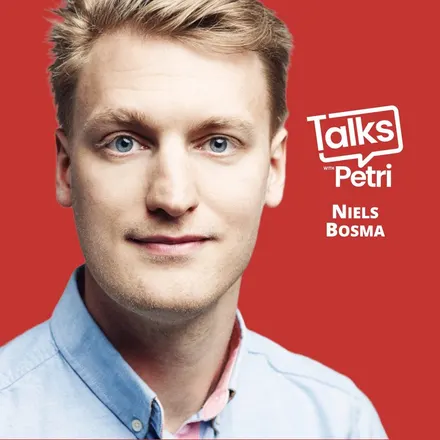
EpisodeTalks with Petri
Growth hacking with gamification
With Niels Bosma
Niels Bosma talks about doing marketing with a technical background, automating your workflows and having friends as co-founders.
Niels Bosma - TALKS WITH PETRI
Niels Bosma talks about doing marketing with a technical background, automating your workflows and what happens when friends become co-founders in the same company.

Growth hacking with gamification
Niels Bosma talks about doing marketing with a technical background, automating your workflows and what happens when friends become co-founders in the same company. See the episode notes: https://www.petrikajander.com/niels . Guest bio …
Bio
Niels Bosma is a passionate growth hacker, product developer and angel investor. He builds growth engines.
His latest venture is Filestar that is revolutionising how people work with their files. He is also a co-founder of Offerta and Tessin, which is Scandinavia's first and largest platform for real estate financing. Niels loves to do side projects such as SeoTools for Excel. He is also an avid mountain biker.
Company | LinkedIn | Twitter | Github
 Play video
- 0:20 leaving early as a startup founder
- 3:40 influence vs. titles
- automation as a part of your workflow
- 15:20 growth hacking and SEO
- 17:40 long-tail landing pages
- 18:00 automated Youtube videos
- 20:20 long-tail traffic as a part of the business model
- 21:40 fully automated Adwords campaigns
- fast development response to demand
- 24:20 marketing is very technical now
- CTO and CMO
- backtracking marketing expenditure
- 30:40 start early with SEO
- 33:40 quantity vs quality in content
- 38:40 reuse your content
- 40:00 open-source intelligence
- 43:20 lead engines and prospecting
- 47:40 sales gamification
- 50:00 culture building
- 55:00 transparency
- 1:00:40 recruitment with the team
- 1:05:20 student training program
- 1:06:40 developing own talents
- 1:07:00 friends as co-founders
- 1:19:40 take funding or not?
Episode links
www.iftt.com
www.zapier.com
https://www.youtube.com/c/JohnHammond010 (John Hammond)
Transcriptmachine transcription · 1:32:39
Transcribed from the recording by machine (Whisper): it may contain errors.
0:01 Welcome to Talks with Petri show. I'm your host Petri. Today we have a serial entrepreneur and angel investor Nils Bosmo with us from Sweden. Welcome Nils. Thank you. Do I see your sauna in the background? Yeah, I work out of my cabin that I have here close to my house. So I have this as my ja saunassa. Joten found early in the company's growth? Good question. I think companies have different stages.
1:09 So you have the scale up phase, you have the product market fit phase, then you have the scale up phase and then you have sort of a maintain phase. And I think for each phase requires different skill sets. And for me, I think I excel at the first phase, the product market fit phase. And there's a totally different type of people that are good at when you're scaling up. It's more about as a founder or a management it's more about building a management team and taking the things that you have discovered in the product market fit face and just doing more of the same same so I think for me in my companies I this is something I learned that I really enjoy the the first part that's where my talents are best puts it's also I'm very driven by like learning new things so it's really what keeps me happy so and and that first phase it's really a lot about learning about the domain, about the company.
2:27 So yeah, that's... and many founders they don't... they think that they have to stay too long that it's in the interest of the company but if you're good at knowing when to leave and you'd you design the organization for it, it might actually be good for the company to leave early. You shouldn't just leave out of the blue, but you should plan for it if it can take a year or something. I also understood that you still hold the stocks in the company, so you're not actually exiting, just scaling yourself off from the company and let other people take take your position and then you move on yeah I'm the companies that I've co-founded I mean it's still my baby and I still care about them and I so even though my latest company Tessian we have IPO'd a year ago I still hold those shares and I still work there a few days a week and I think like you I try to work so that like titles are not that important so I don't have to be the CTO the CMO or like I as founder you have still quite a lot of influence so uh right now i'm for example not part of the management team or the board or anything like that but i'm still hanging around and uh help out with with questions and stuff but but gradually moving over to my next project it's called file star and you went also to product hunt with that i think that was late last year and you were so excited
4:34 about it can you tell something you know how it went and and what's what is the latest company you're having yeah so uh so file store is a uh it's a file automation uh software i i uh it's very different from the companies i co-founded previously uh those companies were very sweden based um the customers were in Sweden or in the Nordics so I wanted to do something more software-based and international and I wanted to build a SaaS company and also I've always been like a productivity nerd so I really didn't like those type of software like Sapir and and air table and things and I've really wanted to have something similar to Zapier but oriented around files where can you explain to people what is up here or IFTTT if they stand that yeah so it's it's it's an automation software you can build without any programming skills you can build the flows so based on a trigger for example when you receive your file is uploaded to Google Drive you can then have that as a trigger and automatically maybe send an email or yeah do something else send it to slack for example a lot of flows that I built in Zapier has is based on slack so yeah you can very easily automate things and without any coding skills and you know coding is usually quite expensive so with SAP you can try out pretty advanced flows if you are testing some new idea for some kind of growth hack or something like that it's very easy to do with SAP here and then when it matures and you
6:43 and then you can decide to code it yourself. And so yeah, I was really inspired by that. And Zapper is 100% cloud-based. The triggers are always something that happens outside of your computer. But I wanted something similar to that, but based on really what happens on your computer and more centered around files. So the idea started with the ambition to that you should be able to just select the file and then as easy as possible, just tell the computer, do this with the file. So it could be like a conversion or compression or split merge transform or anything like that. And then when you have that, you should also be able to piece together skills similar to Zapier into flows.
7:42 So let me give you an example that in Firestar you can say, I have a PDF and I want it to split up the PDF in separate pages. But now you can also build what we call a recipe so you can split it up and then you can say then sip it up and then send it as an email And that is a recipe and the recipes are like we try to keep it very simple You mentioned if this than that which is a very similar service to Zapier which is like software can can become quite complicated. It's a lot of it You have to have some quite a lot of computer skills still to really fully utilize Zapier. But if this and that is similar, but it's a lot simpler. It's like one trigger and one action.
8:39 And we we try to design file stars to be very similar to if this and that. Very simple. Like my mother should be able to use it. It should be very intuitive. The interface grows with with how you use it. So if you are more advanced user, the interface grows. And so when you build these recipes, which is really like just a flow of skills, then you can tie it to different automation processes. So you can, for example, create a like a smart shortcut on your desktop. So you just drop the file that you want to do on that icon you can create a smart folder That when you just drop the file in the folder it will back do those steps so if you drop a PDF it will then for that recipe split up and Do those actions that you want to take we're working on some really cool a cool feature where you can actually create a smart printer so if you have for example like Really why I design it is, I created that software.
9:52 It's the software that I want myself. That usually tends to become a good product. And what I really hate with entrepreneurship is handling my receipts. Oh, you mean the expense receipts? Yeah, expense receipts. And especially if you're like, I used to be the CMO at Tessin. And you have this company like marketing credit card. everything today is a credit card base. So you have like Google ads, transactions and Facebook transactions. And yeah, you name it. It could be like a 50, 80 receipts that you have to hunt down. And I hate it at least in Mac when, when you have a, you know, long receipt and it doesn't actually make it like a four.
10:43 It's just like, you know, weirdly just merging those two pages together. and when you see them in preview and stuff and they always not in line and aligned and whatnot. So, yeah, so, so I mean, nowadays it's a little bit easier because you most accounting software, you just send in like email in the receipt and then you have to in the software, you have to match it to the right line item. But still you have to log into the, to example, Facebook, find the receipt and then download it as a PDF and then create an email and then upload again. It's still too many, too few, too many steps. So the funny thing is that, sorry to interrupt, I think IFTTT is using Stripe as their payments, but you know, it's the same thing with them. I don't can do, I haven't, I think I checked, but I couldn't, you know, I have to go to their website every time they send me an email.
11:45 I have to go there. I have to find, okay, is it the invoice or the receipt? And I have to click it and I have to put it there every month. I kind of just, you know, they just cannot put it to the right folder immediately. So, you know, yeah, I think I need IFTT and your product in order to do that. Yeah. Well, with my product, you will be able to, um, to go to the receipts and, and just print it out and instead of printing it out it would actually create a PDF and send it to your your the email of your accounting software so it's a little bit easier removing a few steps and so that's really what five stories is it's it's an automation software based around the things you need to do with files. Um, Apple is by the way, doing with shortcuts, really good stuff as well. So you can do amazing stuff with your mobile phone. If you know how to do it, it's actually quite a complex stuff you can do. Um, the only thing which is missing, I'm missing at least in the Mac OS on the computer side is that you cannot do some, some automations like time based or trigger based. You can only manually trigger them at this point. And the successor or not the successor they had Automator which can do some advanced stuff and I'd say Filestar is very similar to Automator and we're actually porting Filestar to Mac that's what we're doing right now so we'll compete with them and I say our edge is going to be that we are going to be more file centered.
13:36 So we're going to, like we support over 800 file types right now. We have 60,000 different skills. So we will... So you're going back to the 70s? What do you mean? I mean that, you know, really like the Commodore 64 files. Yeah, but you know that every year there's new file types invented so a lot of the files that we that our customers ask us to support our file types that are invented like last five years like hike for example is a very it's a file format that Apple decided to store the camera photos in and for a long time it was very difficult to convert them.
14:28 So, and not like... Another thing, I hope you'll do that. If not, this is an official request. Whenever you do recording just with a QuickTime Pro, for example, just a quick thing you can do with Mac, with the software, you know, all the computers come with. You hit the recording with the video, it'll be a MOV file. And you don't want to send mov file because that's basically MAC thing. So you want to send it as an MP4 file as a container. And I still haven't found an easy way to just do that simple conversion. Well, then you have a file story. We support mov and MP4. You have to wait, though, until the MAC version is released. It's going to be released in a few weeks.
15:17 But yeah, that's something that you can create a smart folder and then anything you drop in that will be converted into MP4. And if you always send it to the same email address, you can configure that as well. So yeah, the file story is the product for you. So how did you start the marketing side of things? you went to product hunt and how do you make people to know that it's existing and what's the strategy growth hacking side of things? Yeah, I mean, I've been interested in growth hacking for a long time. And like we've done a lot of things for in previous startups around the... You've been doing this like 15, 20 years. Yeah. Yeah. So we should probably go a bit further also back later on this episode so people understand that this is not your first ride. Yeah, sure. But now in terms of growth hacking for Filestar we've done, it's, I have a quite long background in SEO, search engine optimization. I created a tool called SEO tools for Excel.com.com yeah it's a it's a it's a tool for growth hacking but but it's based on it's a plugin for Excel so an Excel is really useful for for if you have like you don't have the programming skills but you're you're kind of technical you can you're good at Excel then there's a lot of things you can do when you work operational with growth hacking it's kind of it can become kind of data intense especially SEO is there's a lot of massaging data back and forth so Excel is really good as a tool for that but But anyway, with the background of having creating that tool, a lot of my digital marketing skills
17:27 is based on SEO. So I like to have that as a component in my growth engine. And so a file story really is like part of the business idea is the concept of a skill. So let's say a simple skill could be like convert a MOV to MP3. And so for each of the skills that we have, we of course have a landing page with this gear tour, someone searching for that. So yeah, we have 50,000 of these landing pages. And so we've made it very simple to create the skills just like production-wise. and distribute it. So when we just push that code into our system, we automatically create the landing page. We create a screenshot of that actual feature being used. We create automated YouTube videos. So with code, we create YouTube videos with music and logos. And it looks like a person is is using that actual tool and and YouTube is actually like I think it still is the the second largest search engine in the world so we get loads of traffic from YouTube just people searching for like how do I rotate a PDF or how do I you know so basically for every are you saying that for every feature function you do you make a video out of it or you just somehow select which ones Do you need to do some kind of script, Excel script that, you know, this is what's going to happen or how do you, I'm just curious, how do you actually generate this?
19:17 So YouTube only allows you to upload five videos a day. So we're limited to that. So of course we've, we have analyzed like what are the most valuable keywords. But yeah, I mean, if, when we check in the code into our system, it, it, it, it, it, it video and uploads it. So it's a simple video with music and like a pre-roll with the logo and then we kind of fake it so it looks like somebody is using FileStar. So it's really recording a real computer with the FileStar software being used but it's the mouse is just triggered by the mood with code so yeah it actually happens for real on the computer but it's just screen recorded and and all done with code so and and I mean it would be impossible for us to to be able to create I think we I think we have 1500 videos now and they would not be possible or at least not very fun to create those videos manually so we try to to automate as much as possible to really take the value out of the long tail so so yeah that's part of the duct of the business model to really get a lot of cheap traffic fork I mean I did some initially some search analysis for like the keywords that are related to to our business and it's a huge market people that are searching for for these type of I mean different conversions or simple things they want to do with the file and for us it's very easy to convince a person to like this is the way you should do it we try to keep it very clean a lot of the competitions are like shady Russian you know online services with a lots of ads so you don't know where your files are going or things like that so
21:30 And what are you getting? Yeah, exactly. So for us, there's not a large brand that's taken this space yet. And we are trying to be that brand. So yeah, we were talking about the growth hacks. I think I can also mention like we've managed to, our skills, they actually market them themselves. so our AdWords accounts is fully automated as well so they if when I push in a new skill it automatically creates a whole AdWords campaign just for that skill and so we try to work very data-driven like also the skills that we select we select to develop is apart from customer feedback we we base our our backlog 100% on on just data that we can get from different sources yeah I mean it this is a bunch of cool things that we that we do well so for example we monitor 20 of the biggest blogs or question and ask forums like Quora for example and if someone asks for something like how do I do this we have a monitor for that and then so we get noticed in in slack and then we can go in and and That's very, I mean, it's easy for us to get a lot of link juice.
23:18 But yeah, we have a bunch of different monitors for things so that we can react on. If someone on Reddit says something like, how do I do this conversion from X to Y? And we maybe don't have it yet, but we can be really fast and create a solution and push it out. And in a few hours, we can just rely, oh, we just added this. And the software is not a monolith. It's when you download file store, it's completely empty. And then based on what you used, we patch the software. So you always have, like your files always stays on your computer. It never leaves, all the processing is done in your computer. but the software evolves as you use it. And so it's very easy for us to distribute the small packages with updates and it's a whole distribution engine in mind.
24:19 You mentioned earlier when we were discussing what we're going to talk about here today that you were chief marketing officer and CTO and you really think that these go together and it's like the early days of a startup And obviously, you know, what you just mentioned it so nicely, you know, so you need to do a bit of coding. You need to understand that part about the marketing is not separate. And I haven't heard and seen that too much that usually it's like there's a marketing and then there's the coding and sometimes they talk nicely to each other, but you know, seldom they are the same person. Yeah. I mean, marketing nowadays has evolved to be very technical. If you want to excel at marketing, I mean, you still have all the traditional parts. You have to build a brand and sort of thing.
25:08 But just like the ad buying or just how to, like, before you just, like, what you call it, you just buy some ads and then hope for the best, right? But now, especially for startup, you can choose to focus on performance-based marketing where you can really measure. So you only focus on marketing that you can measure in the beginning. Because in the beginning as a startup, you have so many choices of how to market yourself. So if you choose the performance-based type of marketing, then you can build yourself a playbook. So if you like a testing we We have tracked like every spent Krona Exactly on like how much Like what what did we get? What was the source and build up a whole database with with all the marketing spending We can like for every click that ever clicked on something that we paid for We can track did they invest in a real estate project or something and then that data becomes very valuable you can use it for you know if this is like the CEO says we have to do a big marketing campaign now because we need to you know achieve this then you get to go back to your playbook and just say okay we do some of that and some of that and some of that we don't do that and it's it's very it's easy to to get the results that you like to predict the result in advance you know you know how much a new user cost for example and where like what kind of bang for the buck you get and it's a huge help also when you are negotiating like some ads are still bought by negotiating with a salesperson or something like that so just
27:16 I think that's any startup going into marketing, just have the idea of tracking, put up a system to track every spent Krona down to the last minute. And then as the company grows, then you can go beyond performance-based marketing. But yeah, as a small company, that's really, really important. What's your take on the organic marketing versus giving money to Facebook and Google's in the beginning? Do you, do you first need to experiment and test that it works and then you can boost it with, with paid, it depends, depends on, on the, of course, on the product that you're trying to market. If you're lucky, you have a business model that benefits from organic.
28:14 Filastore, for example, benefits a lot from organic. There's a lot of traffic, a lot of keywords, and the keywords are not high value. Some keywords can cost like $100 just to click for one click. They're really crazy keywords. When I go into a new case or when I advise other startups, I say that you should be open-minded. You have maybe 50 different tactics or channels that you can try to buy. And you should try to test each channel as cheap as possible. So maybe like for Tessin, we were able to test the channel with as low as 2000 euro and gather that data and that'd be enough to say if it's worth it or not.
29:17 So you should and you should not have like a so in the beginning we thought like okay so Tessin it's a it's a financial company and we we work with real estate investments and we had a bias like I'm a Facebook it's not gonna work like nobody's gonna like click on an ad on Facebook to invest in real estate but but yeah like just by just having the mentality of testing each of the the channels we figured out that Facebook actually is really good and so and and nor you all you can't only focus on one channel you have to have a mix of things so if you if you spend money on on adverts or on banners or any if any any other channels that can boost your your organic side as well so it's in in the end when you really analyze if you're good or not at it you should compare all your spending with all your results and that's really the the end score but yeah I mean the thing with organic it can take quite a long time so let's say you're gonna start with with SEO today you're not gonna see the results tomorrow it can take up to six months or even more so it's something that you and and with so with that said you should actually start with organic as soon as possible do maybe do make sure that your websites is has what we call the on-page SEO that is like the search engines can really crawl your whole website and so you can gradually grow the the organic side but it's not gonna give you results immediately but over time it's gonna be become a valuable asset so make sure that you you start early let's say you have an idea for for a new company and you know make
31:24 sure you have the domain and have the domain out there just put up something Some kind of like, we're soon we are going to start this and have some article with relevant keyword just like anything in SEO is has to mature. What has changed when you started to check the SEO space? I think it was because of one of your projects and you need it and then the SEO tools for Excel came as a result of that as well. So what's working now, what's cutting ads now versus the things which were used before? Because there's also been changes with Google, Apple, the privacy things and the weighting has been changing with algorithms as well. Yeah.
32:11 I mean, it's become a lot more difficult to get good results in SEO. of course has their ambition to first that you you should but preferably buy ads and then just get free traffic so so they've changed their algorithm some and how they like where the ads are put and and that changes a lot of things there are also a lot of more competition like all companies trying to compete which makes it more difficult. Google has become a lot better at like there's you know you have this white hat black hat SEO and Google has become a lot better at you know not giving credit to the the shady tactics which I think is a good thing. They have done a lot of things that makes the web better I think.
33:14 so so yeah I have always I've never been very interested in in the black side of SEO because the the the tactics that you use are quite boring it's a lot about creating spammy content and spammy links and that sort of thing so for me as like SEO strategy is mainly I focus a lot on creating quality content so content creation I think still is like the best way and just create things that people enjoy to read and and also make sure that your website of course is optimized for the indexing robots. In regards to the content, question, quality versus quantity?
34:11 I think in the long run I think quality is better than quantity Google is getting again here better at figuring out if it's good content or bad content So it also has a little bit like how do you want to be as a person? I mean, do I enjoy creating a lot of spamming content? Like for me, it's no fun at all. Like setting up shady websites. Well, not shady, but just spammy. They add no value to the user. And I think in the end, you're just going to be penalized for it.
35:03 So, yeah. Yeah, there's also the other aspect of it. If you're not going to the spammy side at all, but it's like, should I do just one really good video like once a month or should I do every day something? And, you know, it's not so high production value. Of course, it needs to be still useful, but it's like, should I just focus on a few things like you know previously companies are doing these trailers or tv ads and you know it that was like a high cost thing you put a lot of money into it and then it's like a buff you're out of budget and you know if it doesn't work then it works or should you just keep on doing a lot of stuff and experiment and then something will come out of it and people just love something i think you should do uh do great quality content but you should produce it as cheap as possible so let's say for example if your company you can create a podcast and you try to like we like one of our best marketing tactics at Tessian was actually to create a a podcast of our own and we had help from a podcasting company We had sponsored the podcast for a few years and then we wanted them to create a podcast for us.
36:25 And so we were the ones that were recruiting the interviewees, I guess it's called. And we also made sure that the interviewees was held at our office. So we were in the real estate business, so we invited a lot of interesting people from the real estate space. We made them come to us. Like, how do you get a person to like you? Well, you ask them to talk about themselves and ask them a lot of questions. So just having them do the interview with us, they kind of thought that, okay, this is Tessin. They created a small relationship with Tessin. And we also tried to, like when we chose the guests, especially in the beginning, we chose guests based on their social media presence.
37:24 So like if you got on interviewed and you're quite likely to share it and spread it. and um so uh so yeah so and we and and we made sure to to uh i think also when you're creating content you should should uh be quite regular you should like if you're releasing once a month you should try to keep that that's uh i don't know why but it's been it's a bit important uh rule to be to stay uh to have like if you always say you're gonna release on a friday then always release on a Friday. It's also the same applies to like newsletters and things. I'll try to be consistent. But the whole thing with the podcast was like create high quality but it should not take too much time. So like the interview like the recruiting things we had the students doing that and we had outsourced the company to do the actually cutting and interview stuff and then like if you create one piece of content you can like what we made sure that we we also took the transcripts and so that was part of the deal from the company that they created transcripts that becomes a nice blog post and that's that is a good search engine food and I think that's a that's really a good good tip to like when you create a great content try to use it for more things like for example if you work with PR and you create this really nice PR piece that you are pushing to journalists maybe they pick it up or maybe they don't but but you can like try to reuse that content for other things because you paid for it and then you can yeah you should make the most value out of it so that maybe can
39:29 become like a blog post or something later same same thing with like native advertisement like you you put a lot of money in creating the content but then yeah try to reuse it you can go from like PR to blog post to newsletter but yeah so to summarize try to create like high quality content but don't pay the price for it try to automate as much as possible try to have a process of creating this content so it's not consumes you too much so both worlds sounds like an IKEA plan yeah bits and pieces you put together cheaply but it's kind of works and it's yeah still good quality what is open source intelligence and how How can you use that in a crowd hacking situation?
40:30 Yeah. So, I kind of like, you know, you have these streaks of you're hanging around on YouTube and you get really interested in a specific topic and then you just, you know, just look at that type of topic. Then you go deep dive and after four hours you come back. Yeah, but I can have for weeks, there's a primitive technology, a half-naked guy going around the forest and just building stuff with his hands. That's one of those deep types I've done for a few weeks. But yeah, I don't like it. Nothing to do with the geopolitics. No, no.
41:19 But yeah, for quite some time I was really interested in just like, you know, internet security, computer security. And there is a whole space with that, of course, on YouTube. And there is a YouTuber, his name is John Hammond. And he's very, he does this kind of capture the flag exercises where someone put up a computer and he tries to hack it. And it's very informative. And within the field of penetration testing or security, there is a subfield called open source intelligence, is really like what kind of information can you get about a subject or a company from open data sources it can be paid data source but it's like it's data that you can get that like without doing anything illegal no hacking stuff like that it's just like how can you you acquire that as much data as possible about a subject and so it's very interesting and there's this is a whole field and they have a bunch of tools that they used to within this field and I just realized like this these tools are can all actually also be very useful for for growth hacking this a lot the tools and the methodology and the mindsets and things so so let's say you are a company that sells the product and then you ask like what is your target audience like who do you like let's say you're selling a thing to and your your typical customers is the CMO of the company that yeah like would it be useful to have the contact details of all the CMOs in
43:25 all of Stockholm for example. I think most companies they can sit and just like ask themselves that question like what would be the ultimate lead list people that are in the market and that's something you you know all you do as a startup you create some kind of lead engine like how can we intelligently get the leads and leads that are as rich as possible with contact details and everything. So I just realized like that's something I've been doing for all of my companies, building these leads engines that try to from a huge set of potential customers just figure out who is really in the market. And yeah, so I just realized like the tools that are available for OSINT, those are exactly the tools that I need and some of them are we're using. Those techniques are very, very useful for creating your lead engine. Is there some concrete tip you can give or some example which is really concrete, something you can you know straight away do after listening to this podcast uh yeah but first of all just like uh in an unbiased way just like if i had this like this list of of uh of potential customers what would it be uh and then because a lot of things with growth hacking and it's mostly about the mindset like anything is possible uh i just need to figure out why so just have that mindset to figure out like okay if i had this this list But then, of course, it's not only about having the list of potential, because you also need to figure out how you're going to approach them.
45:23 Because today is very, it's not as easy today as just sending an email. You're not going to get any customers like that. So you have to also, in part of this process, figure out how to approach people. But yeah, I think about the list, like who is my ideal customer. Then you should figure out how can I get that list. And then there's where OSINT comes in. And then figure out what is the best way for me to approach it. So what we do, for example, at Tesla, we built our own growth engine, leads engine we call it. So we it's based on a few open data sources that we and it's based on a pay a few very expensive paid data sources and then we have this algorithm approach to to To get all this data mesh it together and and from that sort we get leads and Then we have YouTube videos as well Sorry, does do YouTube videos as well. No, that's not YouTube videos. But for example, then we have a student that comes in and just massages the data, the contact data. And then those leads are fed into our CRM system.
46:50 So one of our sales transaction from the transaction team, they get like really high quality leads. So again, we are in the construction space. So like in the detailed view, they see like, what is this customer building right now? What has media said about this customer in the last media? So any data that, like any prospecting data that they can find, they get presented with there. So when they call, they can make a really like a warm call. They can say, oh, I saw your ad in this like local newspaper. Or I see that you can just try to, I don't think salespeople should do prospecting.
47:41 That should be done with code. Yeah, so try to figure out like how can you set up a pipeline like that and it doesn't have to be very complicated But it just talk how to automate it as much as much as possible And then you can do some like fun things with it I've been really Interested in gamification so have I've done some Some fun things with that. We, like, our sales team, they, when there's, like, the best leads are the ones that come from the website. And so, and also for within the organization. So, like, customer service maybe gets a good lead or something like that. So, we've set up a system where, so, if I have a lead that I want to give to the sales team, I email it to a certain email address.
48:41 and what happens is that that starts in Slack an auction so every day they get a couple of credits and the amount of credits you get is based on how many activity or we reward people that do a lot of activity they get a little bit more credits and then they actually have a small 5 minute auction where they can bid in Slack to get that lead and the highest bidder they get then the email gets automatically routed to them. So fun things like that. I think it's fun to make it. And initially the sales team was a bit skeptical but then after a while they found it was really fun. And it also makes it kind of democratic because otherwise the sales manager he has to route the different leads. So we've done a of things like that. We also the leads from the leads engine, you actually buy them in packages. So in Slack, you can say buy leads and then you, so you buy them in packs of 10 and it has a daily supply and demand price. So it's, it goes up and up and down. But what's the currency? What is it?
50:02 you know how can you buy them it's just not it's the credits that you get every day but the sales manager can of course override it all and just say like give hundred leads to this person but yeah so it's a but I've open sourced the the system so you want to set up set up something simple of yourself it's on github but uh yeah it was a fun hack and not really related to growth hacking But yeah, it was fun. Well, while we had the gamification, you've been doing that also in the culture building. Can you give some examples and ideas? Yeah, I think from my I've been part of a few startups and I've realized how important culture is. So in the last company, Tessin, we really, really focused on building a strong culture and and yeah how many people you have interesting at the moment so they can be a background it was 40 something like that we have an office in Finland as well a small office so 40 ish anywhere starting in 2014 or yeah that time so I mean the culture thing and testing maybe it's not really we haven't done much gamification around the culture thing. I mean the slack auction thing that's kind of culture thing. We've done some like and that's just mostly for fun but I built the experimented a lot with like a test and I made the company before testing was Oferta and we shared office with like we have rented big office and then we shared it out to other smaller companies just to share the costs.
51:58 But we were kind of responsible. And when you share office with a lot of different companies, it always looks like shit in the kitchen. Yeah, the dishwasher at least. The dishwasher, yeah. So I tried to like, how can I solve that in a fun way? Like, how can you make it into a game? So I came up with a system called Kitchen Reputation Points. So, and I tried different experiments with how can you get people to do what you want and make a game out of it. So I tried, first iteration was just like if you've done the dishes or like put on coffee or something like that, you just get one point and after a certain while you you know, after a few months, the one with the most points gets a PlayStation.
52:53 And that worked kind of well, but it ended up with just two persons doing it, like competing, and everyone else just dropped out. It was always a fresh pot of coffee. Yeah, it was clean in the kitchen. But then I tried a lot of different iterations. I tried getting... Just like for each point you get a lottery ticket for an air balloon trip. I've tried... What else? Just like if you create two teams, you sign up for a team and then if you do the dishes, you're allowed to participate in for your team in a like you know five tic-tac-toe but five in a row so that was fun so just different things just do if you like do it make it fun it's uh yeah it's it's a gamification is fun way to make people do what you want them to do I'm actually kind of surprised that you didn't take a facial recognition cameras and start to play around with, you know, automate that thing.
54:10 Yeah, I did some more high tech version of this at Tessin actually. I had a period in my life that I was really interested into like Arduinos and Raspberry Pis and stuff like that and then soldering and building. So I actually made a digital version of, also on GitHub, a digital version of the kitchen reputation system where I built a small device where you could select your name and then press enter and it would register that X had done the dishes and it would turn up in a Slack channel so everybody could see that someone had done the dishes yeah and so yeah that's also open source but I had a lot of ideas of how to evolve it but yeah you have to have fun but I think I mean okay so that that is a part of of of culture building a little bit but I think the I like to summarize like how to build a good culture with like one word and that's just transparency. So if you are transparent with your employees then that I think that's gonna create for a strong foundation. So like how we did it at Tessin is like simple things we've had, We always had like TVs in every room with dashboards.
55:53 Like these are the goals that we are achieving. Like so they in real time can follow the progress of the company. So what are the metrics, for example, that's how brutal transparency it is for things? Because sometimes, you know, some things are transparent and maybe the most important things are not transparent. Well, you, you, you, you want to have like actionable metrics. You can separate metrics in vanity metrics and action-album metrics. And vanity metric is like number of users you have on the website for a given day. And those can be really fun. So you should include some of them as well. I mean, it is a nice feeling that you have like a record in a number of users for a certain day. But actual metrics could be like your conversion rate or something that you...
56:45 Like if we improve this metric, it's sustainable. It keeps on giving. Right. So it really depends on the business, but try to have a good mix with vanity metrics and actionable metrics. But did you include leading indicators as well? No. What do you mean leading indicators? Sort of a trend where you're going, not just, you know, what's happening now, about like, like that, okay, if we keep on doing like today, next month or week or whatever the period, you know, this is what's going to happen. So you can pick up stuff earlier on. Yeah. I mean, we try to like, because as a company, we always have like sales goals and, and, and then different goals like that. Or if you have taken funding, maybe you have a goal, like next batch of capital is when we have achieved this amount of users. So I I like to use like burn down charts.
57:44 So you have a goal and you can see like, like where are we in terms of sales? And like you have a straight line is where you should be. And then you can either be over and under. So, something like that. It's also like really nice to, to motivate sales, for example, to have like if somebody done a sale for a new deal, just put it on the board. Like we put a, testing has changed quite a lot since we IPO'd, so like nowadays we are, because of compliance we're not allowed to be as transparent. But in the beginning we had a Slack channel with like every time somebody created a new deal in Pipe Drive, it became a story, a ticket in Slack and the whole company, just join in and to share on like good job and small things like that to unify the company so yeah the dashboard for transparency just as much data as you're comfortable sharing with your your employees we have like we did from the start we've done stand-up with the whole company like 15 minutes standards for everyone including the management just telling what they did today and what they're gonna do and what they did yesterday what are gonna do today uh we did uh like every month we don't do have a what we call beers and brags or uh like every department just uh have one one just telling uh something awesome that they've done so we're taking a lot of things from from like the software world from agile and just implemented it for the whole company take the best pieces of scrum and okrs and and just like yeah so I think but yeah just the whole transparency part like we also like every month the my co-founder Jonas
59:58 the CEO he did like like a full report for everyone the finances and yeah as much transparency as you can that that creates a really good foundation for a good culture and then we've added some other pieces we've tried to like have a have a like a theme around like healthy living so like our kickoffs have been like climbing a mountain or going mountain biking or it's always been it's always something like sporty, sport adventure and like we we made a thing out of only having like healthy stuff like avocados and fruits and berries and stuff Some companies, they hire really smart people and then they give them sugar and crap and then think that they're going to be smarter.
1:00:58 So we try to make things out of that. So all those small pieces are great for a good culture. Are there any growth hacks from you for recruiting and building the company team-wise? Well, recruiting is really hard, especially in the space that I've operated in. like technology and marketing, it's really, really hard. It's been becoming even harder. So one hack is to, if you find good people, make sure that they are really happy and that they stay working for you. So that's one hack, I guess. I think in terms of recruiting is hard. Like even if you have some, you have interviewed someone and you really like this person, you know, it's still a bet.
1:01:55 Right. So what's your process been doing that, you know, already three companies and still counting. And I guess you've been having a lot of different processes, different ways of doing that. So what is your best practices at this point? Yeah, so one part is just like, oh, it's a bet. And we have to work a while to make sure, to see if we're a good fit. But I try to focus a lot of like, is this a good culture of fit? And we do that by, so we have like a normal interview process. We've tried to, in the beginning, all of us three founders, Tessin, we always interviewed everyone.
1:02:46 You do that separately or together? Separately. Yeah, definitely separately. But that is not possible anymore. It's very costly as well. Yeah, I mean, we probably have like one interview every day, so that's going to be too much. But then nowadays we just like take if someone in the in the dev team, yeah, we like apart from the manager, we have like another developer that does the interview and then someone from the like complete outside of the organization. So but but yeah, I think the most important part in our process with like beyond just the normal interview process is to have a like we try to always do like a one full day interview day and it's not really like an interview it's more like a like hang around with the team for a day uh so we uh we start the day with uh like having breakfast together uh and we have lunch together and i think that is really the important part just breaking bread together and just like you know do everybody get the feeling that this is a person that is gonna be a good fit in the team and then we try to so instead of just doing like a whiteboarding sessions or stuff like that we would try to take to do a task where the whole team is involved so we normally just work on you know something that we need to do and try to involve the the candidates in that in that process and just try to simulate as much as possible of how it's going to be to work together.
1:04:36 And I think that is a very, very good approach that works well. Another thing is in terms of when I was working on the marketing side for Tessin, it was very difficult to find people who had any experience. like if you you know let's say you need some experience in adwords or facebook or something like that it's very difficult to get people with like it's difficult to get the fine developers but marketing people can be even harder and if you find find one it's not 100 sure that you know they know a small piece but but uh that piece is going to cost you quite a lot like the salaries become quite high for skills does really you know really not that difficult to acquire and a testing I had especially difficult with like some marketing support staff because the domain that we're in like finance and and real estate if you don't have an interest for that then you're not gonna enjoy creating content for it or stuff like that so so what I figure out was to just take a smart person and train them myself so we we've always had like a student training program with like there's a in the university in Stockholm KTH they have like a real estate engineer oh no it's not yeah it's real estate engineer economic real estate finance program something like that so we've always had like a big like one or two students from there and many of them become employees so and and it's like it's a tough program and and so if you you can graduate from it you're you're a smart person probably and so yeah I try I stole
1:06:47 one of those students and just convinced this person in particular to to to become marketing like have the two skills like real estate and marketing and she was really good and yeah so sometimes you have to develop your own talent because it's easier. Well, how about finding co-founders? You've been building these companies, so they find you or do you find them? Or what's the secret in that part of the company? Yeah, finding co-founders is really the, it's really hard part. And a lot of companies that I, that I coach or like friends that like, I a lot of times I get a get a how do I find a co-founder especially a technical co-founder can be really difficult but I've been lucky like the offer that I started after universe like co-founder of the university can you tell actually what the company is doing so just just briefly but yeah okay so the first company that I participated in was at when I was at university I studied computer science in Linköping and that was with with Jonas who is now also with co-founder of Tessin and we did like an app store for the smartphones of that era before the Apple App Store so I assume be a Nokia yeah yeah and and Sony Ericsson.
1:08:31 So we had developers from all over the world that uploaded their software to our system. We were in an incubator in Linköping. And we had a lot of fun, learned a lot, but we had this "if we build it, they will come" mentality. They did not come. - Sorry? Did they come? Yeah. They did not come, no, really. And I mean, so a good example there is that me and Jonas, I was at the end of my studies and he was kind of in the beginning. So we were not, we ended up, for different reasons, we ended up not running that company any further. But that was the main reason was we were in different stages of life.
1:09:23 I had finished, I needed to have food on the table. My wife had a job in... My now wife had a job in Stockholm. She wanted to move to Stockholm. And Jonas was about to go to South America. So, yeah. Really, a good co-founder is also someone kind of close to you in a life situation. Like, if you want to co-founder or have kids, you might want to work differently, different hours. So, yeah. be in the same stage of life. Yeah, so the story, okay, so after Mobigear, after the studies in Linköping, I worked three years for Motorola. Worked, that's my only three years, working for someone else.
1:10:13 I was working with IPTV in the market and product department. I was responsible for creating interfaces for these set-up boxes and normally the customers created their own interfaces but when Motorola was going to trade shows they needed to have their own interface to show what the set-up box could do. And so I was responsible for creating those demos and went around the world to show them. year I had three shows that I needed to work to get stuff ready for so it was Las Vegas for CES it was 3GSM in Barcelona and then one in Amsterdam and they were like spaced out during the year and so I had work my ass off get to the show present my demo like 10,000 times go home crash and I start over to the next trade show so but yeah was a lot of fun and did that for three years but then another friend from from Linköping who his name is Jens he he approached me and he had had this idea for furta he had been in New Zealand and he had seen some kind of manual like a board where people put up like like I need a carpenter or I need a cleaning person or something like that and he wanted to make it like a digital version of that so he he he got together a team to do to do that and and first I said no I didn't want to participate because I I thought it was not interesting technical wise but then he came to my my wife's birthday party and late at night when having drink too much he convinced
1:12:24 me to to join the company and that was right after I had been at one of those trade shows and I have like completely crashed so he was hacking you he was finding the sweet spot where you're the weakest and I mean I couldn't say no so I was really burnt out and and wanted needed to do something else so that's when I joined that team and my role there was the CTO and a third day so yeah this is this marketplace where you can get like if you need a carpenter for example you go there and you you create your inquiry upload some photos and then it gets with the database with different carpenters gets and they can give you bids and you can manage it and that sort of things so I stayed there for seven years as the CTO and that's also where I really got interested in growth hacking and did it the marketing especially SEO and we were doing SEO as a project and I really needed to have some tools in Excel and That's how SEO tools for Excel got started.
1:13:49 And I just created like a new blog and I needed to put something on the blog. So I just uploaded the tool to that blog. To have content. Yeah, right. Just share it with the world. Quality content. And then like six months goes and I start to hear that people are talking about this tool and like a trade show at SEO conferences around the world. was one quite like one of the most famous SEO people he had blogged about it and talked about it a lot so suddenly I see a lot of traffic to my to that site and that really gave me a lot of energy to to continue working on it like it's as a developer you it's really fun to have people using your products and so yeah That's been like a side gig for the last 10 years.
1:14:48 And now a friend of mine is running it. But yeah, it's been a very successful side gig. And then, so we were talking about co-founders. So Jens was really just like a friend from university. And we've always been like common interest at university. were talking about like startups and you know had that shared interest it was really interesting and discussing like when I was doing mobile gear it was one one person that was really interested in that and so yeah I had most co-founders like I've worked with has been friends and and you're still friends yeah we're friends but I was gonna come to that is that like so should you start company for your friends and and it's a three questions very trick questions because like you you see it you you it's kind of you say like having a co-fathers like it's married without the fucking right you you kind of from like socializing of outside of work you stop doing that but I mean can you do a lot of socializing in work and you go out and eat and stuff like that but it's not really the same it's not like you you continue to do like family dinners with the girlfriends stuff like that it of course you do some of it but it's not the same you're not it's not and also like an after it's like if you don't if when you stop working together like for all of my cases I have had different co-founders and you kind of like become they become your ex-wife sort of like you
1:16:58 can meet and you can be really friendly and and you know I have like Jens for example we have lunch you know a few times a year and and stuff like that but it's not not not the same it's not like we are like I would not call him say should we go out to see a movie for example I might call him to like have a some business ideas for example to get his feedback or something but yeah it's a it's a little so so yeah if you start friends if you start company with all of your friends then it's the relationship changes at least to something else so you have to be prepared to that but also the like the thing with the co-founder is Because if you don't know the person, it's not sure that you're going to work together.
1:18:00 It's really the thing that can grow. If you don't have the same attitude towards work, for example, that's really a common thing. Like how it turns bad. So let's say you always want to work Sunday and and and they are not prepared to do that or they have kids and you know That my co-founder said Tessin who is the company that came after a further I Co-founded that with Jonas from the mobile gear and a guy called Eric and we were really in the same Stages of life and we had the same like the same needs for for Like, yeah.
1:18:48 And that has probably been my most successful partnership so far with Jonas and Eric. I think what made that a really strong partnership is that we are, in terms of skills, we all are, like, really good at our different areas. like Eric is a lawyer, me in tech and marketing, Jonas in the whole management side, like we've all had our domains and shared like the entrepreneurship but yeah, we've... Another thing that's wrong with us is that we can say that like we between, maybe not today, but when we started companies like between our three we had all the skills to run the entire company uh so let's say you i mean uh technical co-founder is is very difficult to find and and if you have to to pay for developers and you that can be really expensive but so yeah best way to have like a core team that the past and necessary skills what about then the financial partners so taking other people's money take VC or not take VC angels what's your take on the funding side of the company ideally you you you have no investors it I mean you're you have to play the the cards that you have so in in in I mean now it was easy for me to say that like testing for example we took in took in too much capital too early so you mean that you diluted too much so yeah we diluted too much but we were also in the stage where like I had at that point I had not sold any of my Oferta shares so and I had two kids and I had a house that I needed to or an apartment it was then I needed to
1:21:04 pay and so it's all of us were in that kind of stage where we had kids or we had a house we had we needed a salary so that was a need from like if you're a student you can live on like almost nothing right but if you if you have built up kind of a foundation and you have bills to pay then it's it's that becomes a part of the equation. So yeah we needed to have initially have a salary and that kind of guided us to like if we would be able to not take a salary then we would probably not have to take in that much capital in the beginning and that would have been a lot stronger and probably would have been better for the case in the long run because it's the amount of equity that you have on the floor is it's really important for when you are trying to race the follow-on run rounds you always have to think about the round that's coming after and so yeah like try to bootstrap as much as possible for five start I have a little bit different approach now I have financially in a better position so I can bootstrap a lot of this myself I know it's mainly the main competence is that needed is the development like programming skills so I can do a lot of the work myself and if I if I need I can outsource some parts but I can do it. I don't have to have Swedish developers. I've done a lot of outsourcing from other countries. And I know how to speak their language and to be really scrappy. And so I think like if I can, my goal is with FileStory to bootstrap through the product market fit phase
1:23:19 and then have a if i want to go that way i have a a really strong case going forward but uh but yeah so to answer your question like uh if you can uh don't take any vc but uh and and uh only take these if you can take vc when it when it's uh when you figure out the the main gears of the the business model and then you just use it to scale up to go faster than anyone else. It's a difficult question really to like how much VC and it's not like you can always choose. It's hard work to get funding. It's a lot of hard work. So a lot of people underestimated how much work it is. It can easily take 100% of your time for six months to get funding.
1:24:20 So yeah, and I mean make sure you... there's always a lot of talk that you're gonna get like smart money that people that you're getting anything else than money but in my experience there is it's always the like nobody is gonna spend as much time as yourself in your business you're always going to be like 100% into that domain whereas like somebody else that spends maybe one or two hours every month on your case is not going to be able to help out that much so i think hands-off investors are my preferred what is your favorite word my favorite word um a couple years ago i read so my favorite word is probably pragmatic i try to be pragmatic in everything I do and I read a book really good book called the pragmatic programmer so if you're a programmer that's like a really good book but yeah so just curious this is not a good next question but it's like what is a idealistic programmer is there such a thing an idealist of course there are idealistic programmers but can I give you a good example I don't know what I would that would be better well let's go to the next question then what is the least what is your least favorite word I have to use two words but but and not possible when people tell me it's not possible it's like everything is possible
1:26:25 just amount of time so and I think that's the strength for me like working with developers when when they tell me that something is not possible I you know it's always possible yeah what does you on creatively spiritually or emotionally I'm a very I like I'm a very creative person I really love to learn new things to learn learn new tools on how to be creative like now I was at a holiday last week and I decided to start learn like 3d modeling with blender and yeah I cannot have more fun than that just taking a new thing and just learn just watching YouTube videos tutorials and just and I don't have anything I use it for it just I want to learn it so yeah that's really and I and like in every like if I start a new company like a part of the decision of to start that company is like will there be new learnings for me so then when we started testing for example I uh I said okay this time I'm going to be the CMO because I want to learn more about that I was into into like growth hacking and I want to deep down and they told me my co-founder said you have to also be the CTO because otherwise we don't have CTO so but yeah so learn new things what turns you off?
1:27:58 I really don't like negative people that can really drain my energy and I get really affected by negativity it's the easiest way to make me hostile is to be negative What is your favorite curse word? My favorite curse word It has to be Godverdomme I have a Dutch That's Dutch for damn it I have a Dutch My parents are from Holland And the good thing with that word Is that I can say it aloud at home And even if my two kids Learn it Then they can repeat it at school And nobody knows what it means so and has a nice ring to it as well what sound or noise do you love what sound or noise do I love hmm my my oldest daughter Julia she's quite picky with her food and but when she does eat something that she likes she does this mmm sound and it's my my grandmother did that as well so that's really nice to hear because then we know that she's gonna eat what sound or noise do you hate So I'm a really avid mountain biker and when you have your derailer not aligned really with the whole drivetrain, it makes this like the chain can jump from one cog to another and it's a really annoying sound.
1:29:50 That has to be my... yeah, not a good... What profession other than your own would you like to attempt? I think it would be really cool to be an astronaut. I like to go to Mars. That would be really cool. What profession would you not like to do? I think I would be a really bad doctor. When I was younger, my father really wanted me to be a doctor. So I studied really hard and got like I had the grades to become a doctor. But then I saw like a documentary and it was like an eye operation. And I realized I will never become a doctor because I'm in Swedish called Ekel Morgan, like squeamish. And I really can't stand like people, like on the movies when they cut into people. So that was like an eye opener for you. Yeah, exactly. Now I would be a really bad doctor because I think the inside of the human is disgusting. If you could be a co-founder of any startup in any era, which one would you choose?
1:31:14 It would be, I like to be part of the run of, you know, the blood testing company. But without the scams, I think the most left. Yeah, maybe I would if they were also be successful in creating the technology. I think that something I've given a lot of thought about is that like when human are able to create a technology where they can do blood testing in a way that it's easy to do like every day and you could maybe like 3d print or exactly tell what it would be the optimal food or medicine or whatever that would be really a game changer to human health so they have the vision was right but the implementation was wrong and yeah that would be really cool but i would not enjoy the whole the whole scam part any final words to the audience uh learn to code uh it's never you it's it can be useful in any any profession and it's like you can use it as a superpower so yeah learn to code it's fun and useful Kiitos paljon Nils.
1:32:39 On ollut paljon asioita. Palkimme 1.5 hk:t
More from Talks with PetriAll episodes →
- Henry NilertSpeed and resilience in market downturns22 May 2022
- Alyona MyskoWartime CEO18 Apr 2022
- YouneeImprovise with a total bravery20 Jan 2022

- Pierre StanislasKeep provoking happy accidents21 Dec 2021