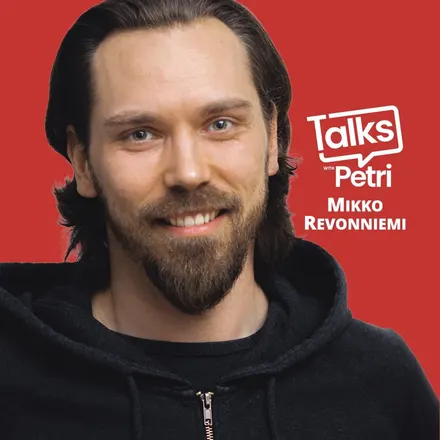
EpisodeTalks with Petri
Founder burnout
With Mikko Revonniemi
Mikko Revonniemi talks about the founding and the early years of Four Sigmatic, his burnout and the measures it took to overcome it. He also shares his insights from e-commerce marketing and how to get leads to your DTC startup.
Mikko Revonniemi - TALKS WITH PETRI
Mikko Revonniemi talks about the founding and the early years of Four Sigmatic, his burnout and the measures it took to overcome it. He also shares his insights from e-commerce marketing and how to get leads to your DTC startup.

Founder burnout
Mikko Revonniemi talks about the founding and the early years of Four Sigmatic, his burnout and the measures it took to overcome it. He also shares his insights from e-commerce marketing and how to get leads to your DTC startup. See the …
Bio
Mikko Revonniemi is a purpose-driven entrepreneur passionate about creating solutions for people to optimize their health and well-being on physical, mental, and spiritual levels. He is a co-founder at Four Sigmatic, a company focusing on medicinal mushrooms, and Taimi, which aims to solve nutrition-related diseases with personalized nutrition and data. He is an ex-trail runner and over-achiever whose new interest, after a long burnout, is in meaning and balance in all aspects of life.
 Play video
- 1:40 The struggle vs. the Tim Ferriss effect
- 6:20 Early days in Shanghai
- 7:00 Learning Chinese
- 7:20 Mushrooms
- 8:20 The food and beverage approach
- Setting up the business in HongKong
- Reputational issues in the early days
- 13:00 What can go wrong when you’re selling mushrooms online?
- 16:20 Influencer marketing
- Funding issues and lack of working capital
- Blender almost blunder
- 20:40 Go-to-market approach
- 21:20 Into the US via Finland and Canada
- B2B (business-to-business) and DTC (direct-to-consumer)
- 27:00 Be persistent and follow up with your customers
- 27:20 Organised chaos and opportunism
- 28:20 Logistics and customs issues
- 31:40 Marketing differences between Europe and the US
- 33:00 The origin of the brand name
- 37:40 Founder burnout and symptoms
- 38:40 The realisation moment and what could have been done before
- 41:40 Remote team communication and picking up signals
- 42:40 Radical honesty
- 44:20 Ultrarunning
- 44:40 The nature of HongKong
- 45:00 The competitive nature kicks in running
- 52:20 When stepping down from Four Sigmatic was not enough to stop the burnout
- 52:40 Recovering from the burnout
- 53:40 Self-reflection
- The origin story of Taimi.love
- 1:00:40 The US market launch issues in 2020
- 1:01:40 Payment gateways, Meta and Google as gatekeepers
- Arguing against algorithms
- 1:03:40 The webinar approach
- 1:04:00 DTC marketing tips
- 1:08:00 Cost per lead in the US vs. Finland
- 1:09:00 Get your own leads: don’t trust the big platforms
- 1:10:20 Surprises in how people pay
- 1:12:00 Abandoned cart email sequence works
- 1:24:20 overachieving is not a thing
Transcriptmachine transcription · 1:25:35
Transcribed from the recording by machine (Whisper): it may contain errors.
0:00 Welcome to Talks with Petri show . I'm your host Petri and today we have Mikko Revonniemi as our guest. Welcome, Mikko. Thank you for having me. How do you get Tim Ferriss to endorse your product? That was actually partly luck. It was mainly luck, but it's a funny story in a way that when we started the company, we had a few major goals. And what was the company? What is the name of the company? Four Sigmatic. So early days when we started the company, we were thinking like, what are these major goals if we reach these? We have succeeded. And one was that Tim Ferriss will endorse our products. So you mean you named Tim Ferriss?
0:49 It was not like someone famous. It was Tim Ferriss. It was exactly Tim Ferriss. We all have read the four hours of work week. And Tim Ferriss at the time in 2010, he was, I would say, big name in an entrepreneur circle. So we're thinking if he will endorse us, we've made it. And four years later, roughly four years later, he actually did it. And we're like, yes, we did it. And it actually happened so that my colleague, Mikael, was doing calisthenics in Venice Beach with his friend. and he always we had this rule that always carry your own products so he had some lion's mane mushroom powder with him and he was doing the calisthenics with his friend and his friend was like I know someone who knows someone who knows Tim Ferriss so if you can give me a few of those I'll pass them to my friend and he'll pass them to Tim Ferriss because he most likely will find was interesting and and a few weeks later he uh Tim Ferriss contacted us and asked if we want to uh have him promote our products he found them especially the lion's mane extract he found it really interesting and obviously we were yes because that was one of our main goals and it was also a very funny story because everything before that moment was struggle for us like every single thing trying to find new customers trying to find retailers um it was just struggle we were in the brink of bankruptcy almost every day and when tinferries contacted us we sold our u.s warehouse in a matter of one or two days and um whole foods market which we had been trying to contact many times they have six different sales regions and we we've been calling them all like hey do you You want to have R4 Sigmatic products?
2:47 And they're like, no, I'm not really interested in it. And after Tim Ferriss mentioned us once in his podcast, the next day, Whole Foods Market started calling us. Hey, can we start stocking your products? I was like, yeah, sure, why not? But yeah, it was pure luck, like many of these things. Just nothing to do with, well, it has a lot to do with persistence, but it was mainly the moment was just luck, good fortune. But it was not just pure luck because you actually did something. You were thinking of it. You actually also put the chain in effect that you knew someone who knew someone who knew someone and you actually made it to happen. So it was not like that you did nothing. Yeah, we were working hard for four years. We were working hard for four years. So that's like, if you work hard, you get the luck eventually.
3:38 Let's go back. So how did it all start? I understood it was your idea. You were walking in Shanghai, but how did you end up in Shanghai? And when did this happen? That was 2010. Prior to that, I've been working my father's company. Both of my parents have been entrepreneurs. Mother, when I was just toddler, and father later on. So I've been working for his company and was planning to go to university to study business. And then there was this opportunity to go to Shanghai to work for FinPro, which is nowadays business Finland, to promote Finland in the World Expo. And I was thinking that that's very exciting on many levels. First of all, before that, I've been thinking about learning a new language.
4:30 And I was thinking, what could be the most difficult language to learn? And I was like, yeah, it's probably Chinese. And then there is this opportunity to go to Shanghai. and um i sent an application and i got to interview which was in english and during the interview the interviewer asked like do you speak any chinese i was like no well it's a requirement but how hard can it be and and uh um the interviewer asked me like if we get you into haka helia in helsinki i was living in thambara if we get you to helsinki for beginner's course will you take it i was like I will take it. And then I traveled twice a week for three, four months to Helsinki to study Chinese. I took some summer course in Thambere as well. And then half a year later from the first interview, there was the second interview, which was in Chinese. And I sucked at it. I was really bad at it. But fortunately, the one who interviewed me was the Chinese teacher from Haga Helia. And he told me that you weren't really that good but given how much you have studied you were really good so i believe that once you get to shanghai you will learn what you need to learn and i will recommend you so i was the only one there was 40 of us in our team and i was the only one who hadn't been studied chinese prior to that and i thought when i was going to shanghai that i can actually speak pretty good Chinese because of these two beginners class and when I when I got there you know I couldn't distinguish a single word when the locals were speaking it was just long kind of like a sound wave with no individual wordings and I was like god I'm gonna be screwed because at the work I need to speak Chinese but yeah eventually it went good I actually learned the language pretty well during those years and and during that one year um um when i was working at fin pro i i
6:41 i basically kind of like shifted my um these shifts i was shuffling my shift so that i working long hours long days like two weeks in a row and then the remaining time i have like two or three weeks uh days off when i was traveling around china and during these times i noticed well actually I've noticed in Shanghai already that you have all these medicinal mushrooms and you have this Chinese traditional herbalism, all these things that are based on traditional Chinese medicine. And I found that really interesting because even before I went to China, all these health food, superfoods, supplements, and those were really close to my heart. I always wanted to... I played ice hockey before, so I wanted to get maximal results with minimum effort.
7:34 Didn't really work for my ice hockey career, but I learned a lot about vitamins and supplements. So when I was in China, I noticed these, you know, say chaga mushrooms, rishin mushrooms, and cordyceps mushrooms. And I was like, this is very interesting. I started studying herbalism from the perspective of Chinese traditional medicine. I was like, I got to do something about this, especially with the medicinal mushrooms. There were a few companies at the time doing medicinal mushrooms, but they weren't doing it that well. So I called my friend Tero, who is now running the company in the US, that I think we should do something with the Chinese medicinal mushrooms. And the original idea was to do just regular capsules, just more affordably.
8:24 You know, there is already market. Let's take a bigger share of that. Just selling some capsules and supplements. And we start developing that brand a few weeks. Then we're like, no, let's not do this. Let's do something totally different. Like, you know, if we believe that traditional Chinese medicine and these medicinal mushrooms are actually good for you, it's not enough that we're going to do another product that is exactly like everyone else's product. So there came the concept of let's make these beverages. Let's bring them closer to food and beverage instead of going to supplements. And when I was working in Shanghai and I had these long vacations, I traveled around China. I went to see the farmers.
9:12 I went to see the factories that can actually process them and trying to put together the whole supply chain. So once, because I knew the Shanghai job I had, it was one year project. So I knew it's going to end. And originally my plan was to go back to Finland and go to study. And then with this new idea, I was like, maybe I'm not going to do it. Maybe we're going to just have this company. I'm going to move to Hong Kong. We're going to set it up and I'm going to run it from there. And well, that's how we did it like in late 2010 when the project ended. And I had built the business, like written the business plan, which was, you know, the old type of what you would learn in school, like 40 pages, a lot of text, a lot of, you know, stuff you don't need.
10:04 But it was a good exercise. But yeah, I did it. And since then I have learned like you can do that much better as well, but it was a good exercise. So anyway, at the end of 2010, then I moved to Hong Kong. And with my backpack, with one luggage, I didn't know anyone there. But my only idea was to set up the company and start doing the business with very little understanding how to do it over the start. What were the hardest part in the beginning? Can you still remember what happened? I understood that you find the cheapest hotels or motels and you didn't know, like you mentioned, you didn't know anyone. So how did you put it up and running? And the world was a different place.
10:51 Was Shopify even existing at the time? It was after the crisis. So the world looked quite different than how it's nowadays. Yeah, there were many things that were difficult. In the beginning, it was actually like, where do I start? I live in another country in a culture that I don't understand, with no friends nearby. Everything was near. So it's like, where do I even start? Like, how do I set up a company in Hong Kong? Where should I live? When I moved to Hong Kong, it was 1 a.m. in the morning. I flew from Shanghai to Sanchen. I took the cross-border bus to Hong Kong. They dropped me to TST, which is, you know, if you see any movies where they're shots from Hong Kong, and when you have all these neon light boards and that, that's TST.
11:43 So I went to the cheapest hostel in Chungking Mansion, notorious Chungking Mansion, with all the prostitutes, all the drug dealers, and the cheapest hostels. And I was sitting there like, okay, now I'm Hong Kong. What now? What next? Like, what's going to happen now? And so just to know what to do. And back in the days, my style of doing things was, I'm not asking anyone. I'll figure it out myself. So that was hard. Since then, I have learned to actually ask people. But in terms of business, I think the most difficult thing is for us, that when you do fast-moving consumer goods, You actually need to have a lot of capital to have the initial stock. We were also doing products that no one else were doing before.
12:35 We were doing in the industry that no one actually knew. It was sketchy for most people. There were times, I remember laughing at this. Again, Mikael, he was in Sweden. I think it was 2011 or 2012 in a coffee shop. took some hot water and started using our own products there, like adding some cordyceps mushroom into water. And then the waitress comes like, what are you doing? I'm just adding the mushroom coffee here. And they're like, what? Mushroom? Get out. You're not using drugs here. So that was the level we were at. And it was really difficult to get people to accept the idea.
13:22 And then obviously Shopify was brand new back then. We were using Shopify, but it wasn't as intuitive as it was now. Also, even though people bought products online, it wasn't as normal as it is nowadays. So when you sell mushrooms online, there are many things you can think that are actually pretty difficult. we had to kind of like let people understand like build the trust basically like one thing what we did um we were thinking how can we build the trust there were two things one that we need to get a lot of reviews a lot of testimonials on our side so one thing when we did there was like michael there and me we had this friendly competition who will get the most amount of testimonials and we end up getting I think 50 40 or 50 testimonials from friends and family most of them had tried the products there were a few who didn't but you know they trusted that it's good so we got the we got the review there another thing with what we did which is shipped some products to say um um less known celebrities or um athletes and like try this product for one month and then write an article what you think about it and usually when people get free products they don't want to give you a bad review back so it was most often it was better it was better than worse and so so those were the ways we were trying to build the trust in the beginning before there was no one else um no one else um they will they weren't like a proper review apps back then um so it was very simple e-commerce business what else also that was very difficult that we were at the a pring of bankruptcy almost all the time because like having having most of the money went to the stock i didn't get any salary for the first two years and when if the stock didn't sell well we were
15:30 in trouble um and one thing what we did for example is like we were noticing we have like two max three more weeks of um cash and cash left and something needs to be done um so we decided that we're going to use that money to do something totally different that should work and we're thinking what can it be and we decided let's do let's do a blender uh because most of our customers are in the health and wellness field and they do smoothies and the major blender back then was Vitamix. Costed like $1,500 and that's an expensive investment for many people. So what we did, I basically sourced another factory that does a similar kind of blenders and we got the samples, tested them out and it seemed to be pretty good and we decided okay let's let's do a beautiful design for this and it's it's a high-tech blender a lot of power we call it gizmo because you know that because when you put in water there it turns into a monster so it was four sigmatic it was actually back then it was four sigma foods gizmo fsf gizmo and uh everything went well we have a few influencers who promoted them um and we made a lot of revenue and we're like okay this is going to be the new business like okay we do mushrooms but we also do high quality you know um where that company people can use to improve their well-being until very soon we noticed that a lot of those blenders start breaking down um you know first one customer told us like it's it's you know there's something wrong with the blender, it doesn't work anymore.
17:20 Then a second, then a third one, all of a sudden we notice, oh gosh, there's a lot of customers complaining about the blenders. So it turned out the sample we got wasn't exactly the same than the production, the actual production. So the sample was some kind of like really well built, but when they started mass producing the factory, it was slightly less high quality. And we had an agreement that in this case, that if there is a certain percentage turns unviable or broken, then they have to reimburse us. So I started calling the factory up and telling them, okay, we have this 5% of all these blenders we sold are now breaking down.
18:13 So based on our contract, you need to pay for us. And they stopped answering my calls and emails. So what I had to do is I just flew in. I just flew in and sat their office until they actually paid me. And the city is also, it's funny. China is a funny country. It's like, the city is called Tishishu. It's a small 2 million people town in between Hangzhou, Shanghai, and Ningbo. there is nothing there except factories making blenders. It's like the whole city is dedicated building blenders. And I was sitting in one of these factories and telling them like, okay, you need to pay me this much money now in US dollars. And they're like, no can do.
19:01 We can pay you in RMB, the local Chinese money. And the local Chinese money is RMB, the Chinese Yuan. There's a law, at least back in the days there, there was a law that you can't you can't um take more than 6 000 yuans out from china otherwise it's smuggling money out of the country and they were giving me a few hundred thousand of those local monies and i was thinking like okay so i have two options i leave the money here or i smuggle them to hong kong and i was like if i leave them here the company will go down if I smuggle them to Hong Kong there's a chance that I may go down and I was like maybe I'll just smuggle them to Hong Kong so I walked from Shenzhen to Hong Kong across the border I was sweating, my hands were shaking and I was thinking like if they now get me, it's gonna be it's gonna be end of me, I'm gonna be in some kind of unknown prison camp you know, just doing something like I don't know what. Luckily that didn't happen. I got to Hong Kong and you know then I start basically depositing the money to several different bank of Chinas because Bank of China is the only bank who can actually take Chinese Yuan and I didn't want to just give too many of those in one go otherwise they start asking questions. So the next month I was just walking around Hong Kong in different Bank of China's depositing a few hundred yuanes at a time.
20:44 Well, so that kind of things, you know, those things are, you know, those things that you can expect, I guess they are the most difficult things. You know. How did you decide the first market? How did you try to reach the customers? You know, those important decisions. are in Asia, you are in Hong Kong. Did you talk the local market? Did you talk some European market? Did you straight away go to the US? Why did you choose the approach you did? We decided to go to Finnish market at first. And since the first day, the US was the goal. We want to get to the US market because if you make something big there, it's going to go global. It's going to be actually big like if you pick in europe it's like it's nice but when you pick in us everybody knows you and you actually make a bigger impact but we understood that we didn't have the knowledge how to get there we didn't even know how to make actual physical products specifically food products and then also finland back in the days in 2010 it was um i would say kind of a hot spot for cutting edge natural products all the like pakurikabat chaga mushroom was was already in the certain uh health and wellness bubble really big thing so people knew the products and we had our own network here so we thought we're probably going to get a pretty good uh market here in finland uh so that we can it can sustain us and we can expand and the next uh step in the plan was the uk market it was kind of like the first English-speaking country, but still in Europe.
22:31 So it's kind of easy to get there. And after the UK, we were thinking, okay, we want to go to North America. But the US is kind of, it's like, you know, Finns play hockey. So it was kind of like an NHL, the toughest place to get in. So how about if we go to Canada first? They are polite. They're nice people. So let's go there and learn the North American way in slightly less competitive and more friendly environment. And that's what we did. And once we were in Canada, it was easier to expand to US. And that was basically the rationale. And we did have, like, we were also selling in Sweden and Germany and France. I think, actually, the second market was Ireland. Because Mikael was working at Google in Ireland back in the days.
23:22 So it was easy for him to get products there. And we had a few shops in Hong Kong as well. And there were like random shops. I think there was someone from Slovenia, I guess, just asking like, can they resell us? I was like, yeah, sure you can. It just sounds better. Like we have 20 countries selling, like our products are sold in 20 countries. In reality, there is one shop in Slovenia selling our products. But hey, it's still a country. So what was the strategy you were directly selling to then reaching out for the customers? Or you were targeting like you said, those who are actually using the blenders as well. So it was particular really aware customers or was it like you were looking for distributors? Or what was the idea?
24:13 We were using in some countries we were using distributors. Then there were countries who were just selling D2C online, D2C online, and in some countries we were selling directly to resellers. But main customer was these, you know, people who really know their health and wellness products at first. Like, we knew that that's the easiest customer for us, and those are the people who are spending a lot of money for health products. But we all the time, we wanted to, the whole mission was to democratize medicinal mushrooms. So we wanted to, as many people, know about them and get benefits out of them. So what we did, we had a lot of these people who were sampling the products in different shops. At one point in Finland, I think we had 20 or 30 people who were for free sampling products, our products for customers in different stores.
25:12 just because they like our mission and they really thought that medicinal mushrooms are the next big thing, which I still believe they are. And yeah, so that way there were a lot of people helping us and like basically sharing the message and letting people to try products. What were the channels people were sharing? Instagram was already existing at the time. Was it Facebook, Instagram, email, word of mouth, you know, just in real life type of way in events or it was a mix of them? It was a mix. It was Facebook. Instagram wasn't that big of a thing in terms of marketing, if I remember correctly. Facebook was bigger back then.
26:01 But we were using influencers. So we were already then before the influencer thing was a thing. we were basically doing collaborations in different countries, these people who are very well known in their own health and wellness bubbles. And that was one of our main sources of revenue. And later on, the same strategy expanded with Tim Ferriss and Joe Rogan and Ben Greenfield, and these bigger names. But back then, it was just micro-influencers in their own bubbles. what were the lessons you learned from finland and the island and these first places and did they actually apply to the other markets you went so did you actually figure out the playbook or was there anything you could actually really like use in the more difficult markets or bigger markets like us then um honestly it's um still when we were expanding to other countries it was kind of organize chaos and we were quite opportunistic um i guess one of the learning points was just be persistent um like very practical things a lot of times we get our products into a health and wellness store and and they are excited about the product and then it's run out it's out of stock and no one orders more even though they like the products and customers like the product but you know the the retailer has two thousand different products on their shop so they just you know can't focus on all of them so what we had to do is basically follow up all the customers all the time that was one major learning point during that time but mainly it was still the first four four years it was basically organized chaos where we're just expanding and trying to trying to use duct tape wherever we can.
28:04 How did you figure out the distribution of logistics as well? Because that could be also different regions. They have their duties. Did you ship all the products? Did you have warehouses somewhere? How did that work out? That was a part I actually learned a lot. I didn't know much about the global logistics and the duties. before that I knew like if I order something I need to pay duties but I didn't really understand how the whole thing works from the brand perspective we had a one big issue for us in the early days was when we shipped the products to Finland we had a warehouse in Finland which was one of our colleagues home so so every time we shipped the products to Finland the Finnish customs took it took samples just testing the products. Does it include what it claims it includes? It sounds like it's nothing but it actually is because when the customs are testing something they actually take the products and ship them to Scotland which is the European Union laboratory where they test everything and it's there for two to three weeks and then it comes back so all that time our stock is just sitting at the customs and when the results come back which they always came clean it includes exactly what it should and we have to pay 1000 or you know 1500 euros for the lab test so it's like our two hours to pay and it wasn't because that's supposed to be a random testing and and it wasn't really random because every single patch was shipped to finland uh got tested So at one point we decided we need to do something about it.
29:58 Like, I mean, like we can't change the customs because the customs is who they are and they do their job. But what can we do? And we figure out since this is a European Union and back then UK was still part of the European Union. So we were like, how about if we ship the products to UK, use the British custom and then ship there to Finland. And that turned out to be a really good idea Because in the UK, you don't have any VAT or import tax for tea products. And our products just happened to be tea products. So we saved that money. And then we got the products to Finland. And it was more affordable. It was faster. And everything went much smoothly. And that was the time we actually set up the first subsidiary. Because the first original company was in Hong Kong.
30:47 But in order to import to UK, we had to have a UK company. So then we decided, okay, let's have a subsidiary in the UK. And that's how the cooperation started. And how did we end up to the Tim Ferriss situation? You were already in Canada or you were already having something in the US? We were already in Canada. We were already in the US. We didn't have much of things going on in the US, but they were basically Tero. And I think Mikael both, they were just traveling around U.S. and meeting different retailers. And I don't know if it happened before or after, but we got approved to Axel Foods Accelerator Program.
31:39 So then the part of the team started staying in New York. Through that program, we got introduced to some of the biggest distributors and wellness industry. So we got big distributors in the US. And I think it was around the same time, there was a lot of things happening at the same time. And then the team fairies happened and things started expanding big time. But it was basically just footwork. We were just going from store to store, meeting people, trying to have them stock our products and then meeting influencers and trying to meet people who can promote us at the same time. Do you remember where the difference is between marketing and selling in Europe versus in the US? So was it basically the same approach you already did in the Finnish market and then it worked out?
32:36 I don't remember back then, but now that you ask me, I would say the big difference is in Europe you are actually educating and telling. And in the US, it's more direct marketing. It's just like buy this, buy this, buy this. And in Europe, it's like, well, you should buy this because it's good. This is a slight nuances, but I think it's more direct, more fast-paced in the US. How about the branding? Where does the name come from and how did you decide? You already mentioned that you wanted to do something differently. You wanted to have it more like a food and beverage category. what was the process and and did you did you learn or was it along the way or was it something you sort of figured out early on that this is how i want to be this is this is you know what looks good and this is the way i want to do it well original name was luonto life uh which is uh finnish luonto means nature and life so we wanted to combine some finnish elements and we thought that would be a good idea and we we very soon we know this especially in ireland that was actually first english-speaking country uh before the uk um that people didn't know how to pronounce it they were just like what is this and if you can't pronounce pronounce it you don't remember it and if you can't remember the brand well that's a bad brand uh so very soon we decided to i think it was like weeks after we launched the brand we were like okay so as soon as we're done with the stock we have to find a new name and and this new name came when um terror was uh living in switzerland and his colleague who was working at cern uh told him that there was explaining like these medicinal mushrooms these are you know um like the best of the best like you have only a few few few food products in the world that are as nutrient dense and as medic medicinal as as as um
34:48 um medicinal mushrooms and then the guy his friend said like oh those are like four sigma foods like what do you mean four sigma foods well in standard deviation if you have say x amount of food products and you have 20 the best out of them he basically just calculated roughly four sigma foods like out of the hundred thousand foods top 20 or top hundred is four sigma and there was oh that's a good idea and it presented us that one is like slightly nerdy slightly engineer is a bit Finnish uh and like yeah let's do it four sigma food is good and and we decided to go with that i was like that's a good story and then in the us when we got to actual foods program very soon there the people were saying that actually i'm i'm not quite sure it was actual Foods or another investor, but they just ask us like Four Sigma Foods, but you sell beverages.
35:54 Like, yeah, that's a good product, a good point. And then their company turned into Four Sigmatic. Like only less syllables, easier to remember. You don't have the food there anymore since it was a efforts company anyway. What about the message and the story? For example, now I understand you're not part of Fossigmatic actively at the moment, but the YouTube video, which is the company trailer in the website is actually quite funny, the story, and it's like the Finnish humor. And was that part of the package as well when you changed and decided that, okay, the US needs a bit different approach no since the early days we've had um quite innovative way of looking at the product packaging for example we've always had in the first products we had there was when you open it up inside you have some text about mushrooms about finland there was like this small business card where there was a photo of me saying like hey thank you for starting to invest in your health and wellness we believe the medicinal mushrooms are the best in the world and like signature it's like trying to make the customer experience as good as possible and even now when you open the package even that you have this same idea there's like a little bit about finland there's a little bit about products and it's like you you just want to see like what else can i find from here and and so incorporating the finishness in the brand was um important since the since the first day. That's why the Luan to Life name, which didn't work, but you can do it otherwise as well.
37:35 And the dry, black, dark Finnish humor is also a good way to do it. Yet the company was actually in Hong Kong and the products were shipped from Hong Kong. So it was just basically the roots of the founders, which is the marketing blend. exactly exactly all right so what happened then was it 2014 you left for sigmatic why was that and what did you do next um i had a major burnout um that was caused by many different reasons but it got in so bad that i couldn't if i got whatsapp message like my heart rate went up to 170 heart rates per minute, beats per minute, and I just couldn't function anymore. And the reasons behind that was that I wasn't really honest to myself.
38:31 I wasn't really honest to my colleagues in a way that I had too many responsibilities, and I wasn't able to say to people, my colleagues, that this is too much for me, because I had this feeling that I need to do all of these things. Originally, I was being the CEO. I was doing the product development. I was doing the finance. I was doing the operations. Well, at one point, we got a few interns to help with the operations as well. But mainly, there were too many hats for me to wear, and it became too heavy for me. And there should have been a moment when I had just, you know, put the brake on it to say like, no, this is we can't continue like this. I can't continue like this.
39:19 And I should have done it because I was the CEO of the company. But I couldn't do it. I felt that there was like partly guilt and partly shame. The feeling that I need to be doing more. I need to contribute more. And then, you know, just I went to point of no return and it got so bad that just I couldn't, you know, the whole house of cards that I was holding was just quickly falling apart. And then, you know, we had to do quite quick decisions like how to continue from here. And then the decisions were that, well, first of all, Terra will take the company and start leading it and we will hire new people to take the other parts what i was doing before and that was we hired the like cfo to take this the business side one of the interns who who was with us he started you know taking part of the operations and and um and there are the ceo tasks so there was basically three people uh three people um taking the tasks i was doing before which means that i wasn't really you know no one can do well three people uh work and that was you know i know that you know the cfo was actually fixing the financial side quite a long time after me so yeah i wasn't doing that well that side but you know it was it was um i think it was a fortune for the for the company actually because I was really good at, I had a vision.
41:03 I was good at, you know, putting the pieces of puzzle together, but I wasn't fit to run the company. So I think it went exactly like it was supposed to go, that I just basically put the foundation there, and there I was really determined. He's super smart. He is like, I knew that he can scale it where it should go. So in a way, it went exactly like, it was a long time coming. like my burnout with the with my mindset i had back in the days it would have come sooner or later was it your decision to actually that you figured finally that okay this this cannot go on or was it the other founders say that okay it's enough you know you know i think the other founders should have said it before and it happened only when i couldn't continue it was me basically just dropping the tools like can't do it anymore i like this can't do it now now we need to do something there's too much so there was a um there was a level of there was actually lack of communication uh from my part to others and there was also i guess lack of noticing the situation from other other founders to me obviously it's pretty difficult to notice because we were a remote team i was in hong kong uh terabas in either new york or um west coast there was a marcus who was France or Finland, Mikael who was in Finland, Mikael who was in UK and sometimes in the US.
42:32 So we hardly ever see each other. So it's like the communication is even more important in those situations. And I wasn't able to do it well enough so that other people would have noticed that everything is not okay now. If you're working 16 hours per day, then everything is not okay. What about the signals now reflecting back that you know you should have or you could have now I'm thinking other people who may actually be or will become in that situation so that you could actually pick it up earlier that it doesn't go as far as in your case. Radical honesty. I mean radical honesty yourself and to others it's so important that you can just look look yourself in the mirror and say i'm not equipped to do this or i need someone else to do i need help or uh or or or from the the other colleagues perspective like telling uh straight but with loving kind matter that you know you're not probably doing exactly the way you should be doing and we need to make some changes and also making the changes while they're still small because the longer you wait the bigger the demon will become and the more difficult it is to conquer it so so catch them early those are mentioned that obviously there was this financial situation and there was always difficulties in the business to grow it and and keep it above the water are there some objective if if you will, signals like you didn't take any days off or you were every day working the 16-hour days or something that doesn't take too much of a self-reflection to figure out that, okay, this is not normal.
44:21 Yeah, lots. I was in this kind of like a movers and shakers mentality, like overachiever. Like you just need to do more, need to do more. Everything that I was trying to do, it was just like overachieving. you know like you should like if you don't have balance between your work and other parts of your life work is your life as well but other parts of your life then it's not sustainable in long term um you need to have other stuff too that are actually balancing your working work lifestyle for me it was ultra running so doing this 50 to 100 kilometer running races in nature in trails and that's not sustainable either like if you if you're doing this like like working long hours and then you're also running long hours so when do you have time to you know uh take it easy so yeah exactly exactly so it's it's um in a way i would say um yeah it's it it just needs to you just need to be honest to yourself like you know like for in my case i was running away myself in a way there were like some internal anxiety about xyz maybe it was because i wasn't performing well enough on my opinion maybe i was performing well enough other people's perspective but on my own self harsh self-criticism was like i wasn't doing well enough i i need to do more and then i'm running uh those internal dialogues and feelings away to trails as well so there's no way i wanted to kind of like reflect and look at myself and how am i actually doing and what can i do differently so how did you end up running oh it was there was also a story about that and and it's was it beautiful hong kong scenery which maybe not too many people know if
46:29 they haven't been there that just think that it's just like a urban urban place but uh there's more to hong kong as well oh yeah hong kong is a beautiful place it's a um i do love the city actually i do love the nature i don't like the city that much but it's also it's also nice but 70% of Hong Kong is, you know, nature. You have beautiful mountains, these, like, subtropical forests, amazing beaches, just like hidden beaches. You can run a trail one or two hours, you end up this beach that there's no one else there. You just see ocean in front of you and mountains behind you, and it's beautiful. So that was, like, nature. I've always loved nature a lot, so that was one of the reasons. And another reason was that it was a balancing act. like it actually was a balancing act to my my work life first so i was doing short runs and short walks in the nature but very quickly my you know the distance started getting longer i was starting to run faster and then i end up meeting these trail runners who are actually doing a long distance like super long distances and they asked me to join then i was like yeah why not like you know sounds fun and then all of a sudden i'm starting to compete like the first race was 50 kilometers and i did pretty well i was like yeah i like it i like winning i wasn't i didn't win but i was doing well on my own opinion i was like yeah i'll do more of this and then i start doing more races then i start training for the races and then i end up being in like happy valley race course which is a horse track like one kilometer race course and i was doing that in the walls in in some when there was like 35 degrees hot and I was I had a headache and it wasn't fun at all and there was this like uh inner dialogue like there was this voice in my head asking like you know Mika why are you doing this this is not what you're signed up for I was like yeah it's not actually and I stopped and I didn't practice anymore I still had one race coming in a few months later
48:37 and I was like, well, I have the tickets. I'm going to go there, but I'm probably not going to run. And I did run, and I did run well. That was actually the best race I ever did. Out of 1,000-something participants, I was 22nd total. And I was like, yeah, this is a good way to stop running. And I haven't done any race since then. I remember you were also mentioning, was it actually what you did after the Four Sigma You started another company and started to do another thing. You were also testing the products and then you went running and the trail running started to have another meaning. I don't know how graphic we need to go, but was that the same period or earlier? That was earlier.
49:24 That was with 4Sigmatic because I was doing the product development for 4Sigmatic. So I had these different mushroom powders and herbal powders and mixing them together and trying how they taste and what are the effects like empirical empirical effects um and there was a few things that were funny as well like we had this sports herbs blend so you had these uh herbal supplements that are supposed to increase your endurance and sports performance and and i had been developing the product for quite some times and i had this running race coming up and and uh and i was like now it's a time for me to test it up and and like five minutes before the race i just took huge amount of that blend and and and and two two three minutes before the race my stomach start crumbling and i was like oh gosh and i need to go and then i just run to bathroom do my thing come back to the race and uh basically one minute before the race starts and and and start going and I was able to do half the distance of the whole race it was 21 kilometers so I did like 10 kilometers had a terrible headache I couldn't even walk properly and I had to leave it there so there I learned that like you know more is not always better better is better and then we end up developing that product but we end up having slightly smaller amount per one dose than what I had during that race.
51:02 It's like, you know, and that's a good example. Like many of these things, like, you know, how the Paracelsus said that everything is poison and nothing is poison, but the dosage makes it so. So that was a good example. Like the same thing that actually boost your endurance can take you out from the race. I just had it too much. Yeah. So after Fossigmatic, you were burnt out, but you didn't stop. How long did it take and what did you do next? And when did you actually fully stop to do stuff? I think I was kind of on hiatus for two weeks when I was thinking, like, what should I do next? I didn't think what happened.
51:54 I was thinking, what should I do next? Like, I need to do something. I need to prove to people that I can do stuff. And I ended up founding a company that was selling all kinds of health and wellness products online. And, you know, everything from nuts to, you know, natural toothpaste to dietary supplements. My idea was that it was kind of like Amazon, but for health and wellness products in Asia. And it was doing pretty okay at first. I was running the company for two years until the burnout that I didn't actually heal from just took me down there were like many things that happened but basically I couldn't continue anymore I was running it for let's say two years and then I had to stop and look at the things that what happened during the four sigmatic first of all just you know if you get a burnout you need to rest you just can't continue even the mind is probably able to you know push you through i was doing the whole two years and it was like a maniac mentality i just do things do things i collected two thousand different products uh for my online store i was managing all those products by myself i was shipping the products out i was uh writing the writing the product descriptions for all those two thousand products and uh doing the marketing everything and my idea was like i'm gonna learn every single thing that there is to do with this business and then i'm gonna get the bigger funding and hire the people and when i was starting to do the funding i realized i can't do it it's like well many things happened couldn't continue company went to bankrupts and uh that was the time when i decided like okay now it's actually me my time to look into the mirror and see what's going on and then i decided to move to finland i moved to orvo which is this beautiful medieval town one hour from helsinki i had this wooden house where i was just doing gardening um heating a wooden stove and fireplace
54:08 and really trying to think like reflect well like what happened during the past almost seven, eight years. Like what were the things I did well? There were a few of those. And what were the things that I didn't do that well? And why did those happen? And that period just took two years. Didn't do anything. But eventually something happened. So what was the next move? You didn't become like, Japanese would say, salaryman. You went back to your roots and become an entrepreneur again. Yeah, that was the time I was actually really thinking hard if I actually do want to be an entrepreneur, like my both parents were, and it was a natural path for me. But then, you know, all the stress, all the things, you know, related to entrepreneurship, I don't know if I want to put myself into that.
55:03 But eventually, if there's a good enough idea, you just sort of kind of like move towards that direction. And that happened to myself as well. So a good friend of mine, Jukka, who is also an entrepreneur, he had this chocolate company called Gudio. And his daughter has some major issues. First of all, she's a special need child. And no one really knows what exactly is going on with her. They've got all kinds of different experts and everybody just said, we don't know something's going on probably it's neurological we didn't know but at one time they went to this um functional medicine doctor to see if there is anything that that person can do and they took all the blood tests and uh checked all the body vitals and said like your child is uh desperately uh nutrient depleted and they recommended 16 different supplements and uh the 16 different supplements is very difficult for a seven-year-old child who is not even able to eat regular food that well not to mention swallowing supplement capsules and pills and um yukka was very frustrated about that you know you know even the doctors it costed 1000 euros and there's like little not no help except like yeah something needs to be done but that's something you can't do it so we start thinking if there could be any possibility to you know can we find a solution to fix this problem and we were we were looking for it like half a year uh thinking in many different approaches until we we found this micro encapsulation technology which is it's actually quite old technology used in uh food industry and medical industry to capsulate ingredients inside this layer that protects the you know the active ingredients inside and and that technology turned out that you can actually
57:13 make certain ingredients tasteless you can improve the shelf life you can improve the bioavailability which means that if you eat something the more actually get absorbed into your body so you get more benefits out of it we're like this sounds pretty good and we're wondering if we can actually use this technology with dietary supplements because if we can we can make this microencapsulated so it's encapsulated on microscopic level it looks like powder that doesn't taste anything but you have these active ingredients that yukka's daughter taimi is able to then take and since the idea was pretty good and without it this could be actually a bigger thing and and i'm usually i'm still kind of a guy when i get a good idea okay let's go let's start executing it and yukko was more like well let's think about it what could be the like 11 star product for this like you know if the five star is the best what would be the 11 star and we start thinking they're like brainstorming different options and we came up with the personalized nutrition so with this service we can actually make you one product you take once a day and it has everything your body needs and even include some of the functions you may want and it was like this is good this is what we want to do and that actually inspires us so but without like that's a slightly too big uh chunk for us immediately so let's do something first before and we decided to create three different functional nutrition blends that have certain certain functions so one improve your sleep quality, another one improves your immunity and third one improves your focus blend.
59:01 And that's what we've been doing so far. And the main goal, the mission is to basically eradicate the nutrient related diseases from the world, which is hopefully we can get at least close. So you started with the Finnish market first, then the playbook was again go to the US. So can you walk us through what happened, what worked, what didn't work, what were the struggles, but now you already have a lot of knowledge from the four sigmatics. So I would assume that you can expedite things. So it's quicker to do things, but still the market has also changed. It has matured, the tools and the competition has changed as well. So it's not like copy pasting the past.
59:51 It's not copy pasting, but it was certainly much easier to develop the products. We have more resources around us. I knew what mistakes not to take. I had a clear understanding what the product will look like. And our idea, because also the UKS company before, the Kudio, they main market is also the US. So we both have been, even though during the Four Sigmatic, I wasn't directly, I was doing some sales overseas over the phone to US, but I wasn't mostly in the US market myself, but I had still understanding how the market works. And there was a network and, you know, same with Jukka. So without like, since instead of going to Finnish market, let's go to the US market first. It's a bigger market and we know how it mainly works in this field.
1:00:47 And everything went pretty well. We developed the products quite quickly. Normally, product development can take one to two years. So we did it in half a year, which was really good during the time, especially when that was 2020 early. I would say it was right before the pandemic. And then we sent the products, huge amounts of products to U.S. We had a warehouse in Chicago. we ship lots of products there and start you know selling we start about to launch the products and one day after the launch Shopify the platform we were using they told us that uh you can use our payment gateway because your products are considered pseudo-pharmaceuticals which means that anything that is vitamin, mineral, amino acids or herbal products are considered pseudo pharmaceuticals and they are not allowed on their platform of the payment gateway so we had to find a new payment gateway which we did quite quickly obviously there are many different options so it's not that difficult to find a new one then everything's okay things are pretty okay now so let's start advertising and and this was already now after the pandemic and it's we couldn't promote any of our products so facebook and google basically banned not banned but they didn't uh approve our our advertisements and we couldn't figure out why well i do figure out now one of the product is called immunity blend so it can you can consider it as a health claim that is not allowed in certain things but the problem was that we couldn't know what was the actual reason because either of the platforms weren't giving us any particular reasons. They just told us that your products are against our community guidelines and there's nothing you can do about it. But we really wanted to do the US market because
1:02:57 the potential was much bigger there. And we tried for half a year how to do it there. We were talking with different brands different company like marketing agencies like what exactly can we do and all of them were like we didn't know no idea like technically all of your products at least the focus blend and a sleep blend should be allowed to solve there but you know many of these things are there's an algorithm behind it and if if the algorithm goes the wrong direction there there maybe no way to turn it back. We tried to have a new Facebook page as well, but that didn't work either. So after half a year and a lot of cash burned, we decided to let's ship the products back to Finland and sell in Finnish market.
1:03:49 At least we have personal connections here we can use to get some revenue. And we had the same problems for a while in Finland with Facebook and Google as well. So we need to just figure out something. Like, what can we do? Okay, we can't use those, but like almost the only way to market these days is through these platforms. So instead of promoting our own products, we created these free webinars and start giving added value to customers. One webinar was sleep. How can you improve your sleep with free techniques. Another one, how can you improve your stress, like lower your stress levels and manage your stress levels in free techniques and then just plug in our own products at the end of it.
1:04:44 And that worked actually really well, better than I expected. Why did you use influencers? Like you mentioned that was in the early days of Sigmatic, you were using heavily influencers. Why that didn't work in the US market? we had a we started it too late um we were actually we uh the major mistake we did this is like by far the biggest mistake we did with the launch in the u.s that we banked with two major influencers in the u.s like we had kind of initially agreed that this is how we're gonna do it with them and we basically put all our eggs into those baskets and then they decided to back down for for whatever reason they had agreements with other brands and they couldn't do it with us and then we were basically left with nothing and that time our team was too small to handle all the issues that came with that pandemic that basically increased the cost of logistics.
1:05:54 We were shipping the products all over the world for production and production to the US. So basically we're running short of cash. We just didn't have enough team members. There's like, let's say we have too many projects and not enough time. Like we were too ambitious and not focused enough that we were actually able to do certain things. That's basically that. Bad management in a way. So direct to consumers, DTC, startups. What can you tell them? What are the ways to do marketing and sales? And what have you learned? And I think you also have something special about Finnish marketing. Focus.
1:06:43 That's the first thing that I especially learned with Timmy, like focus what matters. It's very easy to start doing all these different things that are not really essential, but just having a sharp focus on the major KPIs and metrics and actually do what it needs to be done. Well, you mentioned that it's really hard to actually in some cases, well, it's actually costly even if you can do the Google and Facebook marketing. So is the influencing still the way to go? You mentioned these webinars.
1:07:32 What are the hacks or what do you think are the best ways for those who don't have a lot of cash in the beginning to get to the consumers? always easier to if you can give value to customers that's always the easiest way for example the webinar what we did because I was I was looking for different ways to market we didn't have much of cash anymore left and the normal Facebook marketing didn't work for us we that that just didn't work for us so I was thinking what if we do webinars and I went to look for the metrics for like what are the how much is how much one Facebook lead costs in the US it was about eight dollars and then I compared to Finnish numbers and well there is no cost per lead benchmarks in Finland so I estimated with the Facebook CPA US compared to Facebook CPA in Finland and in Finland the price was half of the US. So I assume that CPL, the cost per lead in Finland, is also roughly half of the US. So that should have been something like 3.5 to 4 euros. And we start doing marketing, I was like, we can do that. If we can get enough leads, turn into customers, that's going to be really good for us. And I made this, it was actually a really good webinar about stress, how to manage stress, especially in the time when people lost stress about pandemic and all these things. It was very useful for a lot of people and start marketing it on Facebook. And our lead, cost per lead was sometimes less than one euro, but it was never more than two euros. So it was most affordable way of marketing and getting leads because it's more important. Like one thing about D2C companies get leads you need a lot of leads in your own system whether it's a newsletter or whatever it is but you can't like really trust that you can't only solely rely on these platforms
1:09:41 Facebook and Google because at any given day they can change their algorithms even if you can get visitors or customers through them they are still not your they are not your customers until they have actually purchased so if they come to your website that doesn't matter so you need to get leads and the more affordable ways of getting leads you have the better it is and for us the webinars that was phenomenal way of doing it is so cheap and i haven't i haven't even know any other ways of getting leads that affordably any legal ways of getting leads that affordably than the Facebook leads with webinars in Finland. It may not work in other countries, but I believe in smaller markets, like all the European markets, at least all the Scandinavian markets, I believe it works.
1:10:39 Then you mentioned something about also the payment methods, which was quite surprising. Can you tell to the audience how people tend to pay oh yeah yeah well okay let's start with the us everyone use credit card that's it there is no other way of paying anything and that's simple and that's clear well when you come to finland uh 70 of people pay bank transfers when they use online e-commerce and 20 are using mobile pay which is this mobile app you can use to pay stuff and only 10 or less are using credit cards and it's it's crazy because i use credit cards for everything i mean it's safer to use credit card it's like you know if something goes wrong you can get it back from the credit company um but a lot of you don't get it back you know if you do the where basically because it's yeah bank doesn't do anything about it yeah yeah it's gone like something happens it's gone you can't get it unless if it's a nice company you're working with that they they really value their customer support but in technically you have no guarantee of getting it back and um one thing we notice um that i got those stats when i was talking with this a pay trail like finnish payment gateway company and they have this internal statistics they use but i noticed that that's that's the that's the trend because we use this abandoned cart sequence to you know try to people who add products to cart but haven't check out to actually check out and it's very standard like first you get this email like hey you left this your card why don't you go one get them now and then there's a second one coming like a day later like okay your card is gonna expire in four hours get it now or otherwise you don't have this card anymore left which i don't
1:12:45 understand why anyone should care because you can go and get the products later but it still it still works um but what normal companies other companies are not doing as far as i know um what we are doing is we're having a third email which looks very personal email there's nothing no edit just a a regular email where I'm asking the customer and it looks like it's coming from me not from the company but me as a as a CEO and asking like hey I have a the subject line is I have two questions for you I hope you can answer and then I ask him like let's say I noticed that recently you add products to your card but you didn't go to checkout and I'm always just wondering if you're able to tell me like what were the reasons that you didn't check out and what would it take for you to check out so that we can improve our service and a lot of people are actually answering to this i'm every day i'm answering two or three emails of this and by far the most common thing is uh you have only credit card option i don't want to give my credit card numbers to anyone except Netflix and Spotify and, you know, but like anyone else.
1:14:04 And that surprised me. So what is your standard reply? Is it like, okay, here's the bank account number, please, you know, wire the money immediately and, you know, we can ship the products. Usually I'm telling that like either you can, it really depends. We actually stopped doing it because usually it doesn't cover the time cost. we did it actually at first like we send we send an invoice here you can pay send to this uh the bank number uh but it doesn't work it's just like too time consuming you have to go to bank account check like okay now they paid now you can ship it manually it takes an hour to do that one being so not not scalable but um uh but yeah we could have like more payment options obviously there are a few reasons like technical reasons we haven't had yet but you know it's a good thing to like when you're a d2c company always check what are the most common payment payment options in certain country like germans use cash or like you know like when i was in hong kong i got this you know and i was like what is this like i i have like wake recollections that people are using this that this exists in like a the last century somewhere earlier part and i actually called my father then like i was like hey you know can you tell me how do i actually use this checkbook and he's like checkbook i think i haven't used those since 80s i don't remember i guess you just put the number and, you know, sign it.
1:15:51 And that's it. So different countries have different methods. What is your favorite word? I love etymology. Like, not the word, but I love the science of words and the history of words. So there's a lot of words I like. I think the words are almost like their own entities and they evolve along the way. It's very interesting. I think in English language, I probably like inspiration because it comes from Latin words inhale. That's not Latin words, but the original word where it's kind of like inhale and the spirit.
1:16:41 So you kind of like inhale spirit or inhale God when you get the inspiration. So that's a beautiful word. But in Finnish, I love the word harrastus, which means when you practice something. But in Finnish, it's because the word comes from harras, which means sacred. And when you do that, when you practice, it's sacred for you. So it's nice. And the word that actually got me into being interested in etymology was the Chinese word, tziran, which means nature, but what it actually means is self-organizing system. And there are so many words.
1:17:29 I have actually a list of words. When I get a new word, I just write it down, and the meaning and the etymology of it is 11. What is your least favorite word? Oh. I don't think I actually have the least favorite word in a way, but I would probably say war, because what's behind war is completely useless. There's no need for that, and usually the wars are fought by the people who are not actually related to the results of the war at all, and it's just creating suffering. And yeah, that's the reason. War, yeah.
1:18:18 What turns you on, creatively, spiritually, or emotionally? I think helping others. If I can, in a way, help someone, and there are many different ways of helping people. it's like i i considered for example four sigmatic is helping a lot of lot of lot of lot of people to become healthier and just by having that force going forward that that that kind of that's great but it can also be if i can help my you know step sister to do her homework and i can see that like she's enjoying it like she appreciates the help and I can be a use for her, then that's also great.
1:19:11 That's also really, really, really great. Like helping others in bigger and smaller things. And I find all my companies are also about helping others. What turns you off? They cannot do attitude. Like there's always like, no, can it be done? No, it's too difficult. And that's a good example. When I moved to Hong Kong and I went to this like Finnish association, they meet once a month, once every Friday in one pub. And when I moved there, I was like, well, I'm just going to go there and just meet the people, meet the other Finns.
1:20:00 And I was 23, I think. And most of the people, they were these people, expats who were working for Nokia or Koneo, one of these big companies, Mezzo and others. And just drinking beer there. Nothing wrong with drinking beer. But when I got there, they asked me, what are you doing here? And I'm super excited. Trying to tell, oh, I have this idea. I'm based on the traditional science medicine. I understand that. I understand it. Like, oh, I'm going to do this medicinal mushroom company. we're going to sell these great products for people. And they're like, oh, that's a stupid idea. It will never work. It's like, that's, yeah, you're too young. I get like, if you have this kind of like bullshit bingo, can't do bingo, I got all the marks done. And then I was like, okay, I guess I don't need to come to another Finnish association gathering.
1:20:52 And it was the only one. No, I did went another time there too, but like, that was like, I don't like that. I like support. I don't like can't do attitude. What is your favorite curse word? I think it's Perkele. It's powerful. It's also, I actually don't remember if it's the God of forest or is it the God of underworld in in in the finnish mythology but i like it's a powerful word and even the foreigners who don't know what it means when you say they're like oh okay got it so i like that what sound or noise do you love I like the sound of forest. When you can hear the wind making the sound with the trees and you can hear the birds chirping and in overall it's not only the one sound there but it's the whole symphony that happens in nature. What sound or noise do you hate? The sound of highway. When you are in forest anywhere in southern Finland and you can hear the birds but behind that you have this very low humming sound that comes from highways that are around you. I hate that, can't stand it.
1:22:38 What profession other than your own would you like to attempt? historian or archaeologist. I love ancient history, Roman, Greek, Egyptian, even ancient Chinese history, all of that. It's super fascinating. I think they figure out something we haven't yet. Many of them like even the philosophy, the stoic philosophy and you know that, the whole that thing, I would like to explore that more. What profession would you not like to do? probably quite many I wouldn't probably wouldn't like to be an accountant I like numbers but I don't like them that much I like to analyze them but I don't like to type them in yeah if you could be a co-founder of any startup in any era which one would you choose?
1:23:55 so for me the startup is not um it's not a thing itself it's more about what you do it's it's like a tool to get something done um so i guess in a way it would have been I don't know East Indian Trading Company that was an interesting time I don't know it was like exploring the new world and bringing tea and spices back to UK and I guess it wasn't the most ethical business at the end of the day we found out later but you know that was the first major cooperation in a way. And I guess it started pretty small. Or maybe not.
1:24:44 I don't know. I guess it was a monopoly. Any final words to the audience? It's good to live balanced life. Overachieving is not a thing. That's something I'm learning right now. I'm shifting from the overachiever. I've been doing it the past six, seven years, but it's still a work in progress. And it's good to have these checks with yourself that asking you like, am I doing this? What's the intention, motivation for me doing this way and that way? And I think what we should in every aspect in our life is try to strive towards balance, whether it's our actions, whether it's the results that are coming from it.
1:25:35 So everything is about balance. So it's kind of like a pseudo deep stuff. Thank you, Mikko, for the great talk. Thank you, everyone, for joining us today. Until next time.