EpisodeTalks with Petri
You can fight gravity but cannot beat it
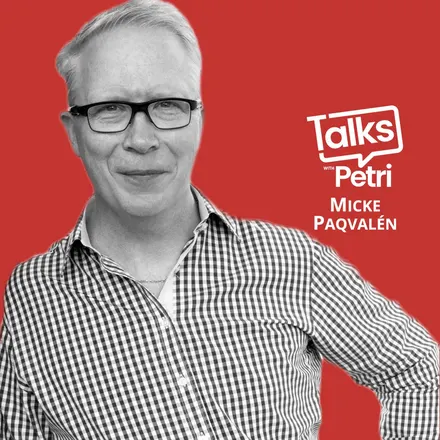
With Micke Paqvalén
Micke Paqvalén talks about building award winning companies, rough times, and almost dying while working too hard. He also reveals his first startup at early age, and founding of a flying boat company.
Micke Paqvalén - TALKS WITH PETRI
Micke Paqvalén talks about building award winning companies, rough times, and almost dying while working too hard. He also reveals his first startup at early age, and founding of a flying boat company.

You can fight gravity but cannot beat it
Micke Paqvalén talks about building award winning companies, rough times, and almost dying while working too hard. He also reveals his first startup at early age, and founding of a flying boat company. See the episode notes: …
Bio
Lars-Michaël (Micke) Paqvalén, M.Sc. (Econ.), is a company builder who has lived and worked internationally for over 25 years and exited four major software companies. He is the founder & chairman of TRÄ Group and Buildbite, co-founder of Brandbassador, Learning Intelligence Group (Claned & GraphoGame), Kiosked, Telepo, HansaWorld and an active early-stage investor in many disruptive companies, such as Proof Analytics among others. He is also on the Advisory Board of Nordic Innovation and Nordic Scalers, a pan-Nordic initiative to find and accelerate next-generation unicorns in the Nordics. During his tenure as an entrepreneur, he has been awarded the European ICT Grand Prize, the award for Best Enterprise Software solution at the Mobile World Congress, the growth entrepreneur of the year in both Finland and Sweden, the American and European Business Awards etc. Micke is a proud father of four children.
 Play video
- 0:00 desert walk
- 1:20 corporate governance
- 2:40 culture and sound values
- 4:00 Hotsip
- 4:20 Telepo
- 7:20 When VCs join your cash-flow positive company
- 9:00 losing 50% of your revenues for years to come
- 10:00 what happens when you remove the founder CEO
- how you get diluted and losing the voting power
- risks with highly scaling up
- 14:00 cost-control and efficiency
- 16:00 founders look after money differently than VCs
- 17:20 The founding of AaltoES
- Yousician, Wolt
- 18:40 Kiosked
- 20:20 Contextual tagging, one-click ecommerce
- 22:20 Google and Facebook taking over the online advertising marketing
- 23:00 debt instruments as a means of startup funding (e.g. EIB)
- 25:00 the fastest growing company in Finland
- 27:20 take care of your health
- near-death by working and stress
- 31:00 Candela
- 37:20 dealership rights for Apple in Finland
- 38:40 Hansaworld
- 41:20 Wallenbergs and Investor
- leaving the secure corporate job
- peer pressure in the startup boom times
- 47:00 you can fight gravity but cannot beat it (make your calls quick)
- 47:20 it’s really easy to make easy things complicated and really hard to make complex things simple
- 47:40 KPIs to focus
- 50:00 the cheapest way of financing, and the most expensive
- 52:00 old wooden buildings
- 52:20 Buildbite
- 58:20 Finnish archipelago
Episode links
- https://www.telepo.com/
- https://yousician.com/
- https://wolt.com/
- https://candela.com/
- https://www.youtube.com/watch?v=CYdpEYWa5Lk (Candela C-8)
- https://www.kiosked.com/
- https://en.wikipedia.org/wiki/Apple_IIe
- https://en.wikipedia.org/wiki/Commodore_VIC-20
- https://en.wikipedia.org/wiki/Macintosh
- https://www.hansaworld.com/en
- https://en.wikipedia.org/wiki/Wallenberg_family
- https://www.investorab.com/
- https://en.wikipedia.org/wiki/Eliel_Saarinen
- https://trahus.fi
- https://buildbite.com/
- https://en.wikipedia.org/wiki/Archipelago_Sea
Transcriptmachine transcription · 1:02:55
Transcribed from the recording by machine (Whisper): it may contain errors.
0:00 Welcome to Talk with Petri show. I'm your host Petri and today's guest is serial entrepreneur and angel investor Micke Paqvalen. Welcome, Micke. Thank you. You started your entrepreneur career at 17 years old. You have raised over 100 million in venture capital. You have several successful exits. What are the lessons you have learned? I think you call them your thesis and let's start with your desert walk. What is a desert walk? Yeah, desert walk is every entrepreneurship. There's something common in every company I've started. And that's that every time it takes three years to find a business model, to get everything nailed down, value propositions, ideal customer profiles. So I started to call it Desert Walk and it's been the commonality of every company I've started at.
1:05 It takes approximately three years to get there, but then things start to roll. And what are the other ones? I think you had maybe three or four more. You have to remind me now when we had this discussion. Yeah, you were showing me those fancy slides and you mentioned people and culture, I think and corporate covenants and flexible finance comes to my mind. So you want to actually just say a little bit of those as well, because I think those And we can then go to the stories because I don't think you just came up one morning and wrote them down. It was more like that you were actually experiencing them. But, you know, I think giving the thesis first and then going to actual stories, how you actually came up with them properly, you know, gives people a little bit of idea that, you know, what happened and how the struggle actually made those two.
2:00 So the second one is corporate governance. And people tend to diminish the importance of corporate governance when setting up a company. Corporate governance is actually extremely important, not only for the internal company, but also externally when you're looking for funding. If you don't have your books in order, the value of the company will deteriorate over time. So corporate governance is kind of a broader concept. It's about both having your books in order from start, but also of actually thinking proactively and engaging the right people at the right time proactively. It's almost like building a house.
2:51 You need to do the, you know, there's certain things you need to do in sequential order. And, but corporate governance is definitely one that you need to start with. Then, I think I mentioned about the culture and the importance of values. And I've seen it, you know, especially when it comes to recruitments and when it comes to building teams, powerful teams. having sound values. It's not something that you just invent. It has to come from your inside of you. And as a founder, you are the one who is actually carrying those values on a daily basis. So I would say that values, corporate governance, and then the desert walk, that's some of the commonalities and some of the things that people very easily stumble on very early in when they're a billion company, when they're so excited about the product, that they forget all these other things that actually can make or break it for you.
3:57 Let's start with TelePol. I think that's really successful case, but there are also some some dire lessons to learn as well. And can you, let's start from the beginning from there. What is Telepo, how did you come up with the idea and then can you sort of tell the story and maybe I can ask some questions in the meanwhile, but let's get started from the beginning. So for those who don't know Telepo, we were very early on in the voice over IP business. That was end of the 1990s. I was part of a very exciting journey called HotSip. Sip being the standard protocol for multimedia communication. Back then it was age 3 to 3 and it only supported voice communication. So we kind of set up a company called HotSip, which was later acquired by Oracle.
4:53 and the investors were they were the big ones like three eyes and arganor and legend and the big guys and and they had this kind of view that that it's the service providers that's going to dominate the world and and and so we we for uh for a couple of years we tried to convince them to to kind of hey look we have this service called simple service which was actually a very nice so you could do you can do multiple things. You could do online video, you could do online gaming. Actually presence was part of that, voice, video, you know, all of that was part of that. It was like a soft client. And we tried to convince them that the future is there. And they were, no, no, no, no, no, you guys, you need to build infrastructure for the big telcos, service providers.
5:46 And then we kind of, okay. came a guy who said okay you know you you're scrapping your your consumer service right because we had this soft client beautiful soft client and we said yeah unfortunately and i remember actually i was one of the probably the first first people to also you know use it and it was it was so fancy you know what it was it was like remember it's all it's more than 25 years ago so it's the time flies so we had this guy coming in and saying okay i mean i can take over him said okay you know you here are the guys who can do it for you and help you do it and like 18 months later he sold the company for i think it was 4.8 billion and it was funny to see how wrong you know these big corporate venture capitalists can be and it was actually skype so i remember that meeting when we met Niklas Sendstrom back in in Stockholm but from there on we were convinced that the consumer side the b2c is is where we need to go and and so i jumped off 2003 i jumped off hot ship where i was the biggest private investor at that time and i started to you know with of course with acceptance of the investor i started to look at the consumer side and and and what are the consumer services we can build and off that came telepo which eventually then ended up being a a more than a you know very much a b2b uh platform for enterprises and today actually i think telepo is the largest uh platform for for for telcos providing b2b services uh in europe we sold it to astra who then sold it part of a bigger group.
7:42 But many learnings. But it's not that simple like any business. In the beginning, you were building it. Did you have one or two co-founders in there? And you started to have it as a cash flow positive company. And can you tell what happens when you start to invite also some VCs in? Yeah, so what happened was we grew the company. We actually grew organically 100% every year. So by 2008, we were doing roughly 10 million ARR. I think it was eight to be honest. And we had a order stock of 10 million. So we were really looking forward to a rapid growth, going from then 10 to 20 to 40 to 100. And a year earlier, we brought on a company called, our venture capital firm called Accel Partners.
8:35 And they were like, you know, They were like saying that you need to fire this. You need to fire this. It's going really well. And you need to bring in the big corporate guys. You need to bring in a CEO, a seasoned CEO. You need to bring in a seasoned sales team and stuff like that. So what happened then was after a year, unfortunately, they convinced me to step down as a founder and bring in one of the guys was head of Oracle's service sales in Europe, and the other guy was head of Cisco's enterprise sales in Europe. And those two guys came on board. And unfortunately, it was 2008 when the financial crisis hit. So what happened was that we actually fourfolded our cost base, but the revenue started dropping.
9:34 So we actually lost 50% revenues every year from there on. And the formula didn't work at all. So later on, a couple of years down the road, that team was gone, but the company was more or less empty and had to restart. And fortunately, we had a really good COO who took over it and actually got the company back on its feet. We did a fundraising and then it was solved. But lesson learned there was, you know, never, ever remove the founder from the equation. Because when you do that, it's so much of the company value base and soul and all those kind of things that I talked about earlier. It's not like a machine where you can just replace one thing with another.
10:28 It's actually a founder is extremely critical for a company's success. And every company I've been in and every company I've invested in, I've seen the same thing happen over and over again. So, you know, make sure you keep the founders happy. That's one of the things I've learned the hard way. And during this journey, of course, then we were diluted down to almost zero. And you also mentioned that they convinced you to step down. was there also some other mechanisms? Yeah. What do you have to be aware of? You know, that's probably coming from the corporate governance, I would guess, the shareholder agreement and investment agreement and all these things which sound so boring. And, you know, you don't want to pay attention to those, you know, if you're busy to build your company, that's the sentiment, at least usually.
11:22 But yeah, a couple of things. First of all, we back in early 2000 or 2006, when we brought on this, It was not only Accel, it was a couple of other VCs. We didn't really understand the value of a shareholders agreement. So for us, we had two-thirds of the company, and we were okay with splitting the board. So basically, they got half of the board, we got half of the board. So we didn't really care much about that. We were just building a company. And they also got a decisive vote when choosing chairman. And that was actually one of the biggest mistakes we've done. Because when the going gets tough, which always it gets, we were growing so fast that we needed continuously to increase our working capital.
12:12 And 2008 financial crisis came. We needed to fill our war chest. And of course, they stepped up. They're professional investors. But they did have some special terms. Since I've been objecting to changing the management or changing the CEO for a while, and we had the majority, they had this small clause embedded in that agreement where basically they had the right to decide when the company was supposed to change the CEO. And so they exercised that right pretty quickly after they kind of financed us. And that ended up, okay, I got a good deal, but that ended up, you know, basically destroying the company. Which, unfortunately, today, I mean, Telepo is doing, I hear that it's the Europe's largest infrastructure provider for these kind of services.
13:12 So, and I know that they, for example, in Sweden, they have many millions of daily users as well. So it's unfortunate, but sometimes you do these mistakes and that was one of the mistakes. So how would you do it differently now? If I recap here, you build it from scratch, basically you were cash flow positive as well and you were doubling the revenues and it was looking good and then you were like, okay, let's make it a bit faster. Let's take some additional capital. But basically, then you were sidelined and then the financial crisis hit and those things happened. So what would you do now? I would be extremely aware with the cost base. So what we did was what we built up a cost base for extremely rapid growth. So as I said, we were looking at the growth rates from, you know, we were doing 100% every year organically. And they wanted us to continue to do it at 100%.
14:15 but that means also that you have to build your cost base in order to support that and sustain that and and i would look for efficiencies there instead of just you know ramping up you know we i think we interviewed some 500 people at that time we were really you know bringing in a lot of people and and and i think what that's one of the core mistakes is when the cost control got out of hands uh it was like we had the cash but when when the start the cash started to diminish that was problem started of course when because the growth didn't come and we had the financial crisis so we didn't get that growth that we were looking for short term and that short term turned out to be a very unhealthy exercise for us how much funds did you actually raise and do you remember the burn rate because usually what happens is that when you're actually going fast and you need to work in capital you have a lot of payroll as well. You raise a lot of money, but you also lose a lot of money per month basis if you're not that profitable or you need it for the growth as well. So things can go quickly wrong. Yeah, we were actually, when I was running the company, we had a burn rate of approximately 500k a month burn rate. And we were doing revenues slightly north of that. So we were, like i said we were cash flow positive when we brought on the new new management suddenly the the burn rate jumped from 500 to well above 1 million and and and and but the revenues didn't jump that much so that's where we started to really really really quickly burn money and i we brought in almost 10 million at that point of time in in chunks uh but uh that wasn't enough so it was like a unfortunate situation but make sure that you don't you know like a co-founder you're always aware you know you always keep you always look for the money look after the money in
16:25 a completely different way that the the venture capitalist does and and that's you know they we have different interests and and and and and uh and unfortunately those interested in meet at that point of time uh they were good i mean i i can't complain on they you know they they had big uh big hopes and they had big plans for us and they they they actually brought in some really good people but you know this terminal mistake of actually uh actually starting to to grow uh the cost base was the biggest mistake we ever did without actually you know making sure that we had the had a long-term sustainability for it. A great company. But then you were and still is. Then you learned from these lessons and you started something called Kiosk and that was a a few years later. Can you tell what is kiosk and explain the case, you know, whichever way you want to go ahead?
17:34 So I took a couple of years break. You know, I actually got a really good deal from them. So I took a couple of years break and I started to look around what's the kind of what's the next challenge I want to take. And in Finland something called Aalto University had been just founded. So I started wandering around there and looking, okay, are there any interesting things to do? And there was a couple of persons who were actually working on something called Aalto Entrepreneurship Society. And I tried to convince these investors, Axel and all these guys, that, hey, Finland is a hot place. This was like 2009. Finland is the place, you know, everything, you know, really cool things are happening in Finland. you know it's bubbling and they were like yeah it's you know it's too far away too far away we're not interested you know later on they you know they made some super good investment in super sales and and in rovio's and you know but that was like three years earlier so i started to wander around there and see and help these guys and and we went on tour to try to find you know different uh exciting companies one of them is today is uh in the music business a very well known brand called musician that we found and and so it was really exciting times there it was a kind of a new generation entrepreneurship generation growing up back then that wanted to take risk and they've gotten rewarded very well so mickey koozy volt was one of those guys that you know i spend a lot of time there um mentoring and helping and and uh back then i i i i i actually met my co-founder at the kiosk he had this idea of tagging images i said why not you know it's it's a great idea and e-commerce is just around the corner why not you know combine uh e-commerce and tagging with each other and you know build something that you know basically what it means is that you can monetize every impulse.
19:36 And it was like early 2010. Monetizing impulses wasn't interesting. So it was like Instagram just started. YouTube was, I don't know, four or five years old. And was it iPhone 4S or something around that time? Or was it even 4? So, you know, we are talking really early years. Yeah, but it was super exciting because we call it a web-wide shop. And basically, the intent was that you could purchase anything you see. Anything you see can be yours was our kind of tagline. So basically, being able to use the phone to basically purchase anything that you see and auto-recognize it and basically enabling it to be... But the problem was that there wasn't any solution on the e-commerce side. E-commerce was very early days.
20:25 Then it was Magento and all those guys were very, very early. So this kind of one-click purchase solutions wasn't out there. So it actually ended up for us, we had to basically, we had to take the customer to a store. And that single thing killed the whole business case. If we would have had back then one-click shopping available, social commerce would be on a completely different level than it is today. But we basically made it really contextual tagging. We almost made it 100% accurate. So we worked with all these big publishers in the UK like Mirror, Times, all of those. They had it on their website.
21:14 And we were able to do contextual tagging automatically. And so we had something which was kind of really, really super, super slick and nice. And we also did video tagging. So, you know, remember, it was 2011. But as the business model didn't fly, you know, we didn't really make any money because it was everything, you know, it was all about the kind of, it wasn't, it was all about the CTA pricing. So basically, you had to purchase in order for us to earn any money. And so we ended up pivoting the whole business in 2012 and going more into advertising. And so we used the same technology to build our own ad servers.
22:04 And then further on down the road, 2015, when Google introduced header bidding and all these new technologies, we went into that business as well. So we kind of pivoted quite a few times during the way. And we also, we did pretty well, actually, I would say. Until 2015, once again, we doubled our revenues every year. So it was an exciting journey. We had a great team. We had great corporate values. We had good corporate governance. we had a great board but then 2015 we all know that google and facebook decided that they want to take the the that market so we were kind of we were forced to kind of uh pivot once again and you also raised a little bit of money i would say it was uh angel investors then there was some VC money and also some other means, the European Investment Bank.
23:14 And it was in two digits in millions, but you raised all together. Yeah, we had really good investors back then. And the funny thing was that we quite early on tried to kind of remember what we did wrong in Telepo. And so we started to look for different debt instruments. And I heard some rumors that European Investment Bank had been in Finland pitching that they were setting up some, you know, debt instruments. And they had been there in April 2000, I think it was 2015. And I just decided to call them up and ask them, how did it go? What's up?
24:00 And I said, no interest in Finland, nowhere. I said, hey, this was in June. I said, you know, I'm really interested. I said, oh, we don't have even had the agreements here for this. So I said, I can fix those for you guys. So we ended up actually closing that 50 million investment round, actually together with European Investments, writing the core agreements that they are using today together with them and setting up this facility of 50 million. And it was a really quick exercise. We did it in less than four weeks because it needed to be done before they went on vacation in August. So we actually signed the papers in the end of July. So first contact was, I think it was midsummer, midsummer day, June. And then we closed the round or the depth instrument in the end of July.
24:57 So it was a really, really, really good ride for us. And in that time, we also wrote all the agreements that for them so that they could actually go. They had the only thing they had was money back then, but they were really eagerly looking for promising startups. So that was really good for us. And when you got the money, I think that was almost like the turning point when things started to go with rough with the kiosk. and also you had some personal issues as well. Yeah. Can you walk us through? Yeah. Like I said, we had grown kiosk also 100% every year. So by 2015, we were the fastest growing company in Finland. Remember, Supercell was also here.
25:48 So we got this reward for the fastest growing company in Finland. And we were doing something like 20 million, a little bit less than 20 million in revenues. And we got the 15 million. What happened then was that Google came out with this new technology and actually more or less decided together with Facebook that they're going to take over the market. So in less than 12 months, we basically lost 50% of our revenues without losing a single client or customer. So this was kind of a really big inflection point for us. and and we had to to basically we had to go back into the engineering room and redesign the technology and and that together with that we had to actually uh we had to take down the number of employees unfortunately quite radically from we were i think we were close to 100 back then we we had to to do a couple of layoff rounds big layoff rounds actually you know triggered um triggered what i have now is uh is uh is uh diabetes one so i actually i had to i had to leave the company i had to take a couple a year off then back then that was 2016 and i i didn't really recognize that i was ill until almost at the last minute i had lost 20 kilos of weight i had lost almost my eyesight but i was still going strong i was still you know we'll fix this we'll fix this uh luckily i had a really good co-founder who basically could jump on and take over the company after me but it was it was a really tough ride so i ended up in in emergency room in hospital for a week and then basically i I had to stop working for a year in order to get back my health.
27:47 And now I'm living with diabetes, but it's not the end of the world. It's you know, you actually you have to take care better. You learn that you have to take care better of yourself. So sleep well, eat well and exercise well. Are there any signals founders who are listening now could sort of pick up that, you know warning signs or some things that you could sort of catch a bit earlier than before you in the emergency room they don't do the same mistake so what i did was i was like back then i was i was traveling like yeah i did i did i think i did in i calculated i did just back and forth travel to stockholm back in those days i did twice a week back and forth to stockholm and from stockholm then I travel everywhere around the world. So I was actually, I spent more than 30% of my awakening time on the planes. I was sleeping two, three hours a day, having small kids, or not small kids, they were already, you know, teenagers back then, but sleeping two, three hours a night and and and and basically you know don't do that it will come back and hit you so it was like a somehow it became a game for me to to survive and and that game ended up you know taking me to to hospital i started to lose rapidly lose weight in 2016 like a half a kilo per day like i said i lost my eyesight i lost my i started to lose skin on my my my bones like big chunks of skin on my bones i started to drink water and somehow you know at that point of time your body you know it's just in a survival mode you don't think and until you know in the last minute i had a good friend who actually recommended me to go to hospital and do a check and when they did the blood screening in hospital they my blood sugar was above 100 so they couldn't even measure it
29:55 And so they just, you know, the only thing they did was they kind of put me into the emergency room and I stayed there for almost a week. Thank, luckily. They told me that later, that was a Saturday evening, they told me I wouldn't have woken up anymore on Monday morning. I was in that bad shape. Miten te työsk skiing so uh in a couple of months i will be skiing every day but uh yeah it it taught me the importance of taking care of yourself because there's nobody else to take care of yourself you can take care of employees you can take care of the companies you know you have you know you have this kind of as a founder you have this kind of you know for you it's important to to make sure that everybody is feeling well but you know you need to take care of yourself first because otherwise it's not gonna fly it was for me it was like almost fatal unfortunately let's have something fun in a uh as a next one or at least something cool which i think is cool uh maybe some of the audience as well candela what is it uh how did you get involved and and how is it disrupting the world? Yes, so Kandela is actually I got 2014 a friend of mine contacted me and said he has this great idea he had read the you know comic books in Sweden and and he had seen this great thing that you know you can boil this flying boats and actually some of them were already built actually already in the late 19th century. So we started to kind of
32:12 look around, you know, are there any, you know, is this possible? And then I promised to help him to set up the company. And so Gustav Hasselskoog, the founder, is actually the inventor, and I don't want to take any credit, but it was a fun journey. So for the first two years, I'll help him to set up the company i helped him to to to create the kind of the vision to i helped him with go to market i think actually i was very very uh i was very involved in the in the sales which so the first 20 boats we sold i was personally doing myself and and but he was actually doing the designs and it was like it was a big struggle for them back then 2014 and 2016 getting the algorithms right getting you know you know the the balance of the boat right everything but when you look at it now uh it's i think it's the world's largest uh today a a electric uh speed boat and they're doing extremely well now they are actually they they've gotten really good investors i know that what's public is that chris anderson has invested there a lot of money and and now for example that stockholm city is actually is testing out their new transport they are actually doing starting to do much more water transportation with candela so candela is turning from being a speedboat to being a much more broader offering and it's uh it's working really well the only problem is the price point it's uh it's unfortunately a little bit too high for me but it was a fun ride to basically build that company from scratch with gustav and and and seeing it fly and then 2016 what we did was we we brought i did you know when i was sick i couldn't do it i was basically you know i stopped doing any work 2016 we had to find a new chairman and our boat we had a former boss called uh hansalinde who stepped up and took over the chairmanship and i left them back then
34:22 Do you still remember that you said that you were involved with the first 20 sales? What was the sales pitch? How do you sell? Who are the first buyers for something which hasn't been done before? And what was the pitch? It was great. It was typically, I mean, the first customer, we couldn't even believe that it was the first customer. We got an email one night that was claimed to be the CTO of Microsoft, who had seen somewhere here on the net he had seen you know something about candela and said he wants one so we had to check them he actually was the cto of microsoft so it was like these very uh enthusiastic engineers who saw that this is a revolutionary thing we also had a very very famous entrepreneur in finland syria entrepreneur in finland who said you know i'm gonna buy your boat i'm gonna pay double price i don't want the boat i just want to make i want to make see that this happens i just want to make one ride with the boat and and then that's fine for me so uh so there are these kind of people and and uh fantastic people i don't want to name them but they are you know fantastic so most of them were really pioneers and take many of them were like tech entrepreneurs that had done well and wanted to see this fly so it was exciting sales. In a way it was an easy sale because they didn't have the money. They thought this was a really cool thing so it was an easy sale.
35:59 Then came all the troubles and luckily I had other things to do then but right now I think they're doing really well. You started early. You were 17 years old and for some reason you started a company. What's the story there? You didn't find anything else to do or you were bored or you know, school was too boring or why did you start as an entrepreneur? Yes, I actually jumped off school three times, but that's a separate story. I actually got so excited about Apple IIe back in the 1980s. And I started to do some... What is Apple IIe for those people who are not so familiar? It was the last model they had before coming out with Lisa and Mac.
37:00 the what is called this Mac Plus Macintosh computer. So I got excited about that. I had some other early experiences from Spectrum, ZX and those kind of VIC-20, those computers back then. And so I got excited about Apple and started to follow them. And then actually when the Macintosh came out was 1984. I couldn't afford one of course, but I actually back then in 1985, I got the dealership rights for Apple from, you know, basically for the whole South of Finland, you know, being 17. Sorry, this sounds so crazy.
37:49 So you cannot afford one computer, but you just got for the dealership rights for the half of Finland. Yeah, but it was super nice, you know, it was. And back then, you know, we had this PageMaker, QuarkXPress, everything was about desktop publishing, right? And then there was FileMaker and HypoCards. HypoCard. So there was some software there. But I always felt that, you know, business is what I like. And back then, as a 17-year-old, I had enrolled at the business school in Finland. And so I started to look, okay, what can I do here? I have the dealership, maybe. So what I do is I started to sell to students in school, Macintoshes. And they had these special deals, special price for students. So I started to make some money on that one.
38:40 I set up a shop called Data Age. And then we started to see, OK, what else can we do? Is there any business software? And since there is FileMaker and PageMaker, why isn't there a business maker? So I found this or we found this great developer in Sweden that had failed once trying to create the bookkeeping software for Macintosh. And together we set up a business called, initially it was called Businessmaker. Then it became Nordic Business Solutions. Then it grew, it became Hansa World and so forth and so forth. And today I think they have about one million enterprises using their software. still going strong and we were three founders myself my co-founder in Finland and the developer and he now I think owns most of the shares in the company and they are doing really well as well but it was a fun ride it was a fun ride being part of this journey from the beginning so why did you stop uh being involved in the company was it you needed to do the military service or you wanted to you know do the school as well or right so i had i had three times already quit business school as well so i i felt that it was too you know too boring when you were doing this and when you were doing your own business and they didn't have any experience or anything like that it's not like you know nowadays you know the business schools are really good back then we didn't have any there was no it was just tests it was just uh you know um you just had to read and test go to test nothing more so we have this thing called military service in Finland you have to do one year i haven't done that so i i still had to do that i was 24 i haven't finished my business school so i had no academic exam so in in 1993 94 i decided to i need to kind of get something at least so something on paper so i i i sold off my shares in the company way too early we just
40:49 back then we had just launched our client service solution we just had launched our windows version and and and the company was like going like this so in hindsight should never have sold they they actually the company has been profitable from day one so they're still going strong and profitable but i i i ended up doing my military service one year in in finland and then uh and then taking my my exam from the business school and then going forward to actually i wanted to try a corporate job so i i moved to sweden and and was recruited by the wallenberg family which is very much like the rockefeller family in in the u.s and they had this really exciting uh i wouldn't say incubator but basically they had collected they had two companies holding companies one was a strategic holding company called investor which is huge today it's basically controlling one more than one third of the nordic ecosystem and then they had this company called incentive which had all these small exciting companies medtech companies you know industrial companies ericsson was part of that portfolio. ASEA was part of that portfolio. So they wanted to kind of divest that portfolio.
42:12 And it was the biggest divestiture in Sweden back then. So they were looking for people who could actually do the groundwork and then work with these companies hands-on. So I felt that that was, you know, for an entrepreneur, that was a pretty nice job to see a 150-year-old family business on the other side and so we it was fantastic time six years uh just being able to you know suck in all the competence that they have and gathered for 150 years fantastic people really knowledgeable people but then 2000 my friends started uh or 99 99 my friends started hot ship so i ended up jumping over there and everybody told me that was crazy you know you had You had a secure job, you had a good pay, you had all this, you had lots of secretaries, you were traveling around the world.
43:07 You had your future lined up, but Startup World is where I belong. Do you still remember when you were thinking about jumping off from that wonderful job? What was the reasoning behind it? Because this was also, was it April 2000 when you actually did the final jump? And for those who actually listened to a few episodes back, there's a Henry Nyler talking about when the market was crashing. Was it lastminute.com? Was it the final IPO, which didn't go well? And this is exactly the same time you decided that now is the best time to go for the startup world. It was a, yeah, they had been, you know, we had been playing indoor hockey twice a week together with all those famous Swedish entrepreneurs. And they were everybody asking, all the time asking me, okay, when do you jump off? When do you jump off? They told me about all this fantastic, let's buy it and information highway exits that they've done and IPOs that they did back then 1999, 2000. So finally I gave up and said, okay, let's try it.
44:23 They had just raised the fund, $90 million fund, and they had invested in 30-something companies. And so I said, okay, I'll give it a try. I actually had an offer on the table to become CTO, one of the largest companies today. cefo sorry of the one of the largest companies of today in the in the swedish swedish companies but i said i don't know why don't i give it a try and actually it was on the 20th of april 2000 and that was when the dotcom crash happened so it was the same day i left and joined them that was the the peak of nasdaq back then so i ended up actually my only job was to clean up so i ended up actually going from country to country closing down their offices because they were burning huge amount of money it was like heydays of the dotcom and they were like they've they they had private apartments all over the world they had cars they had everything so they just burning cash so i ended up cleaning up all of that and and and traveling around the world and closing down 11 offices and and basically firing all the people and and the only thing was was left was a couple of handful of companies and and then just you know closing all these companies as well so it was like a 12 month of just a a a closing down everything unfortunately and i've actually I also lost tons of money on that one. I was I think I was the third largest private investor in that company in that fund. So I lost all that money as well. So it was another ride to remember when you're a little bit older. Are there any stories or experiences or lessons with that period when you were with the corporate because it's an exceptional company, it's an
46:32 exceptional family. And what I understand that they also quite hands-on doing stuff and understanding, so it's not just looking to profit and losses and calculating the dividends, it's actually also running the companies and being there involved with the actual operational side. So are there anything you want to say with that? There was a lot of things I learned but one of the things that they always said and they kind of they were very kind of down to earth, they are fantastic family, they care of each other, the values are really important. One of the things that they always said was I always remember two things: Mikke, you can't fight gravity but you can't beat it. That was one things they said so you know make your calls quick and the other thing was they kind of a they were a little bit reluctant to consultants they always you know that the saying was that it's really it's it's really easy to make things complicated that's why we have consultants really easy to make easy things complicated but it's really difficult to make difficult things easy that's why we have us and that was like you know you know for them it was a simplicity was really important for example when when we had we had factories in more than 60 countries we had logistics centers in more than 70 countries and and and but these guys they knew that they were just you know they were just focusing on one or two KPIs constantly so for example a production capacity. I remember my boss was like, he was like, the only number he wants to see is the production capacity utilization rate. If it was above 72%, he knew that they were making losses.
48:27 If it was below, he knew that they were making losses because they had less, they have more people that they needed. Or if it was above, they needed to go do a couple of more shifts, which made them unprofitable. So he was like, he had this kind of a feeling you know he had this understanding of the dynamics of a business that i haven't seen anybody have you know later on and he was also kind of he was a really good in the numbers he could spot uh he sometimes he even gave he gave me excel sheets and said mickey tell me what's wrong here and he had the capability of actually digesting big amount of numbers in just by glancing at them very quickly and since i have an interest and background as a mathematician as well it actually became one of my big passions so it was really it was really funny we we did some we did some really nice what do you call it not perfect what do we call it jokes for the actually for the board as well back then we sometimes we just swapped the numbers and we just made some crazy summary and and and and they But it was fantastic. I had a fantastic boss back then.
49:48 So what are the KPIs you now closely following with the startup investments in your own companies? Do you have that similar kind of... Cash flow. Cash flow. You can do growth, but if you don't have the cash flow in order, it doesn't matter. So it's all about the cash flow, making sure that you have control of your cash flow. And that's also when it comes to financing. That's the cheapest way of financing as well. The more you can get from your customers in advance, the cheaper your financing cost is. The most expensive capital is, of course, not debt, but venture capital. Because there you are not only paying interest rate, you're giving away control. And control is in for an entrepreneur is really important.
50:37 But we can see now in the last few years that actually venture capitals have started to understand that. And also entrepreneurs have started to understand that. That's why we're seeing so much new debt instruments coming out on the market. And EIB is also introducing new debt instruments all the time. So, you know, these debt instruments, they can fuel also entrepreneurship. They're the whole kind of their... entrepreneurs' drive, because you don't need to give away all that control that we did. We had to give. You've been building something the last two years as well, and what I heard that you actually used the design thinking approach there as well, knocking on doors of 100 different contractors and the target market customers and asking what's wrong and how do you do stuff.
51:37 Can you explain how do you started to approach? Because you knew that there's an issue firsthand. There's a problem in industry. And there's like, how did you, what were the steps that, okay, we have an issue here, Houston, there's a problem. And then now this week, you just mentioned that actually as of today, It's now filed in the product, at least the MVP product, is in the Apple Store and Google Store finalization processes. So they are coming up live pretty soon. So what was the first step and how do you walk through? And I think this happened in the last two years now. Yeah, this is the kind of once again, you know, when you say never again and you do it again. So 2017, when I kind of, when I cured and I found a new balance in life, I actually started to see what's my big passion in life. And that's old buildings, old wooden buildings. So I have this old wooden building from the early 20th century, 1910. It's built by a famous architect called Elia Saarinen. And I started to renovate it and I had some really bad experiences, both from customer experience, but also from a kind of professional experience.
52:55 It's really hard to find people who know how to handle these old houses. So I said, OK, this is interesting because around me here where I live, it's a lake here, just outside of Helsinki. There's like 20 of those buildings. And if I can't find anyone who can fix them, the other ones can't either find. So I decided there's an opportunity here. So I set up a company called Trehus, which is a wooden house called and started to gather those people and find those people. But, you know, once again, going into a new category or new segment, you know, you don't know anything about. It's always a challenge. So the first three years we were really doing half a million, a million losses every year, trying to find the right people.
53:44 Construction is not famous for being customer-centric. And we pivoted a couple of times. And it wasn't until like 18 months ago that we found a secret sauce on how to basically build this business. So now we have 40 people. We're not looking for more people. We actually have a solid, good, profitable business. We have two legs to stand on. We are both renovating old houses, everything from the 15th century until today. And then we have two carpenter shops that actually where we do everything from windows to furniture to kitchens. We do a lot of kitchens for people, you know, without all these plastics and all these glues and all this kind of stuff. It's beautiful, beautiful, like Danish design kitchens by hand.
54:44 Everything is done by hand. But when we did this pivot, we also recognized that there is no real digital tools out there. I mean, if you look at a typical construction company, they use 10 to 15 different tools. So everything from you know basic like WhatsApp or Slack to Trello for project management, then they use like Congrid or they use Excel for calculations. Then they use... you know so they have... they're using... normally they're using between 10 to 15 different SaaS software for doing all the stuff that can be done in one application. So what we did was initially we thought that okay this is interesting this is a b2b opportunity as well but we saw that there's so many dinosaurs out there so many big b2b platforms out there so we ended pivoting into the b2c software and actually you know launched the first application with all these features that you now basically are buying from 10 different sources you can get in one application time tracking is embedded included forecasting is embedded included reporting is embedded included everything is mobile so basically now you can actually get you can do all the things that you used 10 different software to do you can do in one solution and that's what we just launched and we're slowly growing it now we know that the market is huge there's nothing similar we know that the market is opportunity is big and And so we're taking country by country right now.
56:30 What is your favorite word? Oh, yeah. I think, you know, my favorite word is like, I would say, let's do it. If you have a problem. I mean, there's nothing, you know, for an entrepreneur, it's like, There's no obstacles. So let's just roll up our sleeves and do it. If we have a problem, let's fix it. Long answer to a short question. What is your least favorite word? Oh, this is the one that I always get when somebody, you know, when you have corporate people involved, you get this. And nobody told me. Nobody told me that. Couldn't you figure it out yourself? No. But nobody said to me that, to do that. That annoys me a lot.
57:20 What turns you on creatively, spiritually or emotionally? Developing new things. It is so fun to see solving problems and seeing things develop both things and people. It actually is, you know, seeing people grow and develop, that makes me feel really good. What does you of? There it's easy to say one word: betrayal. And for me, having worked with the Wallenberg family, you know, that was the key thing, you know, you're honest, you're open, you're honest. You don't betray anyone. You know, we are all in the same boat.
58:11 So betrayal is a kind of a... that's a no-go. What is your favorite curse word? I don't use curse words. I like to listen. There's a famous Swedish musician, Thomas Torsten, who sings "fan, fan, fan". It's like "shit, shit, shit" almost. But that's not curse word I use, but that's the kind of music I listen to when I'm really pissed off. And then just go ahead again. What sound or noise do you love? I'm actually brought out in the Finnish archipelago. It's beautiful. For those who haven't seen it, it's fantastic.
59:03 All the different... throughout the year, you know, how it changes. And the sound of birds, the sound of water, you know, it's fantastic. That's kind of, that's my inner peace. And the Finnish archipelago, everybody should experience it. In the kiosk, we actually, we used to have this archipelago race, where actually once a year we took all people out in the Finnish archipelago to experience it. And they were all amazed every time. What sound or noise do you hate? You know, I have four kids and with four kids everything happens. But every now and a while you hear something breaking.
59:56 And that's what's happened now. And that's the kind of... that sound of breaking. You know that's okay, not again, what happened now? What profession other than your own would you like to attend? I've always admired lawyers. I always admire because I'm a mathematician and everything is so logical and so is law. Very logical. So if I would choose a new profession, I would actually probably be a lawyer. Because right now I'm always writing my own agreements or company agreements as well, most of them. So I think I started to become pretty good at doing that. So negotiating agreements.
1:00:48 So I think a lawyer would be very natural for me. What profession would you not like to do? Oh, that's easy. That's a corporate job. Doing something where somebody is just telling you what to do constantly and having opinions? No. I mean, come on. Hey, but you could say I didn't know. Nobody told. Nobody told me. Doing a corporate job, that's... I know, I'm not going to do that. If you could be a co-founder of any startup in any era, which one would you choose? Apple. I was back then intrigued by, you know, I had my first design company actually when I was 16, 16, 17. We were doing designing business cons back then with Apple computer.
1:01:44 And, you know, this combination of computing and design is something that's always fascinated me. And it's the beauty. It's the kind of the, it's so much, you know, it's the peacefulness. They're kind of being able to relax your eye on something that you know is really well done. That intrigues me. So I would definitely say design and computing. Any final words to the audience? And remember, yeah, I don't know what I should say final words, but I would say this is that we entrepreneurs, we are a special breed in a way. We always help each other. And remember to ask for advice. If you want to become an entrepreneur or if you're an entrepreneur, if you have a business already running, don't be afraid of asking for advice. It's like, you know, it's part of the whole kind of the community that we help each other.
1:02:55 And I think giving back is really a powerful thing. So I think we entrepreneurs, we need to give back. We need to work more on helping others to become successful. That's the only way we can bring things forward. So giving back is something, you know, don't be afraid of asking, but don't be afraid of giving back. It will always come back. Hope I can... Thank you Mick. Sorry. Hope I can help somebody. Yeah, I guess there was so many lessons even in this hour we had. So I'm sure somebody already got some ideas from what you said today. And thank you audience as well for joining us today and till next time.
More from Talks with PetriAll episodes →
- Ahti HeinlaThe impossible equation23 Nov 2022
- Hannu RyopponenIKEA—Ingvar Kamprad’s startup from 194325 Oct 2022
- Andrew ZinchukUkrainian startup ecosystem1 Sept 2022
- Mikko RevonniemiFounder burnout20 Jul 2022