EpisodeTalks with Petri
Efforts create the achievements
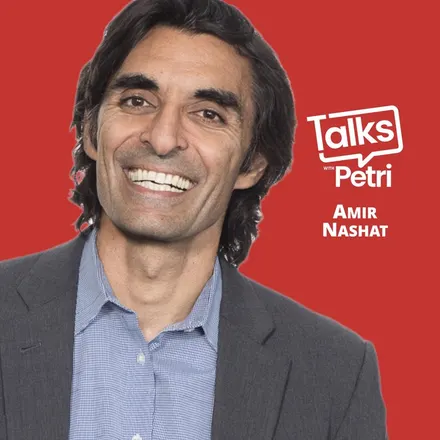
With Amir Nashat
Amir Nashat talks about working with stellar people, how curiosity leads you to amazing results, and what is exciting in the biotech field.
Amir Nashat - TALKS WITH PETRI
Amir Nashat talks about working with stellar people, how curiosity leads you to amazing results, and what is exciting in the biotech field. He also reveals how he met his childhood hero.

Efforts create the achievements
Amir Nashat talks about working with stellar people, how curiosity leads you to amazing results, and what is exciting in the biotech field. He also reveals how he met his childhood hero. See the episode notes: …
Bio
Amir Nashat is a managing partner in Polaris’ Boston office. He joined Polaris in 2002 and focuses on investments in healthcare.
Additionally, Amir has served as a director of Adnexus Therapeutics (Bristol Myers Squibb), Athenix Corporation (Bayer), Avila Therapeutics (Celgene), Fate Therapeutics (NASDAQ: FATE), Freenome, Living Proof (Unilever), Promedior Pharmaceuticals (Roche), Receptos (Celgene), Selecta Biosciences (NASDAQ: SELB), Sun Catalytix (Lockheed Martin), and TARIS Biomedical (J&J).
In addition to his investment role, Amir has served as the CEO of Dewpoint, Jnana, Living Proof, Olivo Labs, and Sun Catalytix. Amir also serves on the Partners Innovation Fund and the Investment Advisory Committee for The Engine at MIT, and helped launch the MIT Sandbox Innovation Fund as its active president.
He has been named to the Forbes Midas List of “Top 100 Venture Capitalists.”
Prior to joining Polaris, Amir completed his ScD as a Hertz Fellow in Chemical Engineering at the Massachusetts Institute of Technology with a minor in Biology under the guidance of Dr. Robert Langer. Amir also earned both his MS and BS in Materials Science and Mechanical Engineering at the University of California, Berkeley.
 Play video
- 3:00 company creation by VCs
- 8:20 interesting people vs. defined goals
- 8:40 learning from people
- 9:00 decision-making with people
- 10:40 curiosity leading to new people
- 12:20 experienced people as co-founders
- 15:40 mistakes sole entrepreneurs do
- 17:20 building companies in different environments
- 20:40 cultural behaviour and approach to risk
- 22:00 international teams working and communicating together
- 22:40 values and goals
- 24:40 persistence, cultural risks, and the meaning of failure
- salaries vs. equity as remuneration
- 30:40 take your bug and turn it into a feature
- 32:20 appreciate your limitations and make the best of them
- 33:40 COVID-19 remote redundancy by geography
- 35:00 time zones as hurdles
- 40:40 work and family life on remote mode
- 43:40 social and cultural bonds
- 44:00 importance of trust
- 44:20 defining company culture
- 47:00 finding your way of recruiting people
- 51:40 setting the culture and making it unique
- 52:20 stories and culture
- meeting Rodney Mullen
- 1:01:00 skating, water polo and surfing
- MIT Sandbox as a testbed for entrepreneurship
- 1:08:00 central bank money printing and startup funding
- 1:10:00 differences and similarities in biotech and IT startups
- 1:13:00 this decade on biotech
- 1:15:40 ethical considerations in biotech
- 1:17:40 engineering your reality
- 1:28:00 Peter Crisp, founding partner of Venrock
- 1:30:20 efforts create the achievements
Episode links
https://en.wikipedia.org/wiki/Rodney_Mullen (Rodney Mullen)
https://sandbox.mit.edu/ (MIT Sandbox)
https://www.venrock.co (Venrock)
Transcriptmachine transcription · 1:31:31
Transcribed from the recording by machine (Whisper): it may contain errors.
0:01 This is Talks with Petri show. And today, we have as our guest Amir Nasat. Welcome. Thank you, Petri. Thanks for having me. So great to have you. Great to see you. It sounded like you become a VC as an accident. How can that happen? Yeah. I mean, I don't know. I'm old enough that most people that became VCs in my generation was almost always by accident. So we, I started out as a scientist, actually, and was working in a laboratory in biomedical and bioengineering. And over the course of my research, you know, I ended up working with a number of people who were starting companies and spinning them out. And then I, you know, as a student, you know, in Massachusetts, Boston, and there was this group of people that had like funded this company and I needed a job really badly because I was getting my I was finishing my PhD so my office mate who is the founder of the company said well you know why don't you just come work at our company and but I had to interview these people and and they and they had offices in a place I needed or like borrow my friend's car and there was like no transportation it was like a total hassle um ended up meeting these people and they were all really nice but I didn't know what they did you know they kept saying oh we're venture capitalists but I had no idea what a venture capitalist was.
1:27 But they were very interesting. One of my partners in the early days had written the protocol for Ethernet. And so he had founded a company called 3Com and his name's Bob Metcalf. Really wonderful. So I got to meet the guy who wrote the Ethernet protocol. And then I met another person who was there at the very, very early days of Lotus and actually told me this interesting story when I was interviewing. I didn't even know I was interviewing. I was just having these conversations with people. around different things. So you were still a student at the time? I was finishing. PhDs don't end with a bang. They kind of end with a clatter. It's like a bunch of stuff that falls on the floor. And so it takes you a while from when you finish to finishing papers and closing all the experiments and then transferring the experiments to the next generation student that picks up the projects.
2:17 And so during that kind of interim period, I was supposed to be working at this startup. And then what happened was after, I don't know, probably 15, 20, you know, meetings with people, maybe less, it felt like it, maybe 10 meetings. I finally turned to my friends and said, you know, I need a job. Like, are we getting a job or not? You know, I don't understand why I have to keep driving out there and meeting new people. And what they told me was like, well, the venture capitalists actually would prefer you go work for them, helping them with new companies and things that they were working on. And it turned out that they were just the company that I was going to go work at had already been established. But my other firm, Polaris, was just starting a second company in a new area. And they needed some support for that. So I ended up going at the VC firm, working on a project, which was hatched with a number of really very, very exceptional scientists in the Massachusetts area and in Germany as well, actually.
3:20 And then a few people at Polaris and other VC firms kind of came together and we started this company called Alnylam, which has gone on to be a very, very important company in the pharmaceutical or I would say biotech space. I think there are four medicines on the market now. And that was like the first project I worked on. And it kind of showed me this world, which is not strictly venture capital. It's more kind of company creation. You're kind of helping founder the companies at the same time that you're helping with all the, bring the investment together, et cetera. And then you're also an investor. So it's this very hybrid. This was now 2002. And Polaris. Now it's called more like Y Combinators or Incubators. But this was something else. Now it's common back then. I think we were the only venture firm I knew of that was doing that kind of work.
4:10 Ourselves and the other firm were working with Cardinal Partners. Polaris had started a number of companies with those groups. Actually, my partners had started another company before that called Akamai, which went on to become a very important company. That's a very famous. So, yeah, so, you know, two of my partners in the office basically helped, you know, one of my partners, George Kinradis at the time. He was a venture partner at Polaris. He was the founding CEO. And, you know, again, these companies get kind of created in this strange intersection of early stage venture capitalists and people with ideas. So it's a very blurry, it can be a very, very exciting, very collaborative and kind of a blurry line. You know, of course, there's other companies that I've invested in, we've invested in where, you know, there's a team and there's a CEO and there's a whole management team.
4:58 And that's more of a traditional investing role. I think if you're going to work at the very early stage, you have to be a little bit more flexible to sometimes, you know, roll up your sleeves and founder or CEO or, you know, a co-founder or something and be willing to take that kind of responsibility on also. So it's, you know, my firm, we do a wide variety of things and I've been lucky to be in a wide variety of projects. So did you actually work in your first company basically? I think early on. No, I never did. Actually, I never ended up going to that company. It was a company called Momento Pharmaceuticals, which ended up launching a medicine. I think it may have been the fastest medicine to get to a billion dollars in sales or something like that. It had a certain distinction when it launched its medicine.
5:48 So it was a very important company. It was recently acquired by another pharmaceutical firm. But I ended up never working there. I've been on the kind of startup team for a few of the other investments we've made. And in some cases was kind of instrumental in coming up with the idea and pulling everybody together. So, yeah. You mentioned somewhere that you've been lucky to meet and work with really exceptional people. Can you elaborate a bit and something, you know, how do you find these good people and good opportunities as well? Is there a secret formula for that? Is it like being the right place like, you know, MIT and... Well, it certainly helps. I mean, I think that each of us has like a process, you know, whatever. I've always said to people, sometimes people will come by asking for advice on career changes, or you can tell that they're looking for jobs, but they're at this pivot point in their careers, either from science to business or from science to investments or whatever, or from the company side to the venture side or the investment side.
6:57 And what I always try to ask people is to figure out like, what is your process for making decisions, right? And trying to understand how you made the key decisions in your life and what was the driver that made you choose, let's say, the university you went to if you had a number of choices. or once you were done with university, how you chose which job you took, you know, which firm you went to or which career path, even, you know, decisions around friends or whatever, you know, significant others. I think that when you figure out what your process is, and then you can then, then you have to ask the second question, which is, am I, has that worked for me or has that not worked for me? Like, am I generally really happy with all the decisions I made? Or, you know, has everything always turned out like backwards? And I call it the George Costanza rule from Seinfeld, which was he was a character on the show. And he realized that his decisions were terrible. So he, for a period of time, decided to do the opposite of everything that came to his mind. And he ended up becoming like wildly successful for a certain number of episodes.
8:10 I don't remember how long. And so I always feel like if you think things have gone well, you just keep doing what you've been doing. If you think things are going poorly, you try to reverse it. But the trick is to figure out what is your process, you know? And for me, as I've done that, you know, my process has always been weirdly to not have a predetermined goal or notion. So I don't have goals. I don't have this idea that, oh, I want to be X or I want to be Y. I want to be professor, et cetera. I just found myself always willing to kind of work with people I found really curious and interesting and smarter than me and like had like, just I could tell I was going to learn a lot being around them, whether that was my friends or whether that was, you know, professors I chose to work with. They were just interesting people that, by my definition, I mean, everybody thinks, you know, but they tended to have a broad range of interests and they tended to be more than just technical.
9:13 I mean, again, my background is a technical background. I was an engineer. And they tended to have a very strong social side in the cup, but they were also very technically proficient. And somehow I just knew that they were very curious about things outside of the discipline that they were in. And so I was always intrigued by that. And that's kind of how I've made decisions. And so if you look at the companies I've been involved in, And they've tended to have firm, even choosing to come to Polaris, where I work now. I'm a partner at the firm. What attracted me to Polaris was that I was meeting the guy. I thought I was talking to a bunch of biotech investors, but I was meeting the person who wrote the protocol for Ethernet. I was meeting the person who was telling me stories about the early days of tech and biotech. I was meeting my partner, George Conradius, his venture partner then, who was one of the first people of IBM.
10:09 I mean, he joined IBM in, I think, the 60s. I mean, really, the go, go, go time of IBM. And so it was just amazing stories I was hearing. And I just could tell this was a very diverse group and that I was going to have a lot of fun. And then the details would be worked out later. And that tends to be the way I decide on what to be involved in or what to do. is, you know, I just find interesting people that tell me something I didn't know about before. And I'm like, wow, that's kind of cool. And then I figured it would just be fun hanging out with them. I think there's probably a lot more process to it. Usually, you know, there's an idea they have, the idea has, you know, a certain opportunity around it and all that. So I think in their minds, it's more structured. But if I really dig down, I would say that I'm attracted to people. And that's how I tend to make the decisions I make. But I don't know. But, you know, everyone has their own process. So that's kind of how I've done it. In terms of your question of how do I meet people, I, you know, I'm just extremely, I just found, you know, my family makes fun of me because I really am just curious about people. And I'm just really curious. And so when someone's, I have no problem engaging with almost anybody around a subject that, you know, like they'll tell oh you know like I'll meet someone and they'll be you know you'll quickly discover that they're very very good at some particular thing like fishing or something and I just want to know more about like how did they learn you know what did they learn from their grandfather their father their mother like how did they and you know I think just being curious about what makes people tick has landed me into places with just cool people you know and I think a lot of people are cool if you just take the time to get to know them. I think other people tend to try to meet, you know, people with that are of influence, you know, like influential people, you know, like they try to kind of, and I don't know that that hasn't really worked for me. I mean, you know, my, my approach has been more to find curiosity inside anybody. And that's always led me to
12:17 interesting situations. So. So how does it work with new deals, you know, about the VC company as well. Do you, because first time founders, you know, they don't have, they don't tend to have the track record already. So you have to find it somewhere. And is it the curiosity? Do you pick them from the university or how does it work? Yeah, I think that my, you know, I, if you were to be very, very honest about the investments I've made or the projects I've worked on or, you know, co-found, It's always been usually a combination of people who are very experienced at biotech or have started companies before as academics or university, you know, professors, et cetera. And someone new, someone younger that they've kind of connected with.
13:10 And it's that combination of the two that, you know, so I, you know, I think that I tend to kind of find that for me, if you just look at my companies, They tend to be kind of someone who's experienced plus someone who's less experienced or a first-time person. And that thread is true in almost everything I've done. I'm not sure that's a formula I'm following. It just happens to be the way. I think it's just like what I end up kind of spending my time on. Some of my partners, they prefer people who are extremely new, just brand new to entrepreneurship. It's their first company. I have some other partners who will only work with people who've been, they themselves have worked with before. So it's like this idea of like, I'm going to work with people over and over again. So we're kind of a broad range.
14:01 I'm like a bit of a hybrid. Others are a little bit more one direction versus another. But, you know, I do think that in general, if you're an entrepreneur trying to make your way, especially if you're a new entrepreneur, You really do need to find, I think it's always helpful if you can co-found or find someone who's been successful before, just because their connections, you know, they just know a lot of people because that experience took them to a lot of different VC firms as they were raising money. Sometimes they heard yes, sometimes they heard no, but they met a lot of VCs. They may have met a lot of big companies. They have a lot of people that they worked with in those companies. I just think the network is so strong for people that have been experienced. And so if I was a first-time entrepreneur, I think the best thing to do is find someone who you trust, who you know is going to be a good partner, and you don't mind sharing some of your idea with, and obviously some of the economics.
15:03 But with someone who has a lot of some experience, and is a good mentor, would be a good partner, a good coach, I think that helps a lot. It makes things a lot faster, actually. Because trying to do everything yourself from scratch is just hard. Relationships take time to build. A lot of people that I work with I've known for 15 years. So in three minutes, we have a level of comfort. It took years to develop. And for a first-time entrepreneur, it just takes time to build those things. And so I just think it goes faster if you can partner up with people that have been experienced. Like you and I, you know, got to know each other through a project, you know, and I would say quite a lot of the people involved in that know at least one other person for a long period of time, you know, so it's, it's not that everybody knows everybody, but it's that, you know, one person knows one person for a very long time.
15:58 And then that person knows someone else for a very long time. And then they get into, you know, so there's this trust factor that has created a very strong bond between everybody. You know, because usually a friend of a friend is a friend kind of concept. So, yeah, I think that's a mistake I've seen a lot of young entrepreneurs make is that they just want to do it themselves. And I don't think anything ever gets done by yourself. I don't know. I don't know of any good company or any great idea that germinated all by one person and they dominated the idea all the way through. It just takes a village to build these things. It's also if you have a transactional nature with building and relationship, I don't think it gets you too far either because people will remember. And we had a meeting just a few days ago and it was such a fun to just have and talk with people. And it's because at least from my side, I felt that because people knew each other, some of them for a long time, and it was like a good chemistry between people and it was just basically a pleasure to be there and enjoy.
17:06 And that's a good part of sort of building relationship and having great people around you and getting to know more of the awesome people. But it certainly takes time. Yeah, I agree. You've been building companies in different parts of the world as well, US, Germany, Singapore, and obviously in the US as well. So are there any differences? Yeah. I mean, I think, I mean, I think there's definitely difference. I mean, even in the U.S., you know, there's a big difference. There used to be a big difference between San Francisco and Boston. There still kind of is in more in flavor, you know, Boston's probably more of a biotech heavy environment where San Francisco still, I think tech still kind of dominates and that, that changes the nature of the entrepreneurs. It changes, you know, somewhat the nature of the investors.
17:58 New York is a very different kind of environment. And so, you know, and then when you, we've started some company, we started a company in Iceland, which was before my time, I kind of caught the tail end of it. Very interesting company as well that sequenced the Icelandic, all the genomes of all the people in Iceland to create, you know, a data set that you would help the company create new medicines and be a benefit to the people of Iceland. We've started some companies in Ireland. We used to have an office there in Dublin. And that was a very different environment to Germany. I was CEO of a company where most recently, but I stepped down about a year ago. Yeah, about a year ago. And we had about 60 people in the US and about 30 people in Dresden, Germany. And I'm starting up something new that will probably have a small contingent of people initially in either Berlin or Dresden also.
18:55 And then I've started a company years ago in Hong Kong. It was kind of fun. That was kind of interesting. And then more recently, a company I'm starting will have a unit in Singapore as well. And I think, you know, what you find is that I think that there's just really, really different views people have about risk and about greed, I guess. And, yeah, and I think that those tend to affect people's views, you know, like when I had this company in Dresden, you know, I was a CEO. We started with him. Actually, interestingly, we had more employees initially in Dresden because they had come from the Max Planck Institute in Dresden. We had recruited about eight young scientists, maybe six or eight young scientists.
19:44 So very quickly, we were kind of bigger in Dresden than we were in Boston. Eventually, Boston grew to be bigger. But so I went over and, you know, we were also separate. This is pre-pandemic, but we were using Zoom constantly and we were videoing all the time and things because of the distance. So I went to Dresden first time I visited and put the whole team together. And what we did was, you know, I basically asked the team to write on the board all the prejudices that they had about Americans. Like all the stereotypes, just all the, you know, the worst ideas you've got, all the stereotypes, write them on the board. And, you know, they were obviously not willing to do that. So I was like, well, I'll go first. I'll write all the ones about Germans, you know, that I can think of. And I have actually cousins, you know, my uncle who lived in Berlin, still lives in Berlin. have cousins that were grew up were born in germany grew up there so i've been there many many times and you know i threw up the usual ones ah you know stubborn you know like don't change your minds like you know slow cautious you know i put all these up and then they start going you know all you americans you know you're like you know kind of quick you know flighty you know change your minds all the time arrogant you know and you know they go through the list and what we did was we went and We discussed each one.
21:00 And what we realized, to really get to the part, because it's not that those comments are wrong. They're just oversimplifications of deeper kind of cultural behaviors, right? And what you find is that, as an example, in German culture, you know, one of the classical kind of ways in which people are hot when they go into the business world of like how to succeed is this phrase that a friend of mine told me, another friend told me, is that, you know, that you're told you should do what you say, say what you do, and don't be late. And then if you just do those three things, you'll do fine in life. But when you think about that, that is the basis of a lot of what I considered to be what I would get the conservatism of my team members in Germany was that they were just very cautious about saying something that they didn't mean and they hadn't thought through in detail and then having to change their minds. Changing your mind is very, like, whereas in America, like we would, we would interview, we would say, oh, that candidate is fantastic. You know, let's interview three of them, but that's the one we like. And then we would interview three of them and we'd say, well, actually, I really, you know, that guy, you know, we really like Sally, you know, she was the one that really stood out. And it was, it was viewed as so flaky, you know, because I think in, because for them, you know, if you say, you shouldn't say upfront what you like let's just go through the process whereas for us i think we're constantly communicating so there's a tremendous amount of communication in american culture and some of it is you know by definition 80 of it is going to change over time so we're and so what we did in in creating this binational company was and then we ended up actually also acquiring a little business in canada and some other things um what we've done is we've made it very clear that there are the Things about the company, and actually the CEO of the company now lives in Switzerland, so it's a really, really multinational company.
22:59 And what we agreed to was that there were items, what we would call our values and our goals, that were not ever going to change. So those were in transient. Those were solid. And yet how we achieved them was open to constant innovation and debate. And I think that really settled everybody down because it said, okay, within, you tell me that I have to go do X. That's great. Now you're going to let me be free to do whatever I want to get to X. And I think that helped everybody get on the same page. And so we took a lot of time being very careful about some of the things that we say. And then we were very open that some of the other goals we had were by definition not going to work. They were going to change.
23:46 We were going to fail. We were going to pivot. We were going to do X, Y, Z. Because the science is unknown. I mean, you're really on the edge of knowledge in some of these companies. I think that that was like one interesting learning. I think that in Asia, like in Hong Kong, I remember, you know, the value of... I was thinking that it sounded like the decision-making process was different, you know. With Americans, it was more like you were talking, you know, loudly open, you know, what you were thinking. For the Germans, it was like a silent, you know, and then sort of some kind of a conclusion or you had decided your mind, then you basically started to talk. And then you, well, you do. And then, and when you say you're going to do something, you don't stop till you accomplish it, which also makes you a little bit more conservative because you, it's really bad if you can't get something done. Whereas I think in America, you know, quitting is not good, but I think pivoting is okay in some sense. You know, we adjust as we go along.
24:48 Quickly adjusting. Quickly adjusting. Yeah. And so they're very different, but they're both good by the way, you know, because some goals and some tasks, you know, you can't pivot. You just got to hang there and keep pounding away the thing until you get it done. I think, you know, also in Germany, you know, like in America, I know a number of entrepreneurs who've been unsuccessful a couple of times and then everybody reminds them, remembers them for their third or fourth attempt. And, you know, in Germany, you're personally liable, actually, if your company doesn't do well, if you're the CEO, I think the cultural risk is much, much higher. A failure is much, much higher. That's one thing about America that American entrepreneurship, and I think the Israelis are similar in that sense. As far as I've met, I haven't worked in Israel, but the entrepreneurs I met, failure is not viewed as a bad word.
25:37 It's just viewed as a piece of data. You tried it, it didn't work okay, and then you tried something else and you tried it until you figured it out. If you're always getting better and smarter and faster, we call it innovation, whereas other cultures call it failure. I think that is the biggest cultural barrier to entrepreneurship in what I've seen in Europe, I think, is that pressure. I think in Asia, it's different. I think in China, they're very entrepreneurial, constantly starting new companies, etc. However, I think that their time scales are really short and what i noticed is that equity was not something of great interest to people because they um had never like in private companies they didn't really know how it worked they didn't really understand now this is 2008 you know it's a long time ago but um when we started that company but um but they were very very short the investors in particular but in general people had a there was a very fast paceness to things and so it wasn't going to work fast it wasn't going to work. Ironically, that group that we created, that became the foundation of a company in a subsidiary of a U.S. business, there was a drug that just had really interesting data that came out of that group's work. So I think there are exceptions. It's not a rule, but I just noticed when I was there that most of the people we were interviewing were kind of in a rush to figure out, like, how's this company going to do? How fast is the value going to go up?
27:12 I think, you know, in Singapore, people are very interested in good jobs, you know, and I think salaries mean a lot to people, you know, so. And so I just I think digging deep when you if you're going to start a company, a new environment, if you're going to invest in a company, a new environment, I think really understand what makes the culture tick. Like for some people, having a stable job isn't just about them. It's about the pressure, their wife and their mother and their father and everybody else putting on them and all their friends and everything. So kind of dismissing that and saying, oh, just come to this startup no one's ever heard of before is, you know, you're kind of missing what they're trying to tell you. you know, I think when they're, you know, acting, you know, maybe a little more careful and conservative, like, it's not because they don't understand what you're saying, it's just their cultural rules that they've been, you know, that run that, you know, that run that environment, that run that society. And I think understanding them and really being curious about them. So I find it quite interesting, you know, of like digging in. And hierarchy is also another thing, You know, I mean, you know, a lot of cultures are pretty hierarchical.
28:25 America, a little less so. But, and then understanding how, like, you would hear grumbling sometimes, right? In certain companies I've started in certain places, you know, people grumble a lot. And I always took that really seriously until people said to me, look, because they have to do what the boss says, it's not like America where you just get to, like, combat, you know, like, challenge management all the time. the only way they get to express themselves is through the grumbling. So the grumbling is a necessary part of the feedback process because they can't say it directly. Once the boss says we're going left, you have to go left. But that grumbling is the only thing that allows them to get some of their ideas out and some of their sense of self and independence for the staff. So you actually want to encourage, don't view it, it's an important piece of the pressure valve.
29:17 Whereas you would be arguing your boss in the hallway, They're not allowed to do that. And so, and I think, again, that's true, very different cultures, you know, different cultures have very different sense. I mean, if you go to Japan, very, very different hierarchical, how the layers within a company interact with each other is very different than say in Israel or in America or Germany or, you know, so it's, I think just being super sensitive about that stuff, if you're going to go into new territory is really important. I think we generally aren't that sensitive if we just go in and like and complain that it's not going the way we wanted to go um yeah it's cool yeah there's a there's a rather recent book uh reed hastings about netflix and netflix culture and how they were actually becoming international and they're describing in the book the process of you know americans going to different places and having the same same experiences and what is really in the nature of the of the company yeah and and what are the things we achieve and different ways of doing it. And there's some examples of, you know, difference between Singapore and Americans. And one of the things I remember from the book is that for Americans, you have to start with something positive, sort of wrap it up nicely, you know, sort of a cushion the thing, and then you can actually say the real thing. What do you want to say? And there was there was some other examples. If you haven't read it, it's an excellent book. Did you notice that when you were working with the Germans and the German company and the US office, that they started to sort of become like a hybrid in a way that they started to have, you know, learn from each other and it became like the culture of its own. Well, we, we, um, we pushed for that. I mean, we, we viewed it, you know, I, there's a kind of a general rule I've learned early on that, you know, I saw other people do it is, you know, take your bug and turn it into a feature. If you can't take your limitations and you see this in sports all the time, you know, like for example, there's a great documentary actually on a number of like the best athletes in the various sports. And when you
31:28 interview them, what you realize when they grew up is that they actually were the ones with the efficiency. So Wayne Gretzky, who's a very famous American hockey player, Canadian, actually he's a Canadian who played in both the US and Canadian hockey leagues, very famous. And Wayne Gretzky talked about how he was actually pretty small and pretty slow. He's not a very fast skater. It's ironic because he seems so fast on the ice. But that in his own mind, one of the reasons he had to figure out how to predict the game was because he was slower than the kids around him. And one of the, and the reason he invented kind of essentially became very proficient at skating behind the net was because he would get beat up if he didn't, you know, he couldn't take the hits, you know, consistently over a career if he stayed in the middle. So one of his coaches taught him like, why don't you just kind of spend your time in that, you know, that way you're going to get hit a lot less um and you know this guy jerry rice who for american football fans is viewed as one of the best if not the best receiver at all time and he was unbelievable at his running routes and you always thought he was fast it turns out he's actually quite slow but what so what he had to do is he had to work on perfect timing so his timing was unbelievable and he kind of invented this whole process of being like perfect precision timing on the passes um and it's because he was slow because he didn't have a natural athleticism that some of the people around him did. So I think that part of the secret to life is to appreciate your limitations and make the best of them. And so what we did with this company, Dewpoint, that I was the CEO of was to realize it's a limitation to have half the team in Germany, half the team in the US. So how do we turn it into a positive. I think it ended up weirdly becoming a positive. So yeah, so we definitely spent a lot of time, you know, thinking about the benefits of the culture. I think the real positive came almost in a more, you know, tactical way, because once the pandemic hit, we had already been working by Zoom for a year. So it was, it was like seamless, you know, I was running a company at the time.
33:40 And we also had the advantage that we had two different jurisdictions that were, were going through kind of COVID rules at slightly different times. So our labs could always, we just worked out that we always had a lab that was always up and running because between the two places we could transfer knowledge. Now that was a result of the decision we made early on, was that we would not put certain functions in certain geographies, but that our chemistry group would be spread out in both geographies. Our biology group would be in both geographies. our informatics group was actually being built primarily in the US and Canada, but we would also involve people in Germany. And so, because I didn't want there to be a dividing line that said, oh, the biology is done in Boston and the chemistry is done in Dresden, because then that would make the groups split apart.
34:33 So we wanted to make sure that each scientific discipline of the company or sub-discipline of the company had people in both countries so that it forced the cross-culturalism so and then the benefit that that created was we essentially had a redundancy so when the pandemic hit i didn't i don't think we predicted a pandemic but when the pandemic hit we had people that did biology in both jurisdictions we had people that did by you know chemistry in both places so it's just easy to kind of we had all of our equipment had been you know we essentially had twice as much you know we had equipment almost not quite the same level or amount but we had equipment that could be purposed for any for these functions in both geographies so it made it super easy during the pandemic um to just keep rolling which i think people were a little surprised by so it turned out like a really great thing but it was kind of by accident you know um but i think we did early on consciously want to build a two-country culture. So we force people to always be interacting with each other. I'll tell you one of the things that was really hard is time zones. Because yeah, time zones are surprising. I mean, it seems like such a simple thing, you know, but we especially during the time of the pandemic when, you know, kids were home a lot more, et cetera, we had a lot of issues with, you know, what was kind of 12 o'clock here was now six o'clock, seven o'clock, eight o'clock there, you know, by the afternoon. So people here are wanting to get going and there, you know, they have to feed their kids and stuff. So we started to create like blackout periods, um, you know, in, in both geographies where people were expected to kind of not be around actually.
36:17 And, and, you know, you can, you know, flop back online, you know, once the kids are down or whatever, especially during that period where all families were living together in the house. became really, really difficult. And we tried to institute policies where the people with the kids actually were the ones that made, it didn't matter what your hierarchy was. If you had children or family or whatever, you're the one that decided when the meeting would be. So that we kind of, you know, never really got to that level, but I think just making sure that people with kids understood that they were on our minds and that we were accommodating whatever they wanted, you know, they never took it, you know, never got to be overly, you know, structured, but I think it just gave them a sense, people with, you know, they tend to be the younger people on the staff, et cetera, in the sense that people were completely sensitive to what they were going through.
37:12 So yeah, it was, I think that period of time was interesting because, you know, I think it forced people, if you had a good company culture, you actually got to learn about each other a lot more because you ended up in each other's business a lot more. You know, so if you, you know, had little kids, it was now like totally cool to tell people I've got little kids, you know, whereas before you don't really tell people like in, you know, work is work and home is home. But here it's like, yeah, listen, I, you know, I got a dentist appointment. I can take my little kid to or whatever. And people were cool about it, you know, and I think they just became more accommodating of the real life of a person. I don't know. I thought I just loved that part myself. I didn't find it to be an inconvenience. I don't think we're going back. I think we're just now already in some new way of doing it.
38:01 People are starting. Some obviously love it, but it's always circumstantial that somehow better workplace at home and others need to probably find the quiet and peace elsewhere or do it at night. Yeah. We'll see. We'll see what happens. I mean, we're still kind of in the thick of it, but from a travel restriction, et cetera, we'll see how it goes. I think people are more comfortable being willing to conduct business, you know, without having ever met someone before. And that makes it a little easier. I think in the end, we're still social creatures and we'll still want to meet each other. So I don't know that business travel will ever completely go away. And I don't know that the structured environment of the workday will completely disappear because I think people still like kind of being together during the day and having some separation.
38:57 I mean, there's a downside to it too, which is a lot of people are burning out, you know, working too many hours burning out. And so that's not good either. And I think, you know, so we'll see. We'll see how it goes. One of the things we've been facing in a lot of the companies is that we have stuff happening in New Zealand. and everything between Europe and then the west coast of US. And finding all hands where most of the people are at the same time is becoming really hard. And it's almost impossible. I don't think it's possible, right? Well, it's within some tolerance limits. You can barely do it, but it's really narrowed the window. You can do something together. And this is a challenge in a way that you have to find ways that how we can have the corporate culture, how you make sure that everyone is included, everybody can contribute. And there's the social aspect of doing stuff, but also that you're not missing out when you're sleeping and the other guys are talking somewhere else. And I think that pushes a lot of stuff to the asynchronous communication, doing things in a different way and sort of being innovative. And at the end of the day, the time zones are not going away if the pandemic is going away.
40:21 And that stays anyway. So that's something we've been now facing more because obviously you can travel and it's hard to do and we just have to accommodate what is. Do you have any experiences, anything you want to say about when you're doing stuff remotely that you need to over communicate almost like that you have to do something emphasize something more in order to to keep the level of communication because you can't beat people yeah i think um i mean maybe you could answer a question for me which is like i don't know if you've you know been out outside of finland for a long period your time for a phase in your life or, and then all of a sudden you run into someone who's Finnish, right?
41:11 In a four, you know, you know, that feeling of familiarity, right? And, you know, it's very strong, actually. I mean, it happened, certainly I grew up, you know, in a lot of different countries and then ended up in the U.S. And when I meet people that are Iranian, you know, my background where I was born, there's just a familiarity. You know, there's a very strong connection. You know, it's partly language. It's maybe more expression. It's, you know, it's cultural. It's food. It's a lot of things. And I think that, you know, I think that the communication thing, and this is true in a company regardless of whether you're in two time zones or one, which is I remember when one of the companies that started, you know, this, I was talking to one of the employees and we were sitting next to, I said, how's it going? I said, well, it's interesting. You know, this is the company was growing. And she said this, it's starting to become a situation where things are happening that I don't, people are telling me about things they've done versus me knowing that they were going to do them because we're too big now. And it used to be one office and so anything that was happening i was on my headphones but i could hear but now and i said well how are you how are you feeling about that she's like well i feel at first a little scared because it's like you're feeling like you're out of the loop but in the end i realize it comes down to trust you know i just have to trust that people are doing the right thing so i picture i think that um all those tools like slack and all that crap i think that it fundamentally what it comes down to is, do you have a corporate culture that's unique enough and that's strong enough so that people, and you recruit for people that have a sense of trust about the way they're going to behave?
43:04 You know, trust is a general statement, but what it really implies is that I can predict what you're trying to do. Like I can, so I worked in a bank for a period of time and you could 100% trust that everyone was going to be untrustworthy. Guaranteed. Like, they were going to look out for themselves. It was all about how much money they made for themselves. They were not going to protect you. And it was very comforting in some sense because those were the rules and the rules were codified and they were implicit. I wouldn't say they were explicit, they were implicit, but you saw it in like 95% of people that worked around you, even when they weren't, no one said it out loud, but you could just tell that's the way they were going to behave. And, you know, you know, if you, if you assumed otherwise, you know, you'd get burned. Right. And that was true. And that culture was interesting because when you, when we met people from other places of that, from that same company, they, it felt comfortable, familiar, because they were the same way, you know, so there was no, and I think that's the trick. It's like meeting family members, when you meet family at a wedding that you haven't seen in a long time, or like some uncle's niece or daughter that you'd never met before, there's a comfort, a familiarity. That's because the social imprint of your family, the stories that have been told, the importance, the traits that the family holds is important, are powerful. And I think for a company, defining its culture, recruiting people to that culture, promoting them along the lines of that culture and being very explicit about it. I think that makes it easier because then when you find out that the New Zealanders have done something, you know, and made a decision XYZ, you know, if it's consistent with what you assume they were going to do, then it's, you're like, okay, great. And when you meet them, when you finally make the trip over there, it feels like you're meeting people that you understand very well. And there's a comfort factor. I think If you don't put that kind of effort into it, it's very, very hard.
45:12 I don't think an asynchronous communication tool is going to make up for that. If people aren't, to me, it's all about culture. It's all about company culture. And it's about defining the unique nature of your culture and imprinting it, like putting it, burning it into the back of people's retinas with constant reminders, really getting burnt in there. Now, that culture can be very different. It could be a very flat, egalitarian culture. It can be a very what's-in-it-for-me kind of culture. I mean, you know, there's no good or bad. There's, you know, every company has its culture. It works or it doesn't, right? You know, some of us like to work in one style versus another. You know, there's no – I don't think there's, like, a – I'm not elitist about culture. But I do think that that's probably, to me, what I found.
46:04 And so in this company in Germany and the US, what was a common thread for everybody was incredible scientific curiosity. So the one thing that like, you know, there was obviously honesty and transparency. There was the usual kind of things that we wanted. And that's true in a number of good companies. But what really stood out here was like people were really, really curious about each other's work and very, very good at criticizing and questioning without making people feel bad. And that you could see it all the time. People just have really good conversations. It's a very conversational company. So when you go there, it's like you can sit in the corner and just talk to someone at length about stuff. And I think that made it very comfortable. So when they got on the Zoom or when they, you know, they felt like friends.
46:54 And so I think that's what has kept the bond of that company with a time zone challenge. It's a little harder with New Zealand, the, you know, West Coast and Europe. I think it's basically impossible, but I don't know how you create that shared culture, but that's probably what I would, that's my view of it. Yeah, that's the question I was about to ask that. Can you actually build, create a culture or are you actually recruiting the culture? Well, I think you, so what I've done, I don't know if it works or not, but it's a system I've used, is that once you get to about 8, 10 people, maybe by about, certainly by the time you get to 20, you're going to have a culture. Now, the question is, do you want to be the hammer? Do you want to be the nail?
47:41 Do you want to let the culture just kind of emerge from the 20 people you hired and how they start to interact with each other to be effective and successful? Or do you want to take those 20 people and say, or 15 or 10 or whatever and say, okay, what are the things that we all, the group of us find near and dear and important? And let's put those up on a wall or, you know, wherever on a screen. And let's narrow it down because there'll be a hundred things that everybody loves, like motherhood and apple pie, right? But can you narrow that down to a set of things that define us, like that are the most important for this group of 20 people versus any generic group of 20 people in, say, tech or biotech or whatever? and then start to build the case around the uniqueness of that particular configuration of either words and ideas and goals and really refine it down and make it unique, right?
48:43 And I think to me, that's the trick because then you can start to build a recruiting process that like I had one company where from the very beginning, everybody said they want to working groups. Like the idea was that we would create small units that would tackle problems and versus kind of hierarchical assemblies, a little bit more pods, you know, that you've seen in different places like Google. In biotech, it wasn't that common to operate that way. So it was kind of fun to try it. And what we decided was that the recruiting process was therefore never going to be one-on-one at that time. This was when I was CEO. I don't know what happens now, but so every time we were to recruit somebody, it was always two or three of us and the recruit, always in a quasi public space, you know, kind of a coffee shop or a cafe or the cafeteria or whatever. And always in a conversational way. And that helped solidify the kind of way in which we were going to work in the company and see how this person would interact in that environment. It wasn't a three people asking one person a bunch of questions. It was three people having a conversation and seeing how the fourth interacted in that conversation. And we had to be careful not to over-index for extroverts and under-index for introverts. And we had to be careful with it. Some people don't necessarily want to express an idea right then, but they want to come back to it. So over time, we figured out how to do the interviewing process in such a way that we took out the artifacts, the mistakes that would come from a particular way of doing things and were able to select for the right personalities. But that we were able to imprint on people exactly what we were trying to describe as a culture. And people always remember that. And I think in this other company I was telling you about, the one in the US and Germany, DuPont, I've met people who have worked there, not worked there, interviewed, et cetera. They all remember that everybody has to, which is not
50:49 uncommon in biotype people have to give like a talk like a talk about the science that they've done in the past um it's kind of called the job talk or whatever but usually it's a scientific presentation um in these science organizations and um what what is what people always talk about is the sheer number of people that would dial in from all over the us and germany to anyone's talk and the degree of questions and curiosity for the talk. It was like, that was the thing that was the centerpiece of the interview process was just the way in which everybody would get motivated for anyone's talk. And it was both an advertisement for the company as well as an interview of the person to see that could they handle that kind of curiosity.
51:37 But that's what has been the nature of this company is just broad-based curiosity about stuff. So I think you can do it. I think the interview process is the first place, but it won't. So you have to set your culture. You have to set your promotions, you know, the way in which you give feedback to people, whether it's every three months or once a year or whatever, the way in which you promote people or give them bonuses or recognize them to the rest of your organization for their accomplishments. You know, that all has to be consistent with your culture. They have to be doing things that you have to recognize the things they do that reinforce the culture that you want to see. So I do think just setting the culture and putting words on a board doesn't work. You have to then turn that into, I think it actually starts with your promotion and bonus and reward system and review system.
52:31 And then it also has to be embedded in your recruiting system. But if you just do recruiting and you don't do the others and people kind of drift over time. So it's just like this constant process, you know. I think it's cool, you know. But yeah, you have to set a culture, try to make it unique. But if you think about Finnish culture, I mean, Persian culture, whatever, I mean, a big part of it is also the stories. I think stories and – so I don't know that like Slack to me is like the strongest way to share something because it's like disconnected, like short. But I think stories, you know, recognition, like, you know, I don't know. I think those are more interesting. You know, one of the first inventions mankind made was stories, right? You know, I mean, on the cave, you know, drawings on the cave walls and stuff. I mean, they told stories.
53:21 I mean, stories are very old. You know, Gilgamesh, I think, is the first story. But I may be wrong on that. But certainly, I think, for Western civilization, you know, story of Gilgamesh. and Enkidu is one of the first ones. But these are very, very old things. I think they predated agriculture maybe, and they're really important for passing down information and traits and knowledge that you want to pass down. So I don't know. I'm probably more of a story guy than I am an internet solution than a Python-based solution set, So this brings me an idea. You know, there's no, in some company, there may not be like a corporate culture, you know, manual or book.
54:11 There's just a story book. Yeah. Let me tell a story. Once upon a time, there was, you know, founder, blah, blah, and, you know, then you go on. Yeah. Well, we had actually, one of my companies did that. So this company, Janana, which was when I was involved in, I was the CEO for about a year and change prior to starting DuPont. We came up with this idea. It's called the Book of Janana. And, you know, each people were encouraged. You know, I wrote the first – when I wrote the kind of guiding document for the company and the guiding, you know, premise, like white paper for the company, we made that chapter one of the book. And I don't know if they've continued it, but I think that's a perfectly legitimate thing to do, like to have a scrapbook or something.
54:58 I mean, anything that kind of describes the stories. And think about it, that's your family. I mean, you're talking about old Uncle Henrik that showed up here or there. And I don't know, I had to sleep for two nights in the snow because he forgot his keys to his car. Whatever it is, it's the stories. And it's that set of stories. Each of them has a feature of your family culture that your family finds. I mean, it's a story that people like to tell each other because it highlights something that people want to highlight. And that becomes, you know, kind of imprinted on the rest of your family. And that's basically coming back to the relationships. You know, they are embedded with stories because, you know, what is a relationship without a story? So because we've been now talking so much stories, you were in some conference.
55:49 i bet it was boring or not but you met someone who was um familiar from your past uh how did you met can you can you tell the story and that's how you and i got to know each other was through rodney um well i mean it was strange you know i was at this neuroscience conference um in massachusetts so you know it's easy for me to go to it and there was this gentleman who you know was kind of Didn't, you know, had a slightly different kind of carry and bearing a little bit, you know, and was sitting, was kind of sitting by himself in the hallway, you know, kind of peripheral, like not, you know, some people would go to conference and they sit like in the front table, you know, this is not Rodney. And so there's this gentleman, and I remember thinking, man, that person looks familiar to me.
56:43 I don't know why, but they look – they don't – there's a reason. I know that person, but I don't know why I know that person. I couldn't believe it. So there's like thinking, you know, maybe it's from TV or – Yeah, or something. And then, you know, I'd watch the number of documentaries. And also, you know, he looks a little different than when we were growing up, but, you know, he was quite a big figure in my life as a terrible skater. It's going to be embarrassing, actually, if I ever, we all end up skating together. Because I'm a terrible, terrible skater. But I loved it a lot. And I remember, but he's a little older now, so his look has changed. But I was like, yeah, there's something to worry about that. And then I was looking through the conference program, and I saw, like, that name? Like, that's a skater.
57:30 Is that the same person? And then I Googled him, and yes, and I realized that's him. So I went up to him and I said, you know, are you, I don't want to be rude, but are you Ricky Mullin? And he goes, yeah, cool, man. It's great to see you. And I think I was like the only person that kind of recognized him. And then we just started chatting about, you know, just the conference and stuff. And, you know, part of it also is that, you know, I grew up quite a few hours of my day each day as a child until I was about 14 or 15. I was skating. So there's quite a lot of skate culture that you also absorb during, you know, the eight years or whatever I was kind of skating around. And so that, you know, there's some mannerisms and some behavior that become familiar to each other. And, again, for him, it's a comfort, right?
58:23 because here he is in this environment that, you know, isn't one he's completely comfortable with. And I, you know, the same, it would be true for me. Like if I went to an environment that was all pro skaters, I wouldn't feel so great about myself, but being around someone like him who has a great curiosity for mathematics and for other things, you know, make you feel comfortable, you know, like, okay, I'm not, I'm not completely the only, not like completely the oddball here. And I think that, yeah, it's, um, but like I said, I've always had this curiosity for people that just, yeah, I've just been very curious about people. So if I meet someone and they look like they have an interesting story to tell me, I just go over there. Um, I'll just try to talk to them and chat, chat about stuff and just be super curious about stuff. Um, so yeah, I don't know. That's how we met. Um, and then, and then we became friends. I mean, you know, quite, you know, that, that was like four years ago, I think. and quite a lot of good has come from it, you know, different interactions of, you know, our curiosities and interests.
59:26 Yeah, it's been fun. You know, yeah. And then you shared some stuff also with MIT. I think we also, you were helping to launch the MIT Sandbox Innovation Fund as well. I did, yeah. My partner, Alan Spoon, and I, you know, essentially started that architected it for, um, the, the, at the time the chancellor for student affairs, um, Chancellor Grimson, I believe, um, he had come to us and we'd had breakfast one day and I, you know, I'm, uh, uh, uh, my partner, Alan was a very proud alum of MIT. I went there in grad school. So the, you know, the undergrads tend to think of the grad school ones is like, you know, like second, you know, we're not quite undergrads. We're like, you know, We're MIT associated versus MIT, MIT.
1:00:18 But nonetheless, you know, I spent a lot of years there. And so we had gone to breakfast with the chancellor and he had described this problem they were having, which is that, you know, in general, they're always trying to make the campus more of a engaging and fruitful place for the students and especially the undergraduates. And the average age at which people have started their first company has been going down. So MIT has always had a lot of entrepreneurs. But when they do these surveys, like what was the age at which you started your first company? For a long time, it was in their 40s. Typically, what would happen is people would go and work at like GE or Westinghouse or IBM or whatever. And then at some point, they were like, ah, I can make a better server. I can make a better engine or pump.
1:01:08 And then they would leave to go start their own company. But what was happening was that the average age was dropping dramatically to the point where now like entering kids that were coming in from high school wanted to start companies. And so what we created for MIT, but it was really interesting, you know, like, so I remember, you know, when I was a student there, if you wanted to study, if you wanted to study mathematics, but you were also a very good swimmer. And I played water polos. I played with a lot of the water polo kids. I was in the pool a lot with the swimmers. And so, you know, these are kids that, you know, go off and, you know, study whatever subject they wanted, but because they had a passion for a particular athletic activity, the student, the student body, the faculty, everybody appreciated that they were putting in extra effort to go swim, let's say in the division three championships or whatever, you know, whatever level, if they had a swim meet or they had a competition or whatever, and that they were representing MIT and they would be proud of that.
1:02:07 So they would shift midterms for them. There were accommodations that were made to accommodate the fact that this person was living essentially a double life that was generally good for the campus. On the other hand, if you have a startup, you don't have that benefit, right? Because you have to do everything at night. If you launch a website for XYZ, let's say to connect people on campus who may want to chat with someone about something, all of a sudden that website takes off. all of a sudden, you know, you have like 20,000 new members and everything. If you've got midterms next week, you have midterms next week. They're not, you can't, you have to hide it. You have to hide it, you know, from everybody. And there was no way to be proud of it. Although technically you should be very proud of this and the campus should be very proud of you. So we created the sandbox program where a number of investors put in money and we actually created something kind of interesting, which I'll talk to you about on that.
1:03:02 But basic idea was investors would put in money and create a fund on campus. And that fund would then be essentially almost like a drawdown account for students who wanted to start their companies. Now they would have to propose a business and there's a whole selection process, et cetera. So it would make it somewhat VC-like. But in the end, the selection isn't about finding, like, you know, there's business plan competitions and things. But if you think about a business plan competition, it's to get a thousand kids to submit something. So like two or three wins of money. That's a prize. That's not, this is an education system. So if Petra, you have an idea and you're a student, the most important thing we can do is give you a little bit of money to figure out, do you like trying an idea or are you just better off not being an entrepreneur? Like the single best piece of advice you can get as a young person is, do you like that process of getting negative feedback?
1:03:56 Or do you prefer not to, do you not like that process? And because so many people think they should be entrepreneurs and then a lot of people don't really think they're suited for it or whatever. And then they try and they love it. And so it's really like math. Like, you know, when you go to a university, you should try math. And, you know, half the kids are going to like it and half the kids should drop out and say, you know, I don't really like math. I'm going to go back to chemistry or physics or, you know, English or whatnot, literature. And so I think we'd set it up so that the amounts of dollars were small. the volume of students was high. So they became viewed more as a, as a process for you to self discovery versus, Ooh, like I'm going to win and you know, and so that ended up being very, very successful at this point. I think within a year or two, I think we had pretty, it was offered to every single freshman that came on on campus when they would get the letter that they'd been accepted to MIT, they would say, and by the way, we have money set aside for you in case you have a company you want to try. So it became embedded within the architecture of the university.
1:04:58 and and but when we launched it when we first i went around campus i had to convince all these professors with my partner alan and and the dean of engineering at the time ian awaits who was the big internal champion for it we would meet professors all over and people would say to us well it's going to distract the kids the kids aren't really interested in this um entrepreneur you know it's it was just a lot of negative energy which you know is fine you know it's a new idea but once we tried it everybody kind of got on board and say wow this is like the fabric now the thing we invented, which I thought was kind of cool, is that when I would go on campus and give talks, I always had this issue, you know, some after the talk, people come up to you and tell you like some idea they're working on. And if they're a student, I was always feeling like if the idea was terrible, I actually felt fine because I was just telling them, I think, you know, for XYZ reason, this is a terrible idea. But if the idea is good, you're always a little bit worried because what if you tell this kid, yeah, that's a great idea. And then they drop out of school, you know, And now, you know, now like, you know, say 18 year old, 19 year old, like they drop out of school, they don't get a degree, the idea does or doesn't work, I don't know. But like, I always felt conflicted that you could have like a bad effect on someone's life. And sandbox kind of solved that, because it allowed kids to stay on school, being in class, extending their calendar years, sometimes changing their academic schedule so that they could accommodate these ideas.
1:06:24 So it allowed for that. And what we did was we put in place this idea that the investors in the fund had a fiduciary responsibility to the student. When I invest in a company and I get shares, I have a fiduciary responsibility to all shareholders as a board member. So I have to give the CEO advice and or vote in such a fashion. But what you're investing in here, quote unquote, as an investor in Sandbox, as a financial participant in Sandbox, you're investing in a kid. And when you give him advice, you better be thinking about the kid, not about your money and not about anything else. And we had it as a loose statement that you had a fiduciary responsibility to the student. But we had it very clear that if you ever broke that responsibility, you get kicked off campus and you'd never, you know, like MIT, you know, people would be pretty upset about it. And you'd get kicked out of the program. And lo and behold, that program now has quite a lot of investors in it. It is a key part of the best company ideas. I mean, it's basically where all the startups at MIT happen because the kids can get the money so cheap and so easy.
1:07:34 So investors in those funds have an advantage because they can see stuff a little earlier. But they also just get to meet the students and mentor them and be around them. So it turned out to be quite a good, you know, it was cool. You know, it worked out. It could have been a disaster too, but luckily it didn't. Yeah. But yeah, and some other universities have followed suit. like Harvard now has a similar program and I think Duke launched a similar, I forget Cornell maybe. MIT was approached by a bunch of schools trying to try the same thing out. So how do you see the future? What's changing in this decade in VC funding, startups, even biotech? What's exciting? What are your concerns? Yeah, it's a good question. I mean, you know, we're living at a time of cheap money, which is good because it makes innovation a lot easier, right?
1:08:27 Because when money is cheap... Is it cheap or is it just there's been a bit more money printing? Well, that makes it cheap. It seems to me. Maybe your fund is a bit bigger, so it's cheap for you now. You've been so successful. Well, it's just easier to get because the government's pumping it. You know, people can't... Normally, people would put it in a savings account and save it or get a bond or whatever, but they can't because the government has made... In almost every major country, those ways of saving your money or creating returns are basically gone now. So the only way you can do it is put in equities. And once the stock markets get... There's a defined size of a stock market, a public stock market. Once that gets too expensive, then people turn to the private market. So for an entrepreneur, this is the best time ever to raise money. I think that's true in almost every market.
1:09:19 Valuations are up. I think that that is good, right? Because it gets people to try hundreds and hundreds of ideas that otherwise, when money is scarce, only five or six of those ideas get tried. I do think that competition is very high now because of that. There's a lot more me too and copycatting that's happening. I think that as a consequence, a small sliver of these companies will end up being successful because there's so much extra stuff being generated. Probably what I worry the most about in my world versus biotech is just the amount of... It takes us probably a decade to train someone properly to be a good biotech scientist, because it takes usually six or so years of graduate school training and then another three, four years of being on the job and doing well and stuff.
1:10:17 And then ultimately, your career is kind of moving and maybe you're not quite a mid-level manager, but you're getting there. But the salaries are because of that supply chain problem. All of a sudden, in the last two years or three years, a number of companies exploded. And I think in tech, you had a similar thing happen where the war for talent became very hard. But you had an ability to be virtual. So you had countries like India and Israel and other places contributing huge amounts of talent to the global talent pool. And so companies in San Francisco were able to continue to do well because of that. Biotech is a little harder to do that because the work has to be done physical next to each other. So that mobility is difficult. And at the end of the day, there aren't that many people studying biotech all over the world. I mean, the US is the dominant place. You didn't have like what IIT did in India and what the Israeli military did in Israel for building tech talent. I think it's just taking a lot longer in biotech.
1:11:24 So I think in the life sciences, you're seeing a lot of more companies and people being, you know, there's a, and I worry that the quality of some of these products may ultimately suffer. We may have product failures. These companies may not do well because people just were put in positions of a little, you know, we're kind of, you know, the companies kind of grew too fast, grew too many people, didn't have the experience that's required. And in our world, biotech, especially biotech that meets medicines, that aim to become medicines, if I make a bad decision today, like in tech, you know, if I'm coding something or whatever, I mean, occasionally these problems can be downstream. But usually you find out in six months that the product had a bug or a flaw or whatever. Our projects take 10 years.
1:12:16 So you will find out eight years from now that someone made a bad decision eight years ago or three years ago or whatever. And it's very costly. And so, you know, you don't get the feedback loops that you have in other industries. And I think especially when it comes to manufacturing, it's a problem everyone's having. Like we just can't find enough good manufacturing people, the regulatory people, good number of people, disciplines. And it's just because everybody expanded, but the talent pool doesn't grow as fast. And yeah. And so I think the same thing is happening in Germany right now in the construction industry. Like it just takes a long time to train a good carpenter because of the qualification process, et cetera. But people want to build houses now.
1:13:04 So there's a long wait list. And yeah, so I think that's kind of what's happening in my world is like there's a lot of salary inflation, real estate prices are way high for rent and everything. And at some point, something's got to give, you know, I don't know what it'll be, but something's going to have to snap things back into place. What are the exciting stuff happening in this decade in biotech? You're in the field, so it's obvious to you, but I'm not so familiar with the biotech. And I bet a lot of the listeners, it's the same. If you're coming more from the tech side, we're probably more familiar with AI, ML, and AR, and these type of things. But when it comes to biotech, what are the exciting fields? And we start to see them coming to the consumer as well. Well, I think the big, big, big revolution has been the ability to, with increasing levels of precision, change the code, the DNA, and alter and modify the DNA of something.
1:14:11 Whether that's something is a patient that may have cancer or, you know, could have cancer in the future, whether that's like a virus, you know, mosquito that you're trying to change so it doesn't carry a virus, or whether that's like a cell in a dish or in a manufacturing facility that would produce some chemical that you're interested in. I think just the ability to do kind of precision engineering on biological systems, it's an area, it's been somewhat separate because people call it synthetic biology if you're not dealing with humans or animals and things like that. And they call it kind of agricultural biotech if you're dealing with plants and humans, sorry, animals. And they call it like biotech if you're dealing with humans. But fundamental to all of those is that, you know, you're doing essentially precision engineering on the code. And just over time, it's the tools for doing that precise engineering gotten better.
1:15:04 It used to be, you know, you'd maybe put a whole gene in or, you know, it used to be you would just like do empirical work. and hope you would breed a bunch of things together and hope for the outlier. Then people got to genetic engineering, but now you're doing a lot of very precise abilities to change information inside the DNA code. At the same time, probably relatedly, that you have – so the tools are getting better, but the data is going up because you have so much more genetic monitoring. So all the diagnosing, look at the COVID thing. You know, the sheer number of, you know, sheer number of nucleic acids that were measured around the globe and are measured every day now to see if this virus, someone is infected with a virus is massive. Like that wasn't happening two years ago.
1:15:52 Now, you know, but people were doing a lot more genetic testing and stuff, but it just took a, you know, it just exploded. So I think that the combination of being able to test cheaper and cheaper and being able to change anything you don't like is just going to be profound. At some point, it's going to run into the ethical considerations of humans. And do we want to look? I mean, at the end of the day, if you put a map up, I did this once at a talk I gave at MIT. I put on a screen like one shot. All the organisms that humans have genetically engineered, it's basically everything but humans. I mean, it's like dogs, cats, like you name it, we've genetically engineered them. You know, bananas, like, you know, like there's basically been no, we have no shame in modifying anything.
1:16:45 But the one thing we have decided not to modify is ourselves out of some ethical, some concept of ethics. Now, there's a lot of people that are pissed off that we're modifying everything else around us because, you know, they would argue that's not very ethical. And then, you know, there is this force of people who, you know, will increasingly want to modify ourselves. It'll start as medicine, but it'll probably progress beyond that. So I don't know, I think, you know, you know, I think the ethical considerations of the ability to modify the environment around us and kind of create a designer environment is, and that's becoming increasingly in our control, Whereas before it wasn't really under control. Like we could pick bamboo. Like if I wanted bamboo in my backyard, I could get someone to get me bamboo from China and bring it here. But now I can create like fluorescent bamboo, you know, that I can do whatever the heck I want, you know.
1:17:40 And now it becomes like I get to create, you know, not being a little bit futuristic, but theoretically I should just like be able to modify my environment. So it's a version of the AR or VR thing, except in the living world. so i don't know so i my guess is actually be interesting i haven't thought about it before whether the ethic are there ethical dilemmas and questions and you know futurists wondering about where all that stuff goes and since we're kind of talking about the same thing here which is you get to live in a disconnected reality because you get to engineer your reality right now in the more physical world biological world rather versus a digital world do you have the same problems you I think we are approaching the consciousness question quite deeply coming from the AI world. It's like a generic AI.
1:18:34 Then there's also the quantum physics. We're coming to the point as well, that's been already happening for the last hundred years or so. And then it's like, what is a human? Is it my part? Where is the human part? You know, when I'm a human, when I'm not a human, it's obviously the philosophical question in a way. What is a house? You know, is it the windows? Is it the floor? You know, when it becomes a house, where is the person? You know, where are the limits? You know, how much can be adjusted or modified? And what are the proper ways to do that? And I think we sort of come into these questions whether we want or not, but it's just happening. Yeah. No, I think we're pushing the limits. be interesting to see how you know it's gonna be a complicated world for our kids that's for sure what is your favorite word my favorite word um kind of hope i guess i don't know i kind of like hope what is your least favorite word um quit i guess i just don't like quitting you know what turns you on creatively spiritually or emotionally i think other humans i think we touched on that like i think just i find humans fascinating what turns you off um humans you know i think you know i think there's certainly a lot of cases i think there was a french philosopher who was sort of you know giving that phrase as well yeah I think, you know, yeah, I think probably the same.
1:20:14 Certain humans definitely turn me off. It would get me pretty depressed. Yeah, every man probably, you know, thinks that sometimes, you know, a lot of people are the help. Yeah. What's your favorite curse word? Okay, well, I mean, I'm a big fan of fuck. Like, I think that's... So to be fair, I love it. It's a great word. I use it all the time. My kids are always yelling at me. We have a swear jar. We have a menu system in our house where, depending on how bad the word is that I use. It's always me that use bad words. But for those of your listeners that are from Mexico, the Mexicans have a word for, I don't know, like the same bad word, the F word. But there's a whole philosophy around it. It can be a place.
1:21:01 It's really weird. It's like you can say to people like, I'm just going to sound terrible. I mean, I'm not supposed to say this online, but like, beta la chingada. This is for adults. For adults, yeah. So they just use the word chingar. Chingar is like, you know, there's just different versions of how they use it. It's like so much more sophisticated than the American, so I love it. Yeah, so props to all the Mexican listeners out there. That's just an awesome culture around the word chingar. What sound or noise do you love? it's interesting you know and some of your listeners you know may relate to this is that when and i know that there's only a period of time in my life so i would say waves is generally been my my my thing like just the sound of like waves breaking but more and more what i know is bleeding is what i call the sound of a house waking up because i have kids and like and i and that never used to be a sound I knew about. And then as my kids have gotten older and they wake up and you can hear them go downstairs and, you know, start to kind of like, you hear things like opening and closing and it's like a house awakening, you know, and, you know, in a few years that sound will be gone too. Right. You know, so I would say that that, I don't know if it's a sound specifically, but the sound of a house kind of coming to life is like, to me, awesome. You know, cheers me up whenever I hear it. Now I myself don't like to get out of bed and so I'm like, but everybody else seems to, I don't know, I just love the sound.
1:22:36 What sound or noise do you hate? I don't know, I mean, I think scratchy things, kind of like very high-pitched screams kind of bum me out, but I don't know, I'm not super, people in my family would confirm I'm not very good with sounds and pitch and noise, so I would say, yeah. What profession, other than your own, would you like to attempt? to attempt um well you know i think when you go through so many years of schooling you always have this kind of fascination with being a professor i was lucky to realize that i'd be very bad at it so but in the back of my head there's always like this wow great to be a professor because it seems to have all these benefits which i don't i'm not sure about probably i think more than anything right now I get a lot of comfort working um you know kind of like around a property like you know farming you know just like just a physical labor of being around um livestock and you know and like trees and like plants and stuff and you know I don't know if it would be super fun like if that's all I did but certainly it's like my major distraction that's probably my main distraction right now i don't know if that's a profession that i would do if i you know if i didn't do this but it's certainly like the hobby it's definitely the thing i'm dreaming about doing if i ever stop doing this um and part of it is you know it has a lot less you know bad you know humans are bumming out you know you know trees are pretty cool like they don't mess around too much so what profession would you not like to do would i not like to do Yeah.
1:24:25 I mean, you know, I, I, you know, I interacted with, you know, I was in banking for as an intern for six months and I, it just wasn't for me. And I think part of it, it's just going to sound really ironic to everybody that's listening. I don't really, I'm not motivated by money actually. Like, you know, I went, I got into this business because I was going to work at the company and, And the company was doing something really interesting. And I ended up working on another project that was doing something interesting. We started a beauty company because I thought it was really interesting. We started an energy company because I thought the problem we were trying to solve was really interesting. I guess maybe to be fair, I'm still an engineer at heart. I like to fix things. Engineers are kind of built around fixing things, which is why maybe I wouldn't get bored being a farmer for too long. But I think that for me, banking just didn't have that.
1:25:17 it didn't have a problem you were solving you were just kind of like shuffling money back and forth for the creation of more money you know it kind of bummed me out i think there's a different meaning if you say you're fixing the interest rates yeah exactly you know they you know we would claim that we were fixing clients problems and in some cases we were definitely but but the motivate but you know i mean a doctor in many cases you know like they're of service you know you're sick you know whatever, you know, they're trying to fix something. Yeah. You know, it's true. They have other complexities, you know, they've got a big student loan. They've got to pay off their wife wants, you know, so yes, like there's some abuses in the American system, but broadly speaking, if you're sick, you know, and certainly around the world, we've noticed this, like, you know, the medical profession stepped up to the plate, you know, they stepped up to the plate and saved all our butts, you know, the last two years. I don't know. Have you had a banking crisis where all of a sudden a bunch of bankers like stepped up to the plate and like saved us all from like like some bad no actually never they're running the other direction like so I don't know it's just it's not for me it makes other people happy it's just not for me if you could be a co-founder of any startup in any era which one would you choose yeah you asked me that question I think when we were first talking about this I mean I saw this oh man you know that's a tricky one um i mean i would say that um i still don't have a good answer for you because i think that there are so many companies that have kind of see i consider technology to be magic right in the sense that like you think you know you don't think humans can fly and then you see an airplane you're like oh my god humans can fly you know like the first time like guy used an iPhone. I was like, ah, how do they figure out where the pizza place? It was stuff that wasn't possible before and suddenly became possible. I think that it would be fun to have seen what it was like. I think probably like Bell, it's not so much being a founder, but I think
1:27:28 being at a place like Bell Labs would have been really interesting. I think being at essentially General Electric when Thomas Edison was there would have been just like really interesting because you know it was a time of like solving a lot of problems I think that if you look at start I think Apple is a really interesting company as is Google because they do dabble in so many different things you know and so I don't know I think it would be just really fun company you know that you know to have been at the front end of a company that shaped the whole industry and I think there I can't think of like one company like that. I think, unfortunately, there's quite a few of them and increasingly with more and more speed, you know. So yeah, I mean, I think it would have been fun. I remember one time and you know, the humility of selling people involved in these efforts is like unbelievable. I remember I was in a meeting once with Peter Crisp. So Peter Crisp was a partner at Venrock and incredible, one of the first partners at Venrock, an incredible gentleman.
1:28:32 And one of the first VC companies in the world, more or less. Yeah, very early. Very, very early. And nicest guy, too. Just a gentleman, you know. And I remember we were, I was at this meeting with him. There was 20 of us, maybe 30. And everyone is sitting there on their iPhones. Everybody had an iPhone at that point. And here's the guy that wrote the first check to Steve Jobs. Like, he's there. He's got his own iPhone, too. But he's just watching everybody. He never had to say, you wouldn't have known it. He never had to say, hey, I'm the one that did it or whatever. It was just amazing to me that it was, obviously Jobs and Wozniak and those guys were the ones that created that company. But he had a pretty important part in that. I'm sure he had a lot of interesting discussions with them.
1:29:21 You would never have known it. That nicest man in the world, humble, thanking me for inviting him to this gathering. Oh, it's so nice. I'm thinking like, what are you talking about, man? Like every single one of us is using a product that you bankrolled, you know? So I don't know. I think it would have been, you know, it would have been fun to have been at Microsoft and Apple just because of the sheer dysfunction of those early companies, like the chaos, you know? Like that would have been fun too, you know? I don't know. I think they're all cool. You know, I like all startups, you know, because they're just like very, very entertaining to be there in the early days. but probably I think working with Edison would have been it would have been interesting to see what that was like yeah there was so much stuff happening at the turn of the century and it was quite a revolutionary thing it hasn't happened before we've been now having electricity for a long time well internet didn't happen some of these things are happening here for the first time as well I think Netscape would have been good too because I think that would have been a fun place to work early on too any final words to the audience no i mean thank you know i i guess you know your audience is you know it sounds like mostly entrepreneurs i just think that you know people it's a tough it's a tough life but it's a fun life it's very rewarding um and you know thanks thank you i guess to everybody that's listening for keep trying at it you know it won't always feel great but when it does it's amazing and i think fundamentally the world is better because of all the efforts not all the achievements because the achievements yeah okay that's easy but it's actually all the efforts that create all the achievements because the efforts as a whole that you wouldn't get the achievements if you didn't have everybody trying right in a subset are going to work but not if everybody's not trying simultaneously to push on this thing and so whether it's better energy solutions or better medicines or better tech, you know, products, better, you know, ways of, you know, growing things and, you know, whatever. I just think you need, everybody needs to be
1:31:31 pushing in on all that stuff to make the world better. And the world is getting better. I mean, it's getting worse too in some ways, but it's certainly everyone wants to make a better world. And then more than ever, I think in history, people are like really thinking about the planet and trying to make it better, which is amazing. Thank you, Amir. It's always such a pleasure and privilege to talk with you. I think I would at least go on for hours. Yeah, no, this is fun. Thank you, Petri. Really appreciate the questions. Just before we go, I just want to remind our listeners that if you've been listening to this thing, this episode, you can also go to YouTube and check it out. A few of the latest episodes are also as a video format. Thanks for joining and till next time.