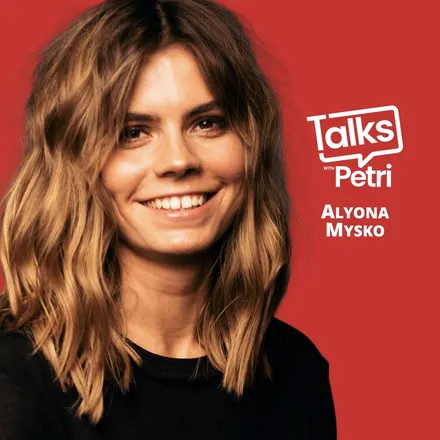
EpisodeTalks with Petri
Wartime CEO
With Alyona Mysko
Ukrainian startup founder Alyona Mysko talks about how to prepare and manage during the crisis, the role of individuals in society, and the reality of solopreneurship.
Alyona Mysko - TALKS WITH PETRI
Ukrainian startup founder Alyona Mysko talks about how to prepare and manage during crisis, the role of individuals in society, and the reality of solopreneurship. She also reveals recruitment tips, and what to do in Moscow.

Wartime CEO
Ukrainian startup founder Alyona Mysko talks about how to prepare and manage during the crisis, the role of individuals in society, and the reality of solopreneurship. She also reveals recruitment tips, and what to do in Moscow. See the …
Bio
Alyona Mysko is thefounder and CEO of Fuelfinance. She has worked in finance for more than 10 years, being an expert in financial planning and risk management. During this period, she was a lecturer for more than 1500 students and participated as a mentor in CEE SeedStars, EO business Incubator, Tech2 Impact programs. Two years ago, she launched her personal startup Fuelfinance, and set the Fuelfinance mission as “Our goal is to save hundreds of thousands of SMBs from bankruptcies and unlock trillions of dollars in GDP growth”. She’s passionate about wakesurfing, Petrykivka painting and Ukrainian Art.
Company | LinkedIn | Twitter | Instagram
 Play video
- business crisis mode
- 5:40 prepare and plan for the worst
- 6:40 team crisis plan
- 11:20 leadership and priorities
- 13:20 normalising the operations
- 14:40 recruitment during the war
- helping yourself, the company and the society
- ways you can help in the wartime
- 21:20 volunteer initiatives
- 23:00 switching your business model overnight
- 25:20 Covid-19 prepared for what happened next
- 27:20 coping mentally and emotionally
- 29:40 Product Hunt campaign
- promotional campaign in the US
- entrepreneurs helping the government in PR
- 36:00 solo founder benefits and downsides
- 36:20 good partnership components
- 42:00 people’s behaviour during the crisis
- recruitment criteria and tips
- 48:20 Fuelfinance company culture
- making a marketing video
- Euromaidan
- 55:00 business trip to Russia in 2014
- 58:20 “Bad but stable”
Episode links
https://fuelfinance.me/2022/03/05/fuel-stands-with-ukraine/
https://bank.gov.ua/en/news/all/natsionalniy-bank-vidkriv-spetsrahunok-dlya-zboru-koshtiv-na-potrebi-armiyi
https://www.uabusiness911.co/
https://spendwithukraine.com/
https://help-business.in.ua/
https://www.producthunt.com/
https://geoffsmart.com/books/who-the-a-method-for-hiring/
https://www.youtube.com/watch?v=eI5VH2Ks9o4 (We do your finance -video)
https://en.wikipedia.org/wiki/Euromaidan
https://www.instagram.com/p/vJzmJLLCcx/ (Alyona in Moscow)
Transcriptmachine transcription · 1:05:13
Transcribed from the recording by machine (Whisper): it may contain errors.
0:01 Hello everyone, this is Talks with Petri show, and I'm your host, Petri. Today's guest is lyona Mysko from Ukraine. Welcome. Hi, hi, very nice to meet you. You are a found of FuelFinance, and you are pretty busy on February. Can you tell us what were you planning and preparing for and how did it go? Yeah, I was pretty busy on February, especially being Ukrainian, you know. We had much work to be done. No, I mean, in the, let's say, that before the full scale was started. So just, but you know, you are start a founder, so there's always a lot of stuff happening, but there was something special you were doing at that. Yeah, I was preparing for the launch of our website, so we had a plan to launch this website, especially like on 24th of February, so everything like was made and preparing in the last night before this day, so that's why it was crazy work. Uh, in, you know, really after midnight already, so it was already 24th February, especially when we finalised all our works with the launch of the website, but here we, uh, I was woke up and uh, understand that launch of the website.
1:21 I think will be postponed. You also did a video as well, you know, that it was, and there was a lot of preparation to work. So just to keep the audience the idea that you were not like, you know, that's the, it was not as small. I thought it was like a lot of stuff happening months before and you were planning. Yeah, I think it was, yeah, it was like uh, I think uh, 6 months or 8, 8 months of really hard work before this day, so it was really video. We made cool video for this website. It was preparation on this website during last 9 months before this launch and uh, also we like created our product and we had much work before this day, so it was like very huge plans for this day. I remember you told me early on that you were working till midnight almost and it was just, it was 5 o'clock, the, the, the, 2nd part of the war started.
2:27 So. Can you walk us through with the feelings of what happened and a bit how do you sift from the launch of the website to some other mode because this is a lesson for all the other startup founders as well. We always talk about artility, how you have to pivot, and you have to do things, but, you know, I guess it's so pale compared to what you needed to do. So, can you, can you just... Yeah, because of the station, I was working like after midnight, so I had much work. I really didn't hear bombs, so and that's why I already like walked up because my boyfriend woke me up and my family, like I received from the number of calls, but really, I was a little bit tired after such hard work on the previous days and night. So that's why I didn't hear it, but yeah, um, 1st of all, it was, it was not the question special about uh, our website launch, but uh, our company uh, messaged me, a company with which we made this uh, website.
3:37 They messaged me that we think we should postpone our launch of the website. We couldn't do it now. Um, but, uh, yes, the 1st priority was not uh, the website, 1st priority was safety, and uh, safety of uh, my family, my friends, and especially of uh, our team. That's why, uh, starting from the 1st like seconds, uh, 1st hours uh, of the start of this war. So we had only one goal, 1st of all, should be in the safe place, understand what is going on, understand what you should do, right? All your team members. I understand that they also have plans and they understand what should be done in the nearest like hours. So it was main priority and not like the launch of the website at all.
4:31 You were preparing for crisis situations already some months before you made a plan. I think that's quite exceptional. I don't hear that often that the startups are preparing for sort of different types of crises. It usually just happens and then you just quickly. Do what needs to be done. So why did you do it then and did it actually help you to copy the situation? Yeah, I think I think it starts up in all worlds, uh, could expect, uh, like, and make preparation for the war, so it's not usual situation at all, but, um, during class months, uh, in Ukraine, uh, we already have had this news about possible war, so atmosphere was really not okay in our country. So we received all this information. And uh, already with our friends founders, from other startups.
5:30 We started to discuss the situation, I think already. Uh in December. So in December, we start to understand, okay, I think that it's really possible. Uh, and uh, yeah, we decided to be prepared. It's like better solution for us. And especially after PS crisis with COVID. Uh, we also like understand now what what we should do, so we should like prepare a financial financial plan for us, we should prepare our plans for different team members, and uh, we also like, uh, understand that, okay, even in the worst case scenario, we had a plan and everything is going okay, so, uh, that's why we decided to make this preparation. We had one to one meetings with different team members.
6:22 Uh, we had also a preparation in financial site, and uh, so that's why when the worst started, it was already a little bit easier because we had this plan and had already these discussions, discussions inside our team. Can you keep some tips, you know, what should be in that type of plan and how detailed and did you go through it before, you know, 2 months before with your team members and everybody already knew what's going to happen or give some practical tips for other founders? Um, yeah, I even like had uh, my Google spreadsheet with uh, like points which should be included and done before divorce. So 1st of all, it was uh, we decided uh, to make this uh, the crisis plan for team members. So understand if everyone from our team they had planned in their families, uh, in case they need to, for example, relocate from the city, if they had car, if they had uh, like backpack, with everything that they need, for the new response, if they had already like, uh, some, if they had some problems, I don't know, in financial parts of something else, and some, something that they, uh, like, should receive from the company in order to be more prepared in this situation.
7:50 So, and we created such list. We with our managers. So managers were responsible for their team members, and they should discuss and arrange this meetings. Uh, with their team members, and in this list, we had all information starting from the place, where, where our team member now, uh, contacts, which uh, contacts of our team member and also of him, uh, him or her family, uh, also like place where this person can relocate in case someone need to do. And so we had the 1st like what was prepared this plan. Uh, and also after that, we were preparing uh, our financial plans. So we decide to analyse what resorts we have.
8:39 So what legal structure we have now. If there are some risks because we also should pay salaries to our team members, if there can be problems with payments like in Ukraine or with banking system in Ukraine, and we had different risks, and also we had like financial plan in revenue plans, cost plans, and our reserves that we have. So, uh, we understand, okay, if you have some Ukrainian clients, or Ukraine-based companies, they can really post uh, their subscription, and uh, in that case, we will have like uh, our decline in revenue. So what will be in different cases and how much resorts we have. So what our burn rate and something like that? So it was like, Main several, I think, points that were prepared during class months.
9:34 So how did it go? Did it go by the plan? Yeah, it's, you know, like, uh, we had this uh, the worst case scenario. We named it and somehow we tried to believe that we will not use the scenario. But yeah, it was something like that, but even, you know, even better because we were waiting that banking system and financial system. Uh, couldn't work in the same way. But uh, we were happy to understand that even during the 1st days and during 1st weeks, banking system in Ukraine and everything about financial parts in Ukraine is working. And we even paid salaries on the 1st day of the war. And everything was okay with banking system.
10:28 So that's why we were happy to understand that yeah, we had this worst case scenario. But in the worst case scenario, we had even problems with payments. So it's not just about yourself, your personal, uh, safety and security. You have a company to run. And then you have actually clients also to take care of. So how that, that go in the, in the 1st days and weeks. Can you describe that, you know, you have to put on the leadership role as well in a more extensive way because there's so many people to take care of. Um, yeah, 1st of all, so, um, 1st of all, we, uh, we're chatting with all our team members in Slack. So it was like every hour, uh, from the start of the war. So I think that like during 1st week we were online exactly every time. And, uh, 1st of all, uh, I decided that like my 1st priority be in safe place and after that, help other mighty members also be in the safe place and help them as much as they can.
11:40 And, uh, it was complicated task because, uh, I should say that leadership in such situation, it's, uh, um, it's really complicated because sometimes you need to be like, I don't know, mom or friends or family for you to members. Uh, but sometimes you need to be uh, like real entrepreneur and uh, uh, you should like, uh, have this communication with all team members exactly in all ways in the same time. And sometimes it was complicated to communicate with team members and explain them. You should leave this place now because it's not safe and uh, especially some of them, they like believe that, okay, nothing is going on here near my house, so it not will be something bad in nearest weeks. And we all understand it will be, but when you are in that place, you want to believe that everything will be okay, and that's why you start to analyse the situation and make not efficient decisions, uh, like not to leave, uh, the place more to more safe place.
12:49 And so more safe cities. That's why it was complicated. But, uh, I think that it was much support, uh, from uh, me and from our all managers to all team members, uh, and already after the 1st 2 weeks when we discussed the situation, and uh, analysed what was done, what was okay, like, like, I don't know, analysis for the next uh, for the future, and uh, we understood, yes, it's according, like, our support, it was made for all team members. It was very good for them and we received like feedback that it was much easier for them to going through the situation with this way of communication. So it's not like, uh, very uh, one way communication, I'm entrepreneur and I'm your CSO, you should do that and that.
13:44 Uh, but sometimes it's like combination of different uh, ways. So, uh, you didn't actually live outside of Ukraine. You stayed and the company was operating the whole time. How long did it take for become like a business as usual if you can say that, getting used to the new situation? Yeah, so we started already to work after I think it was on the 5th day of the war. So we started to work and communicate with all our clients. Uh, and uh, so some, some of them, some of our team members, they started to work from like bomb shelters from the 5th day, but I should say that uh, like the whole capacity like 100% capacity was renewed uh, already on the 2nd week of the war. So during these 2 weeks, uh, we need, needed this time to understand about, uh, 1st of all, how everyone can work.
14:49 Some of team members, they were like in the process of relocation, some of team members, uh, they had no internet, so they couldn't work. And that's why we needed this time 1st 2 weeks to uh, try to work in new conditions. You were also recruiting at the same time. Yeah. Yeah, it was, it was crazy because we even like, and uh, offers like for new to members for 2 new to members, before the war, and we plan to start like work with them already from uh, the 1st uh, 1st March. So we decided not to postpone all this idea, but it was very strange and boring for them, not as usual on boarding. So it was really crazy.
15:42 And yeah, after that, we decided that we should go as we planned, so we had strategy, strategic session before this war. So, That's why we decided, okay, we should go, we should work. We should also help our Ukrainian economy when our business will grow. So uh, we decided uh, to hire new people. And make everything. We can do like in this situation. I remember you mentioned somewhere that you were chasing for laptops and, you know, resources for your employees and bulletproof vests and whatnot. Can you give some stories, you know, how is the reality in those days? Um, yeah, reality, like, um, 1st of all, so, uh, when we discussed, like, what is going on with the warrior, uh, you have had, usually you have this problem with safety, but on the other hand, you, we also like have one 2 member, uh, who decided to join military forces, and uh, it was his decision and uh, it was already on the 3rd week uh, of the war. And when he decided to do it, we also understand that we have another mission to help him.
16:59 Uh, with this like with his decision. So, uh, and, uh, when he was like uh, training during 1st weeks there. Uh, we organised, uh, like, uh, we, 1st of all, we buy, bought for him, like, bulletproof and also cars that he's and uh, he and uh, like uh, his team there needed. Uh, and uh, yeah, so it was like um, additional support from us. Uh, but we're happy that everything is okay with him and uh, we had a call. I think one week less than one week ago and he said, uh, yeah, I'm like financial guy now in the army. I have laptop in my hand, and I have like a cup of 7 in the other hand.
17:52 So, yeah, it's uh, a little bit crazy, but uh, happy to know that uh, with him everything is okay. So is he doing part-time work with you now is he full-time, you know? But it's not a piece of secret. Yeah, even like a joke that uh, uh, now every, every, all, like all our clients, they uh, understand how their financials uh, really it's good uh, at good arms, so they are really protected. What was the response of your client? You have a lot of international clients and your team is growing all the time. So how did you manage with your regular work? Because there was a time when you couldn't basically do the, do the work. in at least in the early days.
18:43 Yeah, we already like messaged our clients from the 1st day and uh, like not from the 1st uh, but I think from the 2nd or 3rd day, we messaged them and said, you know, we like had the situation, but uh, we will work like and we will communicate with you in the nearest days, but everyone uh, everyone understands it and uh, we receive much support from our clients. Some of them wrote with some proposals for help. And with some proposals to and help the relocation of team members. So that's why it was uh, really well, very inhuman like communication. But also, like, I think that for them, it was a shock that we really were working like from the 2nd week because I think that no one expected that, yeah, even in such situation, during the war, we will work. You started to do also initiatives outside of your company.
19:46 When did that start to happen and what was the motivation or was it like everybody else was doing that as well? It was like, okay, we need me to do something as well. What was the thinking? Yeah, you know, like, um, I think that uh, all Ukrainians, they had experience of uh, Maidan, that was in uh, 2013, 14, and uh, we also already had experienced the war which started like also from 2014. So that's why, uh, I think that, uh, yeah, like 1st date was uh, all like all priorities were about safety. But after that, I already started saying, okay, how we can help others now. Uh, how we can help uh, Ukrainian economy, how it can help military forces.
20:40 And it was also strange situation before the start of the war because also in the evening of 23rd February. Uh, we donated as a company, $10,000 to military forces, and uh, we also was shocked. We also were shocked because it was also in the last like, last 1000000s, you know? And um, uh, we uh, also understood already from the last weeks before the war, is that everyone like, started to be prepared for this war. So, not only our accompaniments, destinations, but also many other businesses made destinations to Ukrainian military forces. And when the war started, we understand, okay, now we can make even more donations and we should do it. But on the other hand, what we can do, we can volunteer.
21:34 Uh, we can help uh, like different refugees and uh, other Ukrainians now. But on the other hand, we understood like it was during the college, it's our, uh, key responsibilities, Ukrainian economy, because we are good at finance, and uh, we decided to make our 1st initiatives that was on the 3rd week or 2nd week of the work. Wouldn't remember already. It's like a platform where we connect entrepreneurs and financial managers, CFOs from over Ukraine, and they can arrange pro bono meeting together. Every entrepreneur with financial manager to discuss what is going on in business, to make anti-crisis planned, and also on this platform, we made, uh, like all information that every entrepreneur needs during the war, about legal part, about taxes, about like salaries, about different antichrisis plans, uh, how they can make now and what best practises of other companies. And it was our 1st initiative.
22:42 And uh, we'll really like received many things from entrepreneurs that this uh, platform and this consulting from financial managers and also this anti-crisis plans, they help them a lot. And uh, on the other hand, we decided to make with another company lived 99. Uh, we decided to make uh, another platform uh, with donations to small medium enterprises in Ukraine. Uh, who switched like their daily uh, business to uh, new products, new business uh, that is needed during the war. So, uh, this is... examples of this, you know, what, for example, what type of, how do you switch overnight to a different line of business? Yeah, like, uh, 1st of all, uh, for example, we have here in Ukraine, uh, shoes, brands, uh, and they made like women's shoes, but uh, after the start of the water, uh, they now made uh, military boots, uh, on the other hand, um, uh, we have like restaurants and coffees, but now they, like, they're closed, but they are now preparing uh, 500, 700 dishes per to help hospitals in Kraine and in Kiev and to help also military forces, so they're preparing food for them.
24:10 Uh, but they like use for it or their own money or donations from other people. And it's like several types of businesses which are really switched to a new business model and new product. And uh, that's why we decided to help these businesses because uh, yeah, everyone like in Ukraine now donates all they have, all money they have for different initiatives. But uh, we also understand that uh, it's not enough already. So the listeners, if they are interested of helping somehow, what could they do? Can you give some ideas? Yeah, like, uh, 1st of all, um, we have, we have this, uh, link with the nations to National Bank of Ukraine. It's donation to military forces. On the 2nd hand, we have our platform, uh, with the nations to small medium enterprises who help now, uh, Ukraine to win this war.
25:10 And uh, it's like 3rd one and uh, uh, 2nd one, sorry, and 3rd one is uh, another initiative, which was made by our friends. It's like spent with Ukraine. And uh, you can like buy very cool Ukrainian products, technical products, fashion products, everything else, and uh, it's also support for Ukraine and support for Ukrainian economy now. You mentioned also that um, COVID was really good uh, preparation, uh, what was uh, about to come. What happened in COVID times and what did you learn from that experience? Oh, yeah, quiet was like 1st crisis of few finance, and already, like, after the 6 months of our work, we met our 1st crisis. Uh, but uh, yeah, what's uh, what I have learned uh, with COVID that, uh, it's better to have planned for all cases and whole scenarios.
26:17 And it's better to be in a crisis with this plan. So you already like being prepared when you start to sing before the crisis about everything. And uh, during the COVID, uh, it was also 1st experience, um, 1st experience with support of your team, uh, because it was also like not easy situation for team members, they stuck at home and some of them was children. So yeah, it was also like challengeable. Uh, but uh, already during the COVID, we also organised uh, something similar when we decided to help Ukrainian businesses, and small medium enterprises, and we also made like consulting for them in financial parts, and to crisis plans and everything like that. But for sure, like COVID, it was much easier than the war because in COVID, like during the COVID, you was simply staying at home and like, okay, you had problems with revenue streams and it was a challenge.
27:24 But, uh, he was like, uh, something you were in safe place when you stay at home and you like, will not get ill, but, uh, now in this situation, I think, um, during the war, you knew for us that you couldn't feel safe, um, at home and you couldn't feel safe, especially in other cities also. So it's like new reality, in which you should be like productive, you should work. Uh, but without um, but without this 1st uh, need, like need to be safe. How do you cope mentally and emotionally in this type of crisis? Because it's even to start, just look, you know, from a distance, you know, what's happening, and then you're in the middle of the action, so to speak. Um, I should say that, uh, I try to, um, I try to, 1st of all, uh, now I try to have weekends, so it, exactly, I try to have one day, uh, now already after this 40, 50 crazy days.
28:29 uh, I try to have 1st day, like not doing anything, so, and uh, It helps a lot when you not read news, you like don't work, and uh, you simply try to live your life, so, you simply like try to, I don't know, go to coffee here, invest in Ukraine, and see, and watch like what people do around you, and like, try to understand that uh, life is going on, and uh, Uh, also I try to match uh, uh, my time. Uh, so I like reviews uh, in the morning or in the evening, but during the holiday, I don't reduce at all, so I work. And, uh, like, I think this, uh, good time management now.
29:21 Uh, it's the key how to stay, uh, how to stay like in in a normal mood, uh, and in resourceful mood. So this time management is very important. Also, I believe that, uh, I couldn't like do sport now, but, uh, like without, without anything, I need for it because everything like stayed empty, but, um, uh, I also believe that sport and uh, also this time management, uh, with different activities, it also can help uh, in this situation. You do, you, you did also something which hap, um, uh, previous episode, uh, Neil was mentioning about product hunt, you, you, while the ball was going on in the, in the full scale mode, you, you decided uh, on top of everything you just described that, you know, it's not enough, so you, you properly want to do something else. So why did you do a product hunt?
30:22 What is product hunt and how did it go? Yeah. Uh, so, Brother Count is like the platform where different products make their launches and they like receive different uploads and uh, it's really a cool way, 1st of all, to receive feedback on your product and like make announcements about your product and receive new leads. Uh, and uh, yeah, we decided to do it, like we had this plan before the war. And during the war, we decided, okay, we should do it. So, uh, with work, everything, like, is okay, how it can be possible, but, uh, uh, when we decided to make this product on launch. So when you make the launch, you should be like online all the next 24 hours. And you need to receive comments, you need answering these comments exactly in this, in that time.
31:19 You should write all your friends and founders, friends, your clients who ask for uploads and everything else. So, uh, you should stay online. So, yeah, and uh, uh, it was crazy because exactly in that day, uh, we had here in Western Ukraine, 7 signal 8s during the day. So when you hear this 8, you should go to the bomb shelter, and in the bomb shelter, it's like different situations, because sometimes you have Wi-Fi, but sometimes you don't, because of number of people inside this bomb shelter, and it was really crazy because when, uh, all previous day you had, you had like 2 maybe, 18 per day, but uh, exactly on that day you had like 7, 8, so. It was Russia, come on, please stop.
32:17 It's simply, it was something like we already have a joke in our team that when we plan to launch something. Uh, we should prepare that We will have new challenges. Oh, it's actually the opposite. The government should counsel you. Are you planning on, you know, launching something? Yeah. So how was it as a success? Did you get something out of it? Yeah, it was total success, total success, because we became a number one product of the day, and even in the situation, and the number 3 product of the week, and we received more than 50 leads, and it was a really very cool experience for us, and what is really important that we understand that even in this situation, even during the war, Uh, we could like deliver all results and uh, we could like uh, made all plans.
33:24 Um, Even like in the situation, you have like AIDS and everything else. So I think this, it was really good experience for us like team, uh, that we really understand now, we are really unstoppable. You also started to go on marketing efforts towards the US market. Like all, all this was not enough, so it was good to have some good PR and and, you know, what was the purpose behind that? was it just race awareness and helping synergies, to the Ukraine course, but also for your company and reaching your growth sockets. What's been happening there because I've seen you in quite nice places. CNN has mentioned you. You've been with the Netflix co-founders podcast episode already and I don't know, maybe you'll talk about the president next.
34:20 Yeah, everything, you know, now everything is possible already, yeah, but uh, 1st of all, like, when we started all this communication uh, with uh, NPR strategy for the US market, it was uh, general, like idea to share our idea with our platforms that we created uh, to support uh, Ukrainian businesses, not here in Ukraine. And uh, also we understand that uh, we should like. Uh, we have uh, every like everyone now in Ukraine, they have uh, their fronts and uh, whereas they like uh, try to uh, make everything as possible. And I also understand that uh, we, like other also started founders here from Ukraine, what they do, they try to communicate uh, with uh, different, like, I don't know, with CNN and others, like them, to share what is going on here in Ukraine, to tell the stories because we also understand that, uh, yeah, like 1st month it was uh, high topic. Yeah, were in Ukraine.
35:30 But we also should understand that uh, sometime uh, after 2 months, after 3 months, it becomes something that is uh, already uh, okay, in use and uh, maybe somehow, yeah, like other countries, they cannot be interested, for example, in what's going in Ukraine already, like in that way that it was like the 1st days of the war. So that's why we should uh, like don't forget that we really now should work even harder and harder and uh, with every day. So that's why we have like 1st of all reason to share what is going on here in Ukraine. The 2nd reason we also understand that we now should grow our business and we couldn't have the situation without revenue grows because we need higher Ukrainians, we need like grow Ukrainian economy, so we have much responsibility now. You started this company a few years back as a solo founder.
36:29 What was behind that decision? Why go solo and why not have other co-founders and help you with the journey? Yeah, um, 1st of all, so I had not good experience, uh, earlier with, uh, in partnership, and that's why, uh, after this experience, uh, I decided that it's better for me to be a solo founder, and uh, I also like understood all risks, uh, but uh, I was happy to have all responsibilities on my side, and uh, without discussion of different decisions. Uh, now, now I already understand that it was like, um, simply not good experience uh, earlier. Uh, but yeah, when I started the company as a solo founder, I was, I was really happy during the 1st year, I think, uh, and because, you know, when you like, had not good partnership, and uh, it was not efficient, and when you start the company and make everything like by your own, and uh, you feel very free.
37:40 You feel, okay, I can do this and this and this. So, that's why I think it was on the start. It was a really good decision for me. Can you tell to the audience that, you know, if you want to COVID, some other people that, oh, they're already in a situation where the other co-founders, what could be learned from your experience, what could be done differently, what other things to look after and be a bit more careful about? Um, yeah, one, uh, like, uh, 1st of all, I think uh, experience of uh, like my experience, uh, what is good partnership, yeah, 1st of all, uh, good partnership, it's like when you have uh, discussed all questions with your partner and uh, the best case when you described all these questions, through email or through even like legal documents, uh, it will be better. And you should discuss everything about, I don't know, how you, for what part who will be responsible in business, who make like decisions about marketing, about operations, about product, about everything else.
38:49 And also discussion about your goals, how like everyone in this partnership see the future of the business. And, uh, for me, it was like my main mistake, uh, in that previous, not, not good partnership without all this description. And uh, without uh, all this like uh, in some real way. Uh, that's why when we had like problems, it was already uh, not good for both parts, because um, both parties. Uh, but uh, when I started like, this is when a solo founder, it's also like there are pros and cons. So, on the, on the one hand, you make all decisions, and uh, you can like manage the business in the way you want to do it without discussions, without like needs to, I don't know, have this, uh, uh, long, uh, long discussion what should be done and by in that way by not another way.
39:50 Uh, but, uh, and also like, um, for me, it was under one point year where, where you really, uh, only one, I think, uh, one positive point in being solo founder. Uh, in all other ways. Um, in all other ways, I also understood that uh, in some crisis during some crisis like COVID and the other, you are really solo founders, so you couldn't like discuss all these problems and challenges you have, and you also should be the one who will like responsible for your decisions. And uh, this is more complicated part. And also in the case, like, I don't know, you need to. Sometimes you need like several days to totally like off, yeah, of their business.
40:40 When you're a solo founder, you couldn't do it at all. So you like, can't go off and uh, be, I don't know, several days uh, without working, uh, because you don't have like someone in your business who will help you. So. And it was like also the start of the business. Our executive team is very young and it's not like the way where you have strong executive team. Uh, So I think like 1st um, like my recommendations, like for me, uh, uh, like when I was uh, in that no good partnership, 1st of all, make everything in the written way, uh, every like uh, every point of your partnership, and uh, on the other hand, like uh, better to have some probation period, with your partner, in some previous situations, and, you know, working together or simply, I don't know, managing some ideas, businesses together previously.
41:41 Um, so making something uh, in stress rotation here with um, this person, uh, and uh, for me, like recommendation, uh, as for solo founder, I think, will be like, uh, not, um, not saying that, uh, you, uh, really managing everything like that and everything will be okay. So it's a little bit more complicated. Have you noticed that it doesn't need to be the, you know, with the partners, but also with employees and the people you're working with, that you learn something new from them, you know, how they actually behave, how they react, and when the real crises hit, that some are like paralysed maybe, and somehow actually there's still not really becoming focussed and helpful, and somehow, sort of, you know, not their use or selves. Have you have that type of observation?
42:35 So, surprises. Yeah. Yeah, I had many observations during this already 2 crisis. During the 1st crisis, I really was shocked by some entrepreneurs. So, uh, because uh, like during the COVID, I found that uh, main entrepreneurs, they, uh, not many, but some parts, yeah, like uh, some of entrepreneurs, they simply decide not to, um, receive, like not to, um, Uh, not to change the situation here or do something to change the situation. They simply decide. Um, do nothing, yeah. And uh, it's like uh, was very, for me, it was uh, new experience to see that. Uh, especially when you saw this person in like uh, normal period of business and everything, it was like very uh, very enorgetic and uh, it was done uh, with many ideas and everything else, but, but, crisis started like, uh, if simply, I don't know, like frozen person and uh, couldn't do anything.
43:47 Now, yeah, I saw all these situations also, and um, but I should say this time, um, during the war, I don't know, but, uh, I simply now, uh, among all our clients, I couldn't find even a person who was like, frozen and uh, who, uh, decided not to do like, something, uh, which would be uh, now, for Ukraine very important. So I saw this time that everyone is involved. So everyone doing their best and it was very strange because I think some of uh entrepreneurs were not uh in that way uh was the same like uh, situation uh, and uh, was the same view uh, previous crisis. So I don't know, maybe we grown up or maybe something, something really changed.
44:45 Uh, Javier has your experience of recruiting because you're crowing rapidly and that's how I'm patient to do in the future as well. Uh, changed a bit, like what type of quality, so what are you looking for into people? and can you describe, you know, the, how do you find the good people? Oh. Yeah, like um... Cruising is really a little bit changed. So, we asked, uh, so what's, uh, what person done like in in the 1st days, yeah, what, uh, what, uh, this person like doing now during the war? So, if this person tried to help Ukraine or, uh, and it's really now, it's, uh, I think, much easier to understand, uh, like how this, uh, person, uh, will we manage different risks and, uh, how this person, like, uh, will be like, will be in different stressful situations. And, um, It's a little bit easier now to understand all these factors and all these points before hiring a person. Uh, so you simply ask what you did like during 1st uh, weeks of the war and uh, you already understand uh, more about this person and uh, I think that uh, working in startup and when everything is changed, you have, you have really, very stressed atmosphere.
46:14 So that's why uh, now it's uh, a little bit easier to understand if uh, some person really uh, will be uh, will be okay working in a startup. Um, in cases that there are some countries still left with, uh, not involved at the moment and they don't have that experience. Can you give some, you know, points, hints what to look at from the person, what type of questions to ask. Uh, yeah, we usually like, uh, asked, uh, I think that, uh, uh, I had, I had many problems with hiring people, I think, like any certain founder, and uh, I read uh, one book, um, uh, before uh, uh, 1st thing this for like 2 months before something like that. And we changed completely the hiring process, like the book which was recommended by people, AI company and it's like a principle of hiring or something like that, it's named.
47:18 And they have very cool, like, strategy of a number of calls you should have with the person and what answer, like, what questions you should ask. And we implemented the 1st question, like, I like the most, and for me, it's like very cool question to understand about the person that I asked, uh, for example, in the case, I will ask, uh, your previous company where you work. Uh, about uh, about how you were working about your, like, results and everything else. Uh, what's, um, what will be like, uh, what feedback will be from this person and can you like, uh, give me a point like from one to 10? Uh, what uh, I receive like in the feedback, it will be 9 or 10 for your work or it will be like 76 points for your work.
48:14 And uh, 1st of all, like on the 1st call, you're already understand that if uh, this person like, said you, okay, I think that my previous employees, like, give me like 7. You should understand that, uh, in more cases, it's like less in this than 7 and you should like, uh, still communicates, uh, with uh, all other, like, uh, personal, like employees in your, in your team, who will have like a number 8 and more. So, it was uh, very interesting uh, for me because uh, I think it's uh, much time we were really uh, very optimised. Was optimised with this type of interview. Can you describe your company culture?
49:08 Uh, company culture. Mm. Yeah, I think fuel is, especially how we describe all company culture because, 1st of all, we are really very fast and when we have a person, we discuss it, 1st of all, uh, everything is changed. and uh, we don't have something stable here, but uh, you should be prepared to work in such uh, community and uh, such atmosphere. And also we discuss with all 2 members that everyone should be proactive. So you don't wait for like someone, uh, someone's tasks from someone. If you see some problem, you are the one who can fix this problem.
49:58 So, um, uh, it's like the 2nd one and also like sort advancing responsibility. We are responsible in our team, uh, between like, uh, also between, like, I am responsible, uh, for other team members and also should get, everyone should be responsible, uh, for what they do, what result they, they deliver how they work inside the team, and also responsible, uh, like, uh, with our clients and be like with cool client service for our clients. What other tips are hints you, you could give, um, companies who are working with Ukrainians and Ukrainian culture, because Ukrainian culture is a bit different from the other cultures in the world as well. So, you know, how do you do things differently and what we should be aware of, you know, when we working with Ukrainians?
50:57 Um, I think that, um, I don't know how to explain, but I think that Ukraine is a hard-working. Uh, and uh, now I think that everyone already understand it, like, during this war, but, uh, really, uh, was simply, every time try to do our best. And, um, we will, I think, sometimes we will deliver more even results than every client is expected, because, um, I don't know why, but it's like something in our culture to be really hard-working and do our best. Um, on the other hand, uh, I think that uh, working with uh, Ukrainian teams, um, I think that in all other, uh, in all other like, uh, factors that different from all other countries I couldn't find. So I think it's the only one. You also been doing a lot of things as a CEO and one of them was to be a star in a movie.
52:06 Uh, you know, your company trailer, you know, I understood it took a bit longer time and there was a bit more hardship, and you anticipated for a tiny part. Was it like 15 seconds or 30 seconds or something? Yeah, there was 2 minutes, uh, I mean, it's explainer video. Uh, but it was so much work done before this video, so I think. It was three, 4 months uh, of preparation and uh, yeah, we had the case when we uh, tried to find some actress on this role, but uh, uh, this actress, uh, like it was complicated to find actors who can be very native talking about financial parts about BNL and unit economics. So that's why we decided uh, like uh, other, our team with whom we work, with whom we work, on this video, they decided.
53:02 Okay, I don't know. I was saying that you should like be uh, exercising your video. That's why I had no choice. Um, it was not something I was expected to do uh, in a CO role. But it was something I had to do. Uh, yeah, it was like, it was very strange and uh, completely new experience because uh, route to be good, like in a 2 minute video, you should uh, train a lot. It's like hours, days of trainings. And it's very complicated. But yeah, it really said in that video, I think, 2 sentences, 3 sentences, you know, but it's really much work. Do you speak those sentences in Chinese, so why did it take so much preparation?
53:53 What was the training about? Yeah, before it, because it, like, it should be very native and uh, uh, when they 1st like try to speak the sentences and especially you like, uh, you don't like simply uh, tell the sentences. So, uh, we had like another actor, yeah, in that video, and I should communicate with this actor in that video, and uh, that's why it was, uh, that's why it was complicated. And uh, on the other hand, it's complicated because when you're someone who, 1st of all, uh, like the person who, uh, not only the actors, but one of the managers of uh, hold this video process and uh, It was like twice more challengeable task, be relaxed and being an actress, and on the other hand, be like risk manager during. This uh, video and uh, when everything was uh, made during this day, and you should communicate like with security with all other guys, and uh, it's simple, it's a simple situation when everything uh, going not in that way is what's predicted during this video recording.
55:13 So, yeah, that's why it was real real complicated 14 hours day to make this one shirt video. Before your entrepreneur career, you were working in a cooperate, and you were checking different apart, not apartments, departments, of a company or, you know, auditing, and then you come to, uh, doing different things as well, and, and you, you, you mentioned me that you had a bit of a trip to Russia as well. And and the... And the trouble started already at the airport. Can you, you know, tell a bit, you know, what you did before and, you know, how you were shipped off to Russia and, you know, how did it go? Yeah, it was, uh, it was really my 1st experience visiting Russia and uh, I started like my career as an auditor in uh, Price with House coopers and uh, they have uh, this policy when they switch like team members from one country, they like, uh, switch them between different countries and uh, in Ukraine, in Ukrainian office.
56:26 They decided to, uh, like have this short relocation for me to, to Russia, uh, for several weeks, and uh, I was really shocked because in Ukraine, in that time, they already had my done, and uh, it was like very high situation. 2014. Yeah, yeah, it was 2014 and I was like very active member of my dad and I always like in my life I speak Ukrainians. So what did you do in my life? You were outside the whole winter or what did you do? Uh, yeah, it was like, I was like, uh, volunteering. I helped all other like members who were there and we also had like open institute there. So, uh, we had like many different activities, was helping with food.
57:21 Uh, helping on the kitchen. So like everything else. And uh, when uh, this my dad started and the Ukrainian office decided to uh, like, uh, decided to, um, like, decided that I should go to Moscow office, uh, I was shocked, but I had no choice. So, uh, that's why uh, when we were already in Moscow with several of my colleagues from Ukrainian office, and uh, we were like already in the airport. And starting from this airport, we already had this strange discussion with driver, taxi driver, because he said that, oh, what is going on there in your Ukraine? I, I heard that uh, like some US guy, uh, guys from the US decided to make the smidan, and uh, all, all your other, like, band directs.
58:22 So, and that's why it was already crazy situation. But on the other hand, I decided that I will not switch to Russian language. So, I will speak English or Ukrainian language. And uh, It was already conflict from the start because uh, this guy, uh, and my colleagues, colleagues ask him, uh, yes, we have like a few changes in our country now, so, uh, we are like fighting for freedom now, and um, After that, this guy, uh, he said that, uh, I don't know what you do there, but I think that stable situation, in country, is much better that, uh, different fighting like for freedom. And when we ask, but you have like very bad stable economy situation here in Russia.
59:14 He said, okay, but it's stable situation. So that's why it was already understandable that, uh, 0 my god. I will not like, uh, will not have something uh, with this country at all because it's simply impossible. But yeah, it was a crazy experience, but uh, I should say that, uh, uh, I even like, uh, with some guys from that office, they were really like, okay, and they supported, uh, their Ukrainian, uh, all Ukrainian guys, and they supported like Maidan. Uh, but, uh, uh, and uh, but it was like only 22 people from the whole office, so, and the whole office, like 100s of people. So, uh, that's why you can, you can imagine how small this percent.
1:00:05 And while you were having lunch or having a break, you went to visit sites in Moscow and in particular, there was one wall, you did something, you know, what happened there? Yeah, I decided to make a photo of Ukrainian flag. in Cremon, near the Cremon. And, uh, it was, uh, yeah, yeah, I still, I still have this photo and I have this photo on my Instagram. And uh, it was a really crazy situation, but, and my clique said, okay, we will really, we can stay here for a long time and this rushing. If some police guys, they take us simply. But, uh, yeah, everything was a game. I made this photo.
1:00:53 I was so happy that they made this photo. Uh, and it was like, you know, uh, I think it was some kind of products maybe, or, um, some kind uh, of uh, Ukrainian products because already in uh, 2014, we already had understanding that uh, we had the smile down because of, uh, some type of Russians, uh, invasions uh, in Ukraine, but uh, in very political way, not like uh, in the way of uh, having the war, but uh, will understood it. So that's why I think it was like for me some type of small victory. Yeah, it's been getting more difficult in Russia. Nowadays you see people being arrested and child for just holding an empty piece of paper. Oh, basically, I guess almost like standing.
1:01:46 Well, there's been, and these probably are in my tweet of it, if you dig deep. There was somebody who was coding poutine, so directly his words, somebody who was citing literature. So there's been, it doesn't really matter what you do. It looks like that you, you, some shape or form protest, uh, protesting, then, then, then that's happened. I thought maybe that, that was a different situation in 2014. Or they look, you look like a tourist and they let you go. Ukrainian tourist who is a flag. So you were backing. And you were like, okay, I need a flack. What else, you know, did you prep for? On my own with work.
1:02:37 So you were planning this all along. No, like... in that time, they were not with me. What is your favourite word? Favourite word? Hmm, I think fuel is my favourite word. What is your least favourite word? What turns you on, creatively, spiritually or emotionally? Oh, what is creative, yes? Creatively. Hmm. Hmm, creatively. Hmm. I didn't know.
1:03:26 Complicated question. I think. Hmm. Maybe friends and family. What turns you off? Turns me off. Oh, I think uh, that uh, turns me off uh, really uh, Already now, I understand it. Death, I think only that's that you see and uh, it's near you and uh, I think this is really turns me off. What is your favourite curse word? Favourite pot? Oh, I think like bloody hell. What sound or noise do you love?
1:04:21 Uh, I think uh, uh, the sound of wines uh, in mountains. What sound or noise do you hate? It's and Syrins. What profession other than your own would you like to attempt? I think, uh, journalists. A profession would you not like to do? Um, Doctor, I think I I simply uh scared of blood. If you could be a co-founder of any startup in any era, which one would you choose? Mm-hmm, I think we will choose mine, I think. Any final words for the audience?
1:05:13 Uh, final words, I think that's, um, Simply be brave as Ukrainians and everything will be possible. Thank you, Alona. Thank you everyone for joining us today. Till next time. Slavau grimy. Hello, I'm slow.
More from Talks with PetriAll episodes →
- Per BylundEntrepreneurs and inflation19 Jun 2022
- Henry NilertSpeed and resilience in market downturns22 May 2022
- Niels BosmaGrowth hacking with gamification10 Mar 2022
- YouneeImprovise with a total bravery20 Jan 2022